1. Search Result
Search Result
Pathways Recommended: Stem Cell/Wnt Cell Cycle/DNA Damage
Results for "

ECL cell

" in MedChemExpress (MCE) Product Catalog:

6

Inhibitors & Agonists

1

Fluorescent Dye

2

Peptides

Cat. No. Product Name Target Research Areas Chemical Structure
  • HY-W074143

    Fluorescent Dye Others
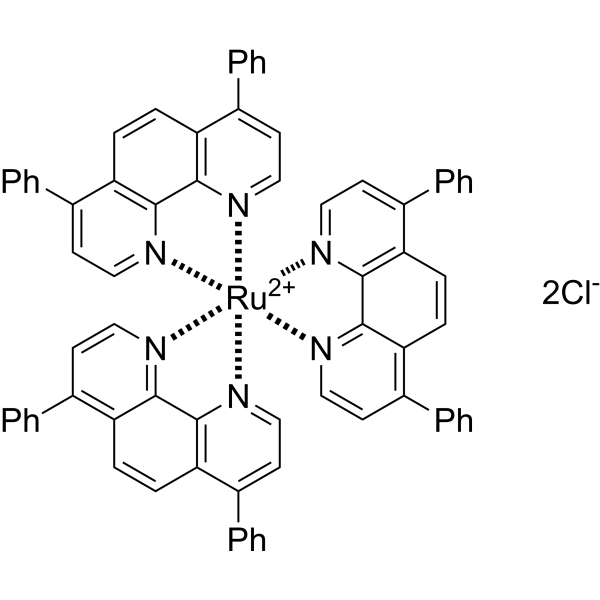
    Tris(4,7-diphenyl-1,10-phenanthroline)ruthenium(II) dichloride ([Ru(dpp)3] 2+) is an electrochemiluminescent (ECL) probe and oxygen-sensitive sensor. Tris(4,7-diphenyl-1,10-phenanthroline)ruthenium(II) dichloride can be used to modify electrode surfaces for the detection of sulfates (S2O8 2-) and oxalates, based on electrochemical reactions that generate excited-state species, releasing photons through irreversible redox reactions. Tris(4,7-diphenyl-1,10-phenanthroline)ruthenium(II) dichloride utilizes the oxygen quenching of fluorescence mechanism, where fluorescence intensity reflects the metabolic rate of living microorganisms or oxygen levels within cells/tumors, allowing for real-time detection. Tris(4,7-diphenyl-1,10-phenanthroline)ruthenium(II) dichloride's main applications include microbial detection, antibacterial activity studies, and tumor microenvironment research .
    Tris(4,7-diphenyl-1,10-phenanthroline)ruthenium(II) dichloride
  • HY-115822

    Amino Acid Decarboxylase Neurological Disease Metabolic Disease
    α-Fluoromethylhistidine dihydrochloride is an orally active histidine decarboxylase inhibitor. α-Fluoromethylhistidine dihydrochloride depletes histamine in enterochromaffin-like (ECL) cells, reduces the number and volume density of secretory vesicles in ECL cells, and does not affect histamine storage in mast cells. α-Fluoromethylhistidine dihydrochloride abolishes Omeprazole (HY-B0113)-induced vacuolization of ECL cells and decreases gastrin-induced histamine efflux from ECL cells. α-Fluoromethylhistidine dihydrochloride does not alter the granular characteristics of ECL cells, omeprazole-induced hypertrophy of ECL cells, gastrin-induced pancreastatin-like immunoreactivity efflux, nor does it affect gastric acid secretion induced by histamine or vagal stimulation. α-Fluoromethylhistidine dihydrochloride inhibits basal and gastrin-stimulated gastric acid secretion, reduces acid output induced by gastrin+IBMX (HY-12318), but does not directly affect acid generation in isolated parietal cells .
    α-Fluoromethylhistidine dihydrochloride
  • HY-W1015419

    α-Fluoromethylhistidine

    Amino Acid Decarboxylase Cardiovascular Disease Neurological Disease
    α-FMH (α-Fluoromethylhistidine) is an orally active histidine decarboxylase inhibitor. α-FMH depletes histamine in enterochromaffin-like (ECL) cells, reduces the number and volume density of secretory vesicles in ECL cells, and does not affect histamine storage in mast cells. α-FMH abolishes Omeprazole (HY-B0113)-induced vacuolization of ECL cells and decreases gastrin-induced histamine efflux from ECL cells. α-FMH does not alter the granular characteristics of ECL cells, omeprazole-induced hypertrophy of ECL cells, gastrin-induced pancreastatin-like immunoreactivity efflux, nor does it affect gastric acid secretion induced by histamine or vagal stimulation. α-FMH inhibits basal and gastrin-stimulated gastric acid secretion, reduces acid output induced by gastrin+IBMX (HY-12318), but does not directly affect acid generation in isolated parietal cells .
    α-FMH
  • HY-P11553

    CCR Inflammation/Immunology
    ECL1i is an allosteric, selective CCR2 inhibitor. ECL1i specifically inhibits CCL2-/CCR2-mediated chemotaxis. ECL1i interferes with CCR2-positive cell recruitment and attenuates disease progression in experimental autoimmune encephalomyelitis .
    ECL1i
  • HY-P11553A

    CCR Infection Inflammation/Immunology
    ECL1i TFA is an allosteric, selective CCR2 inhibitor. ECL1i TFA specifically inhibits CCL2-/CCR2-mediated chemotaxis. ECL1i TFA interferes with CCR2-positive cell recruitment and attenuates disease progression in experimental autoimmune encephalomyelitis .
    ECL1i TFA
  • HY-125314

    Cholecystokinin Receptor Endocrinology Cancer
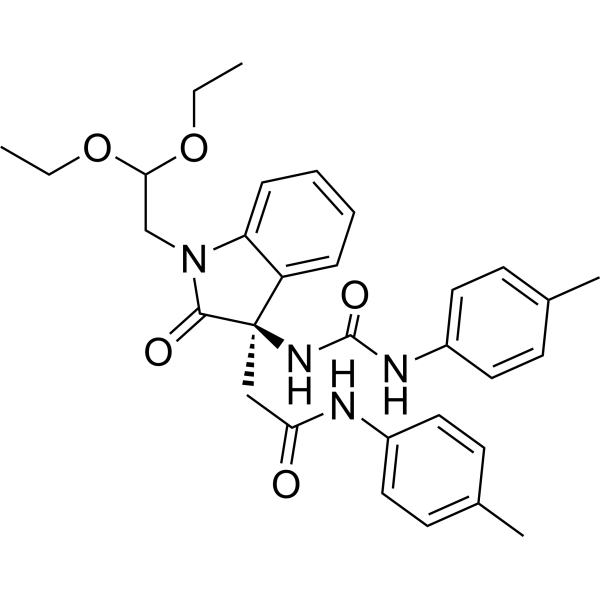
    AG-041R is a potent and selective CCK2 Receptor/Gastrin antagonist. AG-041R inhibits gastrin-evoked secretion of pancreastatin with an IC50 of 2.2 nM. AG-041R inhibits cell growth of Mastomys ECL carcinoid tumor cells .
    AG-041R

Inquiry Online

Your information is safe with us. * Required Fields.

Salutation


Country or Region *

Applicant Name *


Organization Name *

Department *


Email Address *


Product Name *

Cat. No.


Requested quantity *

Phone Number *


Remarks

Inquiry Online

Inquiry Information

Product Name:
Cat. No.:
Quantity:
MCE Japan Authorized Agent:

