1. Search Result
Search Result
Results for "

HT-29 xenograft mice

" in MedChemExpress (MCE) Product Catalog:

9

Inhibitors & Agonists

3

Peptides

Targets Recommended:
Cat. No. Product Name Target Research Areas Chemical Structure
  • HY-D2363

    Radionuclide-Drug Conjugates (RDCs) FAP Prolyl Endopeptidase (PREP) Cancer
    DOTA.SA.FAPi TFA is a selective FAP inhibitor with an IC50 value of 0.9 nM against FAP. DOTA.SA.FAPi TFA forms stable complexes with 68Ga and serves as a PET radiotracer for preclinical imaging of FAP-expressing tumors. DOTA.SA.FAPi TFA can be used in the research of colorectal adenocarcinoma and various other cancers .
    DOTA.SA.FAPi TFA
  • HY-162809

    Ras Cancer
    XMU-MP-9 is a bifunctional compound that binds to the C2 domain of Nedd4-1 and the allosteric site of K-Ras. XMU-MP-9 enhances the interaction between Nedd4-1 and K-Ras, induces conformational changes in the Nedd4-1/K-Ras complex, promotes the ubiquitination and degradation of multiple K-Ras mutants, and inhibits the proliferation of cells carrying K-Ras mutants. XMU-MP-9 can be used for the study of colon, lung and pancreatic cancer .
    XMU-MP-9
  • HY-171745

    ATM/ATR Cancer
    ATR-IN-32 is an orally active ATR inhibitor. ATR-IN-32 potently inhibits the proliferation of MIA PaCa-2 cells. ATR-IN-32 exerts significant tumor growth inhibition in mice bearing LOVO and HT-29 xenografts. ATR-IN-32 can be used for the study of cancers mediated by ATR protein kinase, such as colorectal cancer, pancreatic cancer .
    ATR-IN-32
  • HY-156792

    RIO Kinase Cancer
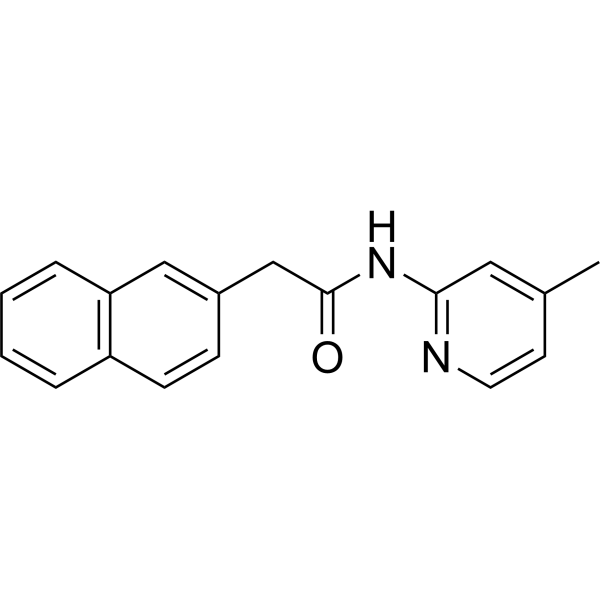
    RIOK2-IN-1 (com 4) is a potent and selective RIOK2 inhibitor (Kd=150 nM), but has low cellular activity (IC50=14,600 nM). RIOK2 is an atypical kinase associated with a variety of human cancers and is involved in ribosome maturation and cell cycle progression. The small molecule inhibitor CQ211 (HY-147655), an improvement of RIOK2-IN-1 as the lead compound, has good in vivo and in vitro activity, inhibits the proliferation of MKN-1 and HT-29 cancer cells, and can xenograft MKN in mice -1 model inhibits tumor progression .
    RIOK2-IN-1
  • HY-146505

    Microtubule/Tubulin Apoptosis Reactive Oxygen Species (ROS) Cancer
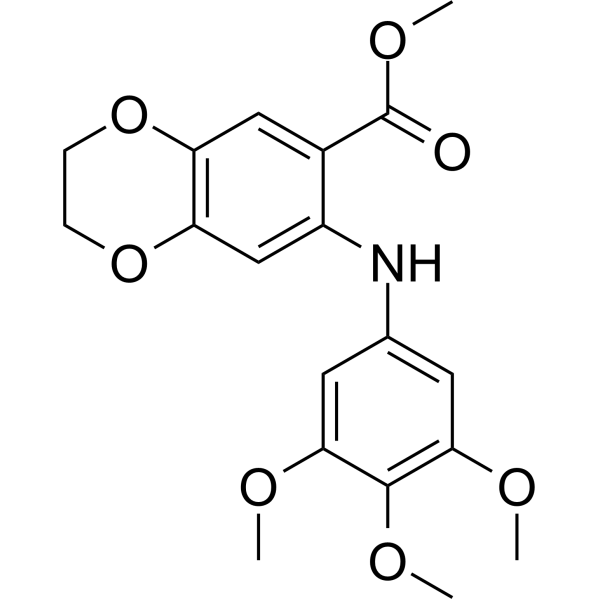
    Tubulin polymerization-IN-6 (compound 5f) is a potent tubulin polymerization inhibitor, with an IC50 of 1.09 μM. Tubulin polymerization-IN-6 inhibits cell migration and tube formation and contributes to the anti-angiogenesis. Tubulin polymerization-IN-6 can greatly inhibit tumor growth on HT29 xenograft Balb/c nude mice .
    Tubulin polymerization-IN-6
  • HY-172617

    BMI1 Microtubule/Tubulin Apoptosis Cancer
    APD-94 is a dual inhibitor targeting tubulin and Bmi-1. APD-94 interfers tubulin normal polymerization. APD-94 suppresses the expression of Bmi-1. APD-94 causes cell cycle arrest at the G2/M phase in cancer cells and induces apoptosis, thus inhibiting cancer cell proliferation. APD-94 represses the growth of HT29 cell xenografts in NOD/SCID mice. APD-94 can be used for colorectal cancer study .
    APD-94
  • HY-123237

    c-Met/HGFR FLT3 Trk Receptor Apoptosis Autophagy Cancer
    KRC-108, an aminopyridine, is an orally active multiple kinase inhibitor with IC50s of 80 nM, 23 nM, 3 nM, 70 nM, 30 nM, 39 nM for c-Met, c-Met M1250T, c-Met Y1230D, Ron, Flt3 and TrkA, respectively. KRC-108 induces cell cycle arrest, apoptotic cell death, and autophagy. KRC-108 exhibits anti-tumor activity in vivo in HT29 colorectal cancer, NCI-H441 lung cancer xenograft models in athymic BALB/c nu/nu mice .
    KRC-108
  • HY-P11845

    Radionuclide-Drug Conjugates (RDCs) Neurotensin Receptor Cancer
    DOTA-NT-20.3-IPBA is a Neurotensin receptor 1 (NTR1)-targeting albumin binder with specific high-affinity binding to NTR1. DOTA-NT-20.3-IPBA is formed by the conjugation of DOTA-NT-20.3 and IPBA. DOTA-NT-20.3-IPBA can be used for positron emission tomography (PET) imaging following labeling with [ 68Ga]Ga .
    DOTA-NT-20.3-IPBA
  • HY-P11594

    Neurotensin Receptor Cancer
    JMV 7490 is a highly potent and highly hydrophilic neurotensin receptor NTS1 probe that can be successfully labeled with 68Ga and 111In. JMV 7490 acts as an efflux inhibitor to reduce its efflux in NTS1-positive cancer cells; it also serves as an internalization inducer and is efficiently and continuously internalized by NTS1-positive cancer cells. 111In-radiolabeled JMV 7490 shows persistent uptake in NTS1-positive xenografts in nude mice, but no significant uptake in NTS1-negative xenografts. JMV 7490 can be used for in vivo tracer applications of NTS1-positive tumors and supports related research on colorectal cancer .
    JMV 7490

Inquiry Online

Your information is safe with us. * Required Fields.

Salutation


Country or Region *

Applicant Name *


Organization Name *

Department *


Email Address *


Product Name *

Cat. No.


Requested quantity *

Phone Number *


Remarks

Inquiry Online

Inquiry Information

Product Name:
Cat. No.:
Quantity:
MCE Japan Authorized Agent:

