17 Results for "

L. mesenteroides NRRL B-21297

" in MedChemExpress (MCE) Product Catalog:
Products (17)

17 Results for "L. mesenteroides NRRL B-21297" in MCE Product Catalog:

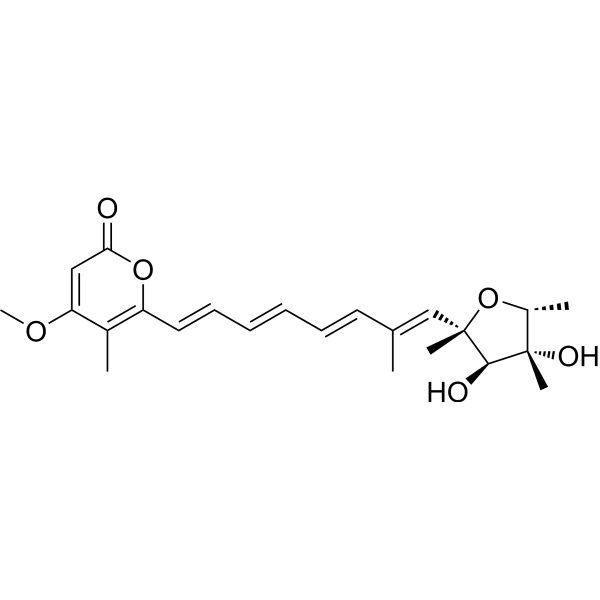
Cat. No.: HY-N6745
CAS No.: 25425-12-1
Citreoviridin, a toxin from Penicillium citreoviride NRRL 2579, inhibits brain synaptosomal Na +/K +-ATPase whereas in microsomes, both Na +/K +-ATPase and Mg 2+-ATPase activities are significantly stimulated in a dose-dependent manner . Citreoviridin inhibits cell proliferation and enhances apoptosis of human umbilical vein endothelial cells .
loading...
    loading...
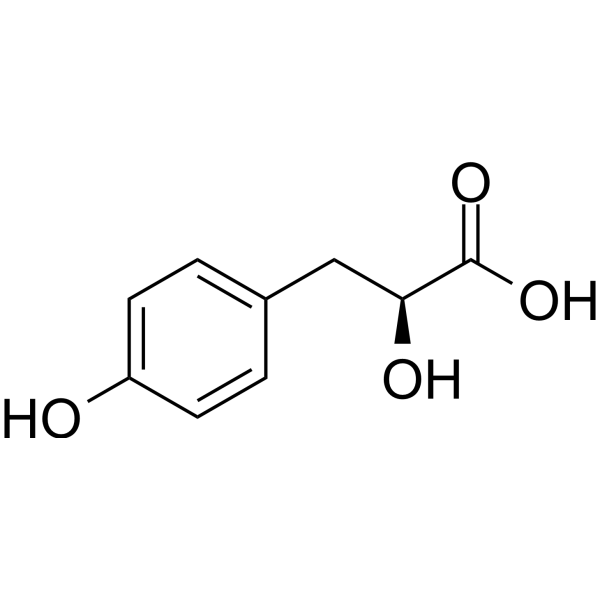
Cat. No.: HY-136593
CAS No.: 23508-35-2
Purity:  99.77%
Synonyms: (S)-3-(4-Hydroxyphenyl)lactic acid
(S)-3-(4-Hydroxyphenyl)-2-hydroxypropionic acid (Compound 1) is a metabolite. (S)-3-(4-Hydroxyphenyl)-2-hydroxypropionic acid can be isolated from the culture medium of Leuconostoc mesenteroides. (S)-3-(4-Hydroxyphenyl)-2-hydroxypropionic acid has strong antioxidant activity .
loading...
    loading...
Cat. No.: HY-159067
CAS No.: 9064-91-9
Synonyms: DEAE-dextran, MW 500000 hydrochloride, from bacterial (Leuconostoc mesenteroides); Diethylaminoethyl-dextran, MW 500000 hydrochloride
DEAE-dextran, MW 500000 hydrochloride (DEAE-dextran, MW 500000 hydrochloride, from bacterial (Leuconostoc mesenteroides)) is a high-molecular-weight positively charged polymer that significantly enhances the uptake of viral RNA by tissue culture cells. When employed in the delivery system for "tumor immunity" RNA-splenocyte transfer, DEAE-dextran can markedly extend the lifespan of tumor-bearing animals, comparable to that of actively immunized animals. Furthermore, DEAE-dextran serves as a complexing agent for nucleic acids, forming composite particles with DNA/RNA for extensive applications in gene delivery. Additionally, DEAE-dextran can be utilized as a coating for liposomes .
loading...
    loading...
Cat. No.: HY-N16392
CAS No.: 3085255-21-3
14-epi-Berkeleylactone F (Compound 8) is a C-14 epimer of Berkeleylactone F (HY-N8386). 14-epi-Berkeleylactone F can be isolated from Penicillium turbatum NRRL 5630. 14-epi-Berkeleylactone F has no significant biological activity against bacterium (Staphylococcus aureus, Bacillus subtilis and E. coli), fungi Candida albicans, the parasite Giardia duodenalis and NS-1 murine myeloma cells .
loading...
    loading...
Cat. No.: HY-N15077
CAS No.: 31652-69-4
11-Deacetoxywortmannin is an antibiotic found in Aspergillus janus NRRL 3807 and Penicillum funiculosum NRRL 3363. 11-Deacetoxywortmannin has a strong anti-fungal and anti-inflammatory effect, and has an anti-edema effect .
loading...
    loading...
Cat. No.: HY-116812
CAS No.: 65641-84-1
Sclerotigenin is an anti-insect benzodiazepine compound identified in Penicillium sclerotigenum (NRRL 3461). Sclerotigenin exhibits significant anti-insect activity against crop pest Helicoverpa zea .
loading...
    loading...
Cat. No.: HY-E70978
Target:  

Endogenous Metabolite

Research Areas:  

Metabolic Disease

6-Phosphogluconolactonase, Leuconostoc mesenteroides is an enzyme in the pentose phosphate pathway. 6-Phosphogluconolactonase, Leuconostoc mesenteroides converts 6-phosphogluconolactone to 6-phosphogluconate.
loading...
    loading...
Cat. No.: HY-E70913B
Research Areas:  

Others

Phosphotransacetylase, Leuconostoc mesenteroides (EC 2.3.1.8) converts coenzyme A to acetyl-CoA. Phosphotransacetylase, Leuconostoc mesenteroides (EC 2.3.1.8) belongs to the transtransferase family and participates in three metabolic pathways: taurine and linolenic acid metabolism, pyruvate metabolism, and propionic acid metabolism.
loading...
    loading...
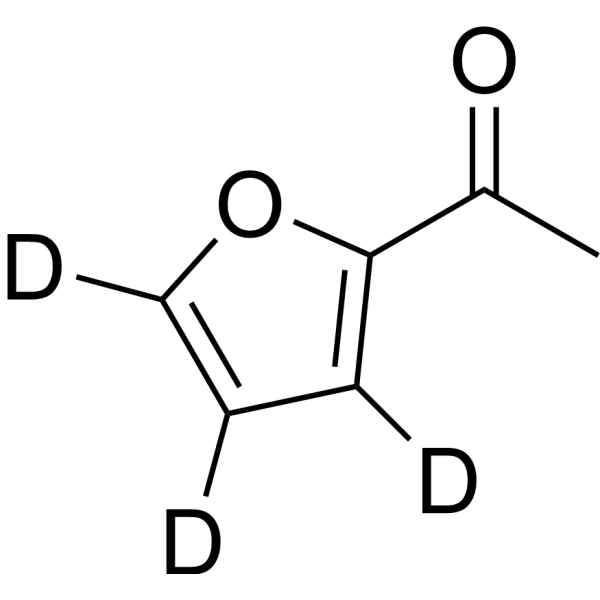
Cat. No.: HY-W015912S
Synonyms: 2-Furyl methyl ketone-d3
2-Acetylfuran-d3 is deuterated labeled Citreoviridin (HY-N6745). Citreoviridin, a toxin from Penicillium citreoviride NRRL 2579, inhibits brain synaptosomal Na +/K +-ATPase whereas in microsomes, both Na +/K +-ATPase and Mg 2+-ATPase activities are significantly stimulated in a dose-dependent manner . Citreoviridin inhibits cell proliferation and enhances apoptosis of human umbilical vein endothelial cells .
loading...
    loading...
Cat. No.: HY-P2897C
Research Areas:  

Metabolic Disease

D-Lactic Dehydrogenase, Leuconostoc mesenteroides (EC 1.1.1.28) is an oxidoreductase that acts on the CH-OH group in the donor molecule and uses cytochrome as the acceptor. D-Lactic Dehydrogenase, Leuconostoc mesenteroides (EC 1.1.1.28) is involved in pyruvate metabolism. It uses a cofactor, namely FAD.
loading...
    loading...
Cat. No.: HY-E71039
Research Areas:  

Others

Chemically modified Glucose-6-phosphate Dehydrogenase, Leuconostoc mesenteroides is a cytosolic enzyme. Chemically modified Glucose-6-phosphate Dehydrogenase, Leuconostoc mesenteroides is in the pentose phosphate pathway, a metabolic pathway that supplies reducing energy to cells (such as erythrocytes) by maintaining the level of the co-enzyme nicotinamide adenine dinucleotide phosphate (NADPH) .
loading...
    loading...
Cat. No.: HY-N14521
CAS No.: 328110-92-5
Pacidamycin 5T is found in the strain of Streptomyces coeruleorubidus NRRL 18370 .
loading...
    loading...
Cat. No.: HY-N14593
CAS No.: 14682-29-2
Target:  

Others

Roridin D is a natural compound foun in Myrothecium roridum S-1135 (NRRL 3005) .
loading...
    loading...
Cat. No.: HY-W344656
CAS No.: 7779-80-8
Isobutyl heptanoate is a valine derivative analog. Isobutyl heptanoate can be isolated from the volatile metabolites of Aspergillus clavatus NRRL1 .
loading...
    loading...
Cat. No.: HY-E71319
Research Areas:  

Others

β-Methylphenylalanine transaminase (EC 2.6.1.107) requires pyridoxal phosphate. Isolated from the bacterium Streptomyces hygroscopicus NRRL3085. It is involved in the biosynthesis of the glycopeptide antibiotic mannopeptimycin.
loading...
    loading...
Cat. No.: HY-N19232
CAS No.: 735316-93-5
Target:  

Fungal

Research Areas:  

Infection

ECO-02301 is an antifungal agent identified in Streptomyces aizunensis NRRL B-11277. ECO-02301 exhibits antifungal activity against human pathogenic fungi including Candida albicans, and can be used in research related to fungal infections .
loading...
    loading...
Cat. No.: HY-W248922
CAS No.: 2316-62-3
Target:  

PDI

Research Areas:  

Infection

2,6-Dibromo-4-(hydroxymethyl) phenol (Compound 5) acts as a selective inhibitor of Saccharomyces cerevisiae glucose-6-phosphate dehydrogenase, with an IC50 value of 50.2 μM, and shows no activity against Leuconostoc mesenteroides glucose-6-phosphate dehydrogenase .
loading...
    loading...
  • 1

