6 Results for "

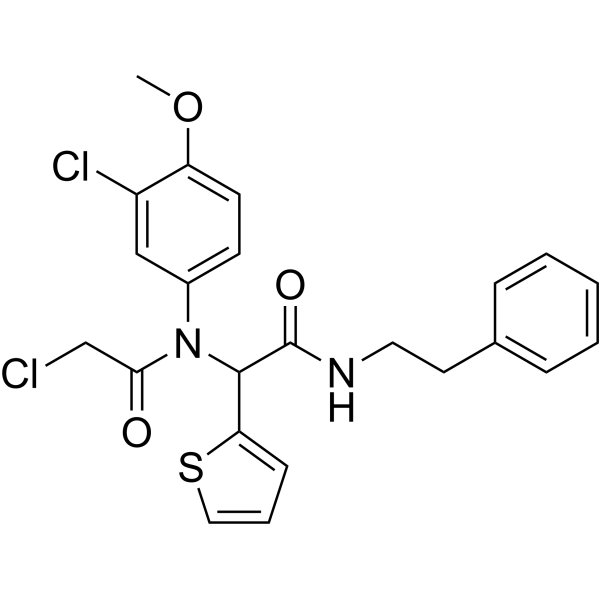
ML162

" in MedChemExpress (MCE) Product Catalog:
Products (6)

6 Results for "ML162" in MCE Product Catalog:

18
18 Cited Publications
Cat. No.: HY-100002
CAS No.: 1035072-16-2
Purity:  99.46%
Research Areas:  

Cancer

ML162 is a covalent glutathione peroxidase 4 (GPX4) inhibitor. ML162 has a selective lethal effect on mutant RAS oncogene-expressing cell lines
loading...
    loading...
Cat. No.: HY-153748
CAS No.: 2883115-46-4
Purity:  99.23%
Research Areas:  

Cancer

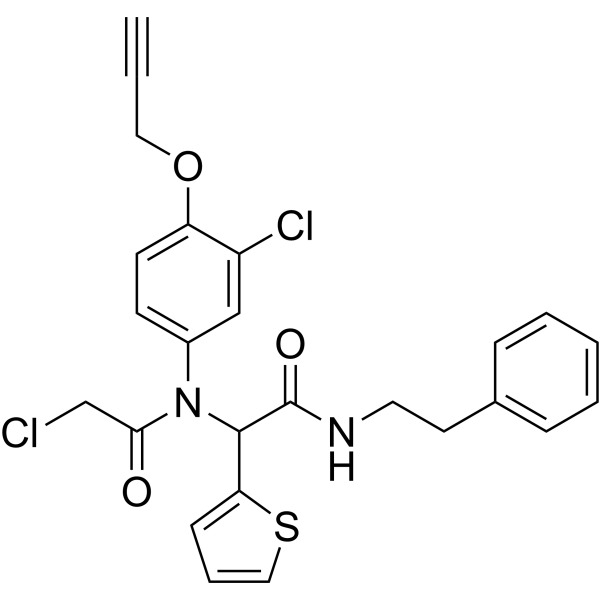
ML162-yne is a potent GPX4-inhibitor affinity probe . ML162-yne is a click chemistry reagent, it contains an Alkyne group and can undergo copper-catalyzed azide-alkyne cycloaddition (CuAAc) with molecules containing Azide groups.
loading...
    loading...
Cat. No.: HY-100002R
CAS No.: 1035072-16-2
ML162 (Standard) is the analytical standard of ML162 (HY-100002). This product is intended for research and analytical applications. ML162 is a covalent glutathione peroxidase 4 (GPX4) inhibitor. ML162 has a selective lethal effect on mutant RAS oncogene-expressing cell lines
loading...
    loading...
Cat. No.: HY-155952
CAS No.: 951948-38-2
Research Areas:  

Cancer

LOC1886 is a covalent inhibitor of GPX4 with slightly lower potency than RSL3 and ML162 .
loading...
    loading...
Cat. No.: HY-173029
Target:  

Ferroptosis

Research Areas:  

Cancer

UAMC-4821 is an inhibitor for ferroptosis with an IC50 of 5.2 nM. UAMC-4821 scavenges free radicals, blocks the lipid peroxidation, inhibits ML162 (HY-100002)-induced ferroptosis, and exhibits protective effect in HT-1080 cell. UAMC-4821 exhibits good pharmacokinetics characteristics in mouse with an oral bioavailability of 63%. UAMC-4821 can cross blood-brain barrier .
loading...
    loading...
Cat. No.: HY-176220
CAS No.: 3060458-90-1
Research Areas:  

Cancer

GPX4-AUTAC is a GPX4-targeting autophagy-mediated degrader (AUTAC). GPX4-AUTAC consists of an inhibitor ML162-yne (HY-153748), a degradation tag FBnG (HY-W073762) and a glycol linker (HY-W021401). GPX4-AUTAC promotes the ubiquitination of GPX4 by E3 ligase TRAF6, and enhances the binding with GPX4 and p62, leading to the selective autophagy-dependent degradation of GPX4. GPX4-AUTAC significantly induces ferroptosis and shows a potent anti-cancer activity in breast cancer cells, breast cancer-derived organoids (PDOs) and MDA-MB-231 tumor xenograft mice model, with potent synergistic effects when combined with Sulfasalazine (SAS) (HY-14655) or chemotherapy drugs (Paclitaxel (HY-B0015) or Cisplatin (HY-17394)) .
loading...
    loading...

