1. Search Result
Search Result
Results for "

Methyl Blue

" in MedChemExpress (MCE) Product Catalog:

9

Inhibitors & Agonists

3

Fluorescent Dyes

1

Biochemical Assay Reagents

3

Natural
Products

Cat. No. Product Name Target Research Areas Chemical Structure
  • HY-D0003

    Environmental Pollutants Bacterial Infection
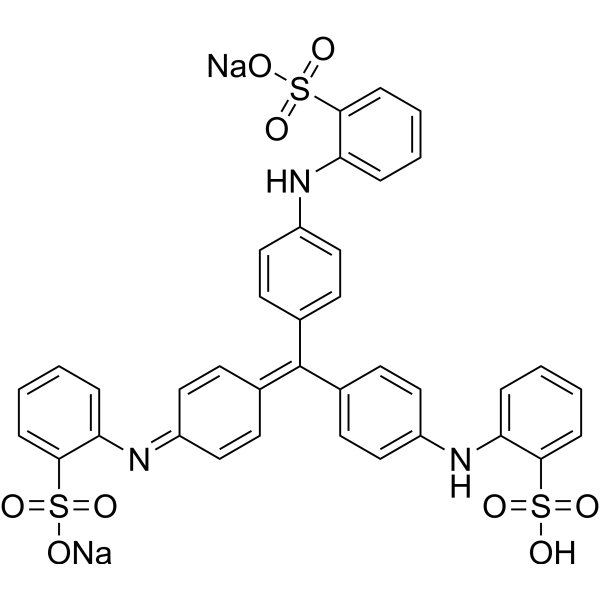
    Methyl blue belongs to the group of triaminotriphenylmethane dyes. Methyl blue is widely used as antiseptic dye in polychrome staining method and has applications in histological and microbiological staining solutions. Methyl blue has been used as a model to study the effect of various catalysts on photodegradation of dyes .
    Methyl Blue
  • HY-D1416
    HMBR
    1 Publications Verification

    Fluorescent Dye Others
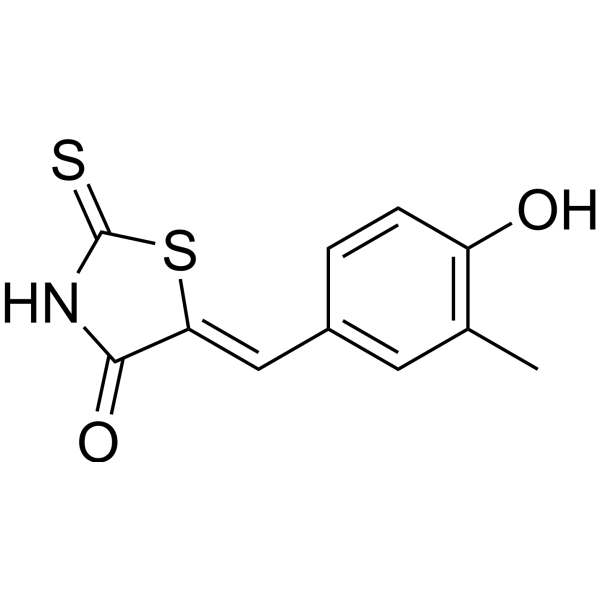
    HMBR is an analogue with an additional methyl group on the aromatic ring and is non-fluorescent. HMBR conjugated with Y-FAST emits yellow fluorescence under blue light excitation (Ex= 419 nm; Em= 525–539 nm). HMBR is non-toxic to zebrafish embryos. HMBR has high cell permeability .
    HMBR
  • HY-15932

    TOOS sodium salt

    Biochemical Assay Reagents Others
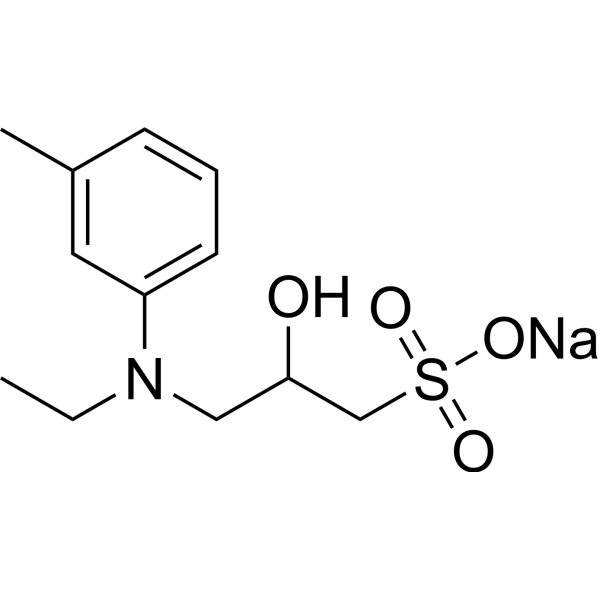
    TOOS (TOOS sodium salt) is a highly water-soluble aniline derivative widely used in diagnostics and biological experiments. TOOS can be combined with 3-methyl-2-benzothiazolinone hydrazone hydrochloride (MBTH) to form a chromogenic system to measure oxidase activity. In the MBTH-TOOS chromogenic system, MBTH is catalytically oxidized to produce (-NH) free radicals, which react with TOOS to form colorless compounds. Furthermore, the colorless compound undergoes a disproportionation reaction to produce a blue-violet quinoid compound .
    TOOS
  • HY-D0026

    7-Amino-4-Methyl-3-coumarinacetic acid N-succinimidyl ester

    Fluorescent Dye Others
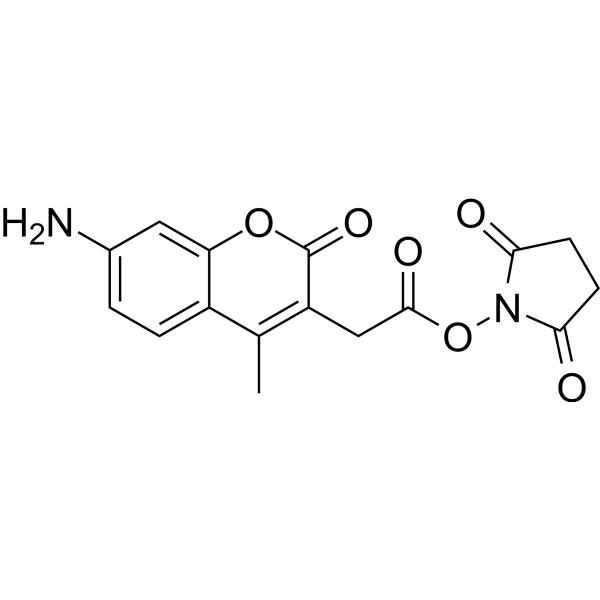
    AMCA,SE (7-Amino-4-methyl-3-coumarinacetic acid N-succinimidyl ester) is a bright blue fluorescent dye. AMCA,SE reacts with amino groups and is excited by ultraviolet light. AMCA,SE can be used for amine reactive labeling (Ex/Em = 354/440 nm) .
    AMCA,SE
  • HY-157579

    PROTACs EGFR Cancer
    MS154N (compound 28) is the negative control of MS39 (HY-157581). MS154N is composed of PROTAC target protein ligand EGFR ligand-11 (HY-168305) (red part), E3 ligase ligand 4-Hydroxy-2-(1-methyl-2,6-dioxopiperidin-3-yl)isoindoline-1,3-dione (HY-W441376) (blue part) and PROTAC Linker 8-Iodooctan-1-amine (HY-168306) (black part), among which the conjugate of E3 ubiquitin ligase ligand + Linker is Me-Thalidomide-O-C8-NH2 (HY-168307) .
    MS154N
  • HY-W714137

    Lesquerellin; 6-Methylthiohexyl isothiocyanate

    Bacterial Infection
    (6-Isothiocyanatohexyl)(methyl)sulfane (Lesquerellin; 6-Methylthiohexyl isothiocyanate) is an isothiocyanate found in wasabi (W. japonica) and has various biological activities. (6-Isothiocyanatohexyl)(methyl)sulfane is active against the bacterium Bacillus subtilis and the fungus T. mentagrophytes (MIC=25 μg/mL). (6-Isothiocyanatohexyl)(methyl)sulfane also has anthelmintic activity against blue mussel (M. edulis). (6-Isothiocyanatohexyl)(methyl)sulfane has antifouling activity when applied to polyvinyl chloride (PVC) panels at a concentration of 50 μmol/cm2 in a conventional immersion test.
    (6-Isothiocyanatohexyl)(methyl)sulfane
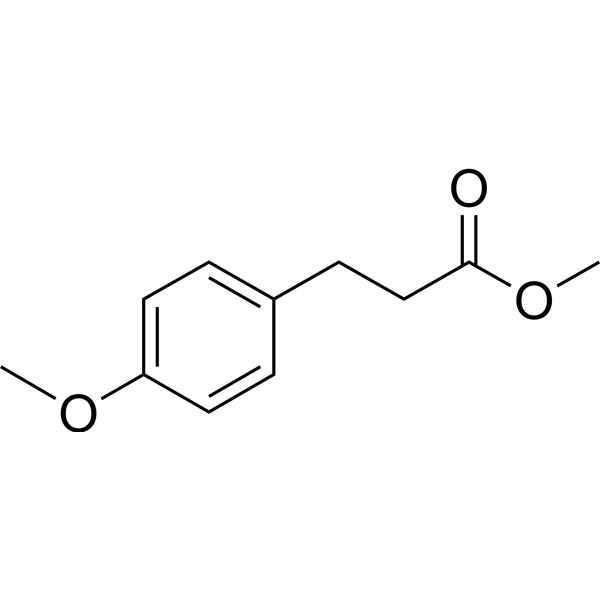
  • HY-N3290

    Methyl p-methoxyphenylpropionate

    Others Others
    Methyl p-methoxyhydrocinnamate is extracted from in liquid culture by the blue stain fungus Ophiostoma crassioaginata .
    Methyl p-methoxyhydrocinnamate
  • HY-W722087

    Endogenous Metabolite Others
    3,6-Dimethylundecane is a type of di-methyl alkanoid compound. 3,6-Dimethylundecane is one of the various branched alkanes identified in the metabolic products of the desert blue-green algae Microcoleus vaginatus .
    3,6-Dimethylundecane
  • HY-N3290R

    Methyl p-methoxyphenylpropionate (Standard)

    Others Reference Standards Others
    Methyl p-methoxyhydrocinnamate (Standard) (Methyl p-methoxyphenylpropionate (Standard)) is the analytical standard of Methyl p-methoxyhydrocinnamate (HY-N3290). This product is intended for research and analytical applications. Methyl p-methoxyhydrocinnamate is extracted from in liquid culture by the blue stain fungus Ophiostoma crassioaginata .
    Methyl p-methoxyhydrocinnamate (Standard)

Inquiry Online

Your information is safe with us. * Required Fields.

Salutation


Country or Region *

Applicant Name *


Organization Name *

Department *


Email Address *


Product Name *

Cat. No.


Requested quantity *

Phone Number *


Remarks

Inquiry Online

Inquiry Information

Product Name:
Cat. No.:
Quantity:
MCE Japan Authorized Agent:

