
9 Results for "

P19 cells

" in MedChemExpress (MCE) Product Catalog:
Products (9)

9 Results for "P19 cells" in MCE Product Catalog:

Cat. No.: HY-P99256
CAS No.: 1326244-10-3
Synonyms: SCH 900222; MK 3222; Anti-Human IL23 Recombinant Antibody
Target:  

Interleukin Related

Research Areas:  

Inflammation/Immunology Cancer

Tildrakizumab (SCH 900222) is a humanized anti-IL-23 (p19 subunit) monoclonal antibody. IL-23 is a critical cytokine to maintain the Th17 cell phenotype. Tildrakizumab has high-affinity for single-chain IL-23 (Kd: 136 pM). Tildrakizumab is effective against moderate to severe plaque psoriasis .
loading...
    loading...
Cat. No.: HY-108440
CAS No.: 326886-05-9
Purity:  99.88%
Target:  

Myosin

Research Areas:  

Cardiovascular Disease

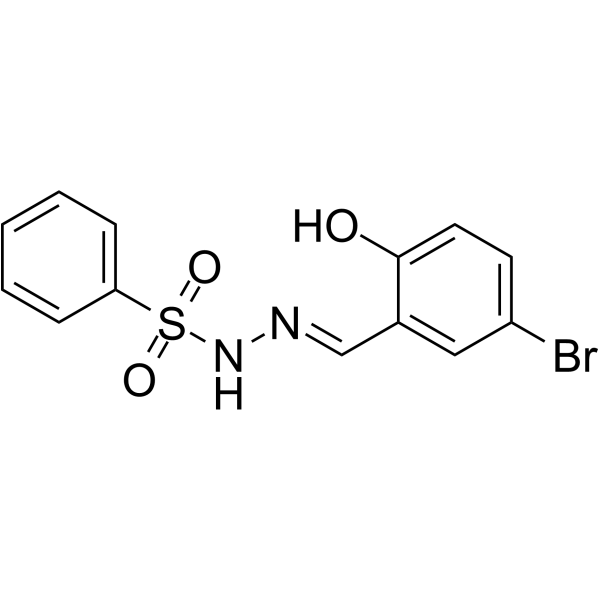
Shz-1, a small cardiogenic molecule, induces various cardiac-specific genes including sarcomeric tropomyosin in P19CL6 cells. Shz-1 induces Nkx2.5 expression in mouse. Shz-1 activates the axolotl TPM4 promoter-driven ectopic expression in C2C12 cells .
loading...
    loading...
Cat. No.: HY-P991274

Target:  

Interleukin Related

Research Areas:  

Inflammation/Immunology

BMS-986010 is a monoclonal antibody inhibitor targeting the p19 subunit of interleukin-23 (IL-23). BMS-986010 reduces IL-23-induced STAT3 phosphorylation and inhibits Th17 cell differentiation and the release of proinflammatory cytokines (such as IL-17 and TNF-α). BMS-986010 is promising for research of autoimmune diseases such as psoriasis and Crohn's disease .
loading...
    loading...
Cat. No.: HY-147934
CAS No.: 2432825-93-7
Target:  

HDAC Apoptosis

Research Areas:  

Cancer

HDAC8-IN-3 (compound P19) is a potent HDAC8 inhibitor with IC50 value of 9.3 μM and produces thermal stabilization. HDAC8-IN-3 has cytotoxicity and induces apoptosis in leukemic cell lines .
loading...
    loading...
Cat. No.: HY-P11198
Research Areas:  

Cancer

AC-P19M is an anticancer peptide. AC-P19M induces apoptosis by disrupting the cell membrane of cancer cells. AC-P19M reverses epithelial-mesenchymal transition (EMT). AC-P19M shows anti-angiogenic activity through the inhibition of VEGF-VEGFR2/ERK/Akt signaling. AC-P19M can be used for lung cancer research .
loading...
    loading...
Cat. No.: HY-180981
CAS No.: 2635386-55-7
Target:  

PROTACs Bcr-Abl

Research Areas:  

Cancer

P19As is a BCR-ABL PROTAC degrader based on Asciminib (HY-104010), with a DC50 value of approximately 200 nM for the wild-type BCR-ABL protein. P19As can degrade the T315I mutant and exhibits potent anti-proliferative activity in BaF3-BCR-ABL (T315I) cells. P19As can be used for the study of chronic myeloid leukemia and acute lymphoblastic leukemia .
loading...
    loading...
Cat. No.: HY-180977
CAS No.: 2512843-74-0
Target:  

PROTACs Bcr-Abl

Research Areas:  

Cancer

P19P is a BCR-ABL PROTAC degrader based on Ponatinib (HY-12047), with a DC50 value of approximately 20 nM for the wild-type BCR-ABL protein. P19P can effectively degrade various drug-resistant mutants such as T315I, E255K, H396R, and V468F, and exhibits potent anti-proliferative activity in BaF3-BCR-ABL (T315I) cells. P19P maintains strong inhibitory activity against ABL (T315I), with a IC50 of 13.1 nM. P19P does not inhibit the formation of vascular lumens in HUVEC. P19P can be used for research on chronic myeloid leukemia and acute lymphoblastic leukemia .
loading...
    loading...
Cat. No.: HY-108440R
CAS No.: 326886-05-9
Research Areas:  

Cardiovascular Disease

Shz-1 (Standard) is the analytical standard of Shz-1 (HY-108440). This product is intended for research and analytical applications. Shz-1, a small cardiogenic molecule, induces various cardiac-specific genes including sarcomeric tropomyosin in P19CL6 cells. Shz-1 induces Nkx2.5 expression in mouse. Shz-1 activates the axolotl TPM4 promoter-driven ectopic expression in C2C12 cells .
loading...
    loading...
Cat. No.: HY-N9932
CAS No.: 125519-47-3
11β,13-Dihydrolactucopicrin is a sesquiterpene lactone and the main bitter component of chicory root. 11β,13-Dihydrolactucopicrin inhibits yeast α-glucosidase activity (IC50 = 27.49 μM) and inhibits Crz1 activation and nuclear accumulation. 1β,13-Dihydrolactucopicrin possesses blood-brain barrier penetration capacity in an in vitro HBMEC blood-brain barrier model and can generate cysteine-conjugated metabolites within brain microvascular endothelial cells. 11β,13-Dihydrolactucopicrin can regulate the lncRNA H19/miR-21-3p signaling axis; it upregulates the expression of ABCG2 and lncRNA H19, downregulates miR-21-3p, inhibits the release of IL-6, TNF-α, and hs-CRP pro-inflammatory mediators, and alleviates urate-induced inflammatory injury in renal epithelial cells. 11β,13-Dihydrolactucopicrin can be used in research on diabetes and renal urate deposition .
loading...
    loading...

