

13 Results for "

PAMPA

" in MedChemExpress (MCE) Product Catalog:
Products (13)

13 Results for "PAMPA" in MCE Product Catalog:

Cat. No.: HY-D2060
CAS No.: 1188422-44-7
ATTO 740 is a near-infrared dye (Ex/Em: 740/764 nm). ATTO 740 can be conjugated with the Cetuximab antibody (HY-P9905) .
loading...
    loading...
Cat. No.: HY-146341
CAS No.: 1338575-38-4
Target:  

FAAH MAGL

Research Areas:  

Neurological Disease

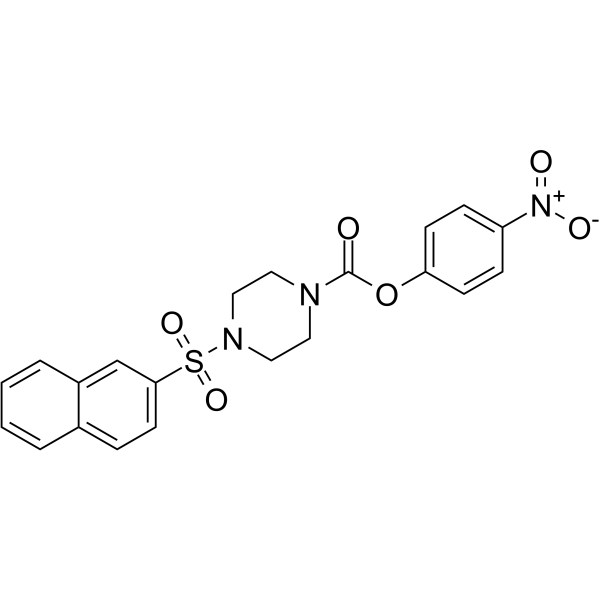
FAAH-IN-5 (Compound 7) is a relative selective, irreversible fatty acid amide hydrolase (FAAH) inhibitor with an IC50 of 10.5 nM. FAAH-IN-5 shows low PAMPA (Parallel Artificial Membrane Permeability Assay) permeability .
loading...
    loading...
Cat. No.: HY-146342
CAS No.: 2848719-34-4
Target:  

FAAH MAGL

Research Areas:  

Neurological Disease

FAAH/MAGL-IN-3 (Compound 10) is an irreversible fatty acid amide hydrolase (FAAH) and monoacylglycerol lipase (MAGL) dual inhibitor with IC50 values of 179 and 759 nM against FAAH and MAGL, respectively. FAAH/MAGL-IN-3 shows low PAMPA (Parallel Artificial Membrane Permeability Assay) permeability .
loading...
    loading...
Cat. No.: HY-144285
CAS No.: 2761009-30-5
Target:  

CXCR HIV

Research Areas:  

Inflammation/Immunology

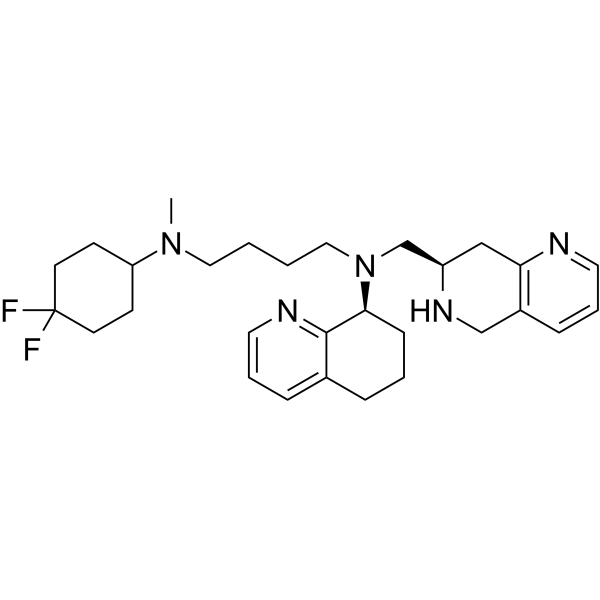
CXCR4 antagonist 4 is a potent, orally active CXCR4 antagonist (IC50=24 nM) with diminished CYP 2D6 activity, improved PAMPA permeability, potent inhibition of human immunodeficiency virus entry (IC50=7 nM) .
loading...
    loading...
Cat. No.: HY-117776
CAS No.: 1443253-20-0
Target:  

ICMT

Research Areas:  

Cancer

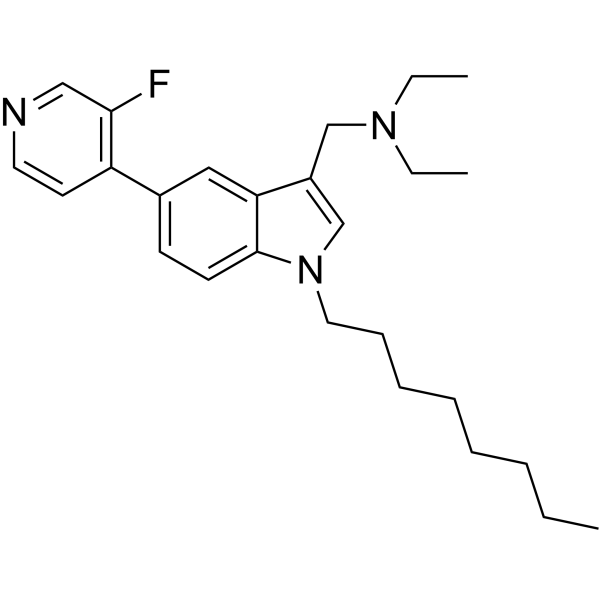
CAY10677 (compound 15) is a potent ICMT inhibitor that inhibits cancer cell proliferation. CAY10677 has good PAMPA penetration .
loading...
    loading...
Cat. No.: HY-149729
CAS No.: 1443253-17-5
Target:  

ICMT

Research Areas:  

Cancer

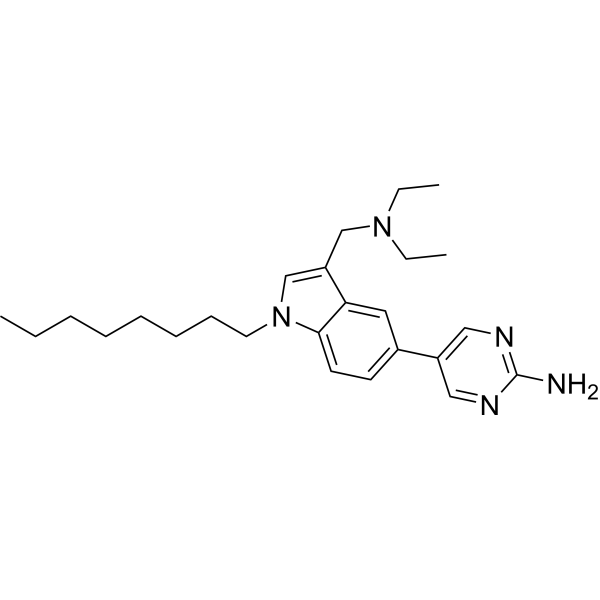
ICMT-IN-53 (compound 12) is an ICMT inhibitor (IC50=0.96 μM) with PAMPA permeability and antiproliferative activity. ICMT-IN-53 inhibits the proliferation of MDA-MB-231 and PC3 with IC50s of 5.14 μM and 5.88 μM, respectively .
loading...
    loading...
Cat. No.: HY-168241
CAS No.: 1639925-34-0
Research Areas:  

Infection

Flucopride (Compound 4a) is an AChE inhibitor (IC50: 24 nM), and a partial 5-HT4R agonist (Ki: 9.6 nM for (h)5-HT4R). Flucopride promotes the non-amyloidogenic processing of APP in COS-7 transiently expressing (h)5-HT4R (EC50: 23.0 nM). Flucopride may has good gastrointestinal track (GIT) penetration, and blood-brain barrier (BBB) cross-membrane penetration (PAMPA assay) .
loading...
    loading...
Cat. No.: HY-L0116V
1,065 compounds

Macrocycles are promising scaffolds for the design of novel RNA targeting molecules. This collection of macrocycles for RNA consists of very diverse, drug-like molecules which incorporate certain known RNA-recognition elements (e.g. nucleobase ring systems and analogs) distributed within macrocyclic rings or peripheral fragments. As macrocyclic molecules tend to be larger than traditional screening molecules, it is vital to carefully assess and control their physicochemical properties. All macrocycles have been tested for aqueous and DMSO solubility with cutoffs applied at 10 mM in DMSO and 50 µM in PBS (pH 7.4); PAMPA permeability has also been tested for representative set of macrocycles.

Cat. No.: HY-L0115V
10,091 compounds

ASINEX has elaborated a library of diverse macrocycles using an effective tool box of synthetic methods. The resulting scaffolds are novel, tremendously diverse, medchem-relevant, macrocyclic frameworks.

Macrocyles tend to be larger than traditional screening molecules which make them perfect discovery tools for targets with shallow or extended binding sites. At the same time, their unique character based on restricted flexibility and ability to form intra-molecular hydrogen bonds allows for design approaches effectively optimizing properties such asaqueous solubility and membrane permeability. Many of these macrocycles have been tested for aqueous and DMSO solubility with cut-offs applied at 10 mM in DMSO and 50 µM in PBS (pH 7.4) followed by PAMPA permeability assay.

Cat. No.: HY-181711
Target:  

NO Synthase

Research Areas:  

Neurological Disease Cancer

nNOS-IN-6 is a human neuronal nitric oxide synthase (hnNOS) inhibitor with a human hnNOS Ki of 16 nM, ~1800-fold selectivity over human eNOS, ~2900-fold selectivity over human iNOS, and a rat nNOS Ki of 34 nM.nNOS-IN-6 exhibits high effective permeability in PAMPA-BBB assays, crosses the blood-brain barrier, and shows sustained systemic exposure, low clearance, and robust brain penetration in mouse in vivo pharmacokinetic studies.nNOS-IN-6 can be used for the research of neurodegenerative diseases, melanoma .
loading...
    loading...
Cat. No.: HY-P11621
Target:  

E1/E2/E3 Enzyme

Research Areas:  

Cancer

JWP24 is the first cell membrane-permeable peptide inhibitor of MAGE-A4, with an IC50 of 200 nM against human MAGE-A4. JWP24 binds to intracellular targets while retaining binding activity, disrupts the interaction between MAGE-A4 and RAD18, and does not induce cytotoxicity at effective concentrations. JWP24 is applicable for cancer-related research .
loading...
    loading...
Cat. No.: HY-181553
Research Areas:  

Others

PROTAC BRD4 Degrader-44 is a BRD4 PROTAC degrader with a DC50 of 16 nM. PROTAC BRD4 Degrader-44 is applicable to studies on membrane-permeable PROTACs .
loading...
    loading...
Cat. No.: HY-181710
Target:  

mTOR PI3K

Research Areas:  

Cancer

LASSBio-2337 is a dual pan-PI3K/mTOR inhibitor with an mTOR IC50 of 5.8 μM.LASSBio-2337 functionally modulates mTOR and all PI3K isoforms.LASSBio-2337 acts as a cytotoxic agent in leukemia cells, including multidrug-resistant populations.LASSBio-2337 spares nontumor human peripheral blood mononuclear cells.LASSBio-2337 displays moderate PAMPA-GIT permeability.LASSBio-2337 shows low metabolic stability in rat liver microsomes.LASSBio-2337 is aqueous insoluble.LASSBio-2337 can be used for the research of acute lymphoblastic leukemia, chronic myelogenous leukemia, breast cancer .
loading...
    loading...
  • 1

