5 Results for "

PC-3 prostate adenocarcinoma cells

" in MedChemExpress (MCE) Product Catalog:
Products (5)

5 Results for "PC-3 prostate adenocarcinoma cells" in MCE Product Catalog:

Cat. No.: HY-121619
CAS No.: 28872-28-8
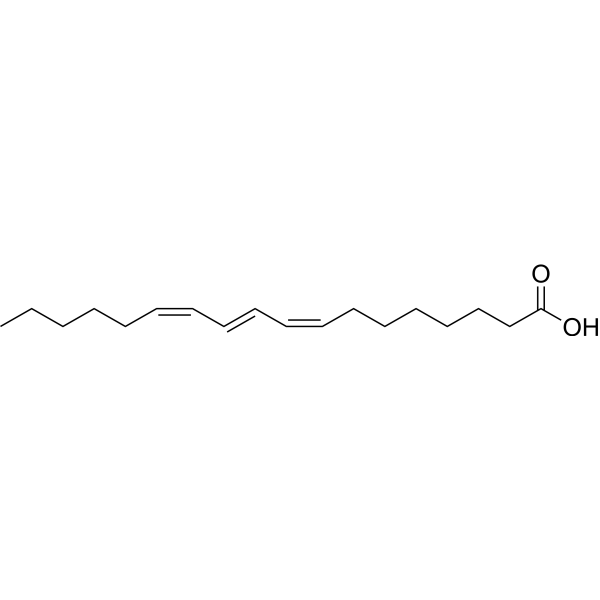
Jacaric acid is a conjugated linolenic acid, which inhibits viability in cells PC-3 (IC50 is 11.8 μM), LNCaP (IC50 is 2.2 μM) and DLD-1, induces apoptosis and necrosis . Jacaric acid exhibits anticaner activity against prostate cancer and adenocarcinoma . Jacaric acid exhibits immunomodulating activity in murine peritoneal macrophages as an immunopotentiator . Jacaric acid is orally active.
loading...
    loading...
Cat. No.: HY-W753557
CAS No.: 24607-08-7
Avocadene is a natural product isolated from Persea americana leaves, with anticancer, insecticidal, anti-Helicobacter pylori, and anti-inflammatory activity. Avocadene exerts antibacterial and anti‑inflammatory effects by suppressing Helicobacter pylori growth and inhibiting protein denaturation. Avocadene displays obvious cytotoxic activity against human prostate cancer PC‑3 cells with an IC50 of 0.5 μg/mL. Avocadene can be used for research of Helicobacter pylori‑associated gastrointestinal inflammation, gastroduodenal injury and prostate tumors .
loading...
    loading...
Cat. No.: HY-186291
CAS No.: 2143464-15-5
Target:  

Others

Research Areas:  

Others

A-486 is an inactive analog that serves as an inactive control analog for A-485 (HY-107455) .
loading...
    loading...
Cat. No.: HY-187100
CAS No.: 21856-94-0
Target:  

Drug Intermediate

Research Areas:  

Cancer

Bis(4-methylphenyl) diselenide is a symmetric aromatic organodiselenide with in vitro cytotoxicity against cancer cells. Bis(4-methylphenyl) diselenide can be used for the research of promyelocytic leukemia, epithelial carcinoma, renal cell adenocarcinoma, colorectal adenocarcinoma, and prostate cancer .
loading...
    loading...
Cat. No.: HY-183765
Target:  

PARP Pyruvate Kinase

Research Areas:  

Cancer

PARP1/PKM2-IN-1 is a dual PARP1/PKM2 inhibitor, with an IC50 of 39.5 nM against PARP1, and IC50 values of 261 nM (recombinant PKM2) and 50 nM (dimeric PKM2) against PKM2. PARP1/PKM2-IN-1 reduces the dimerization of PKM2 and decreases its nuclear accumulation level. PARP1/PKM2-IN-1 also selectively downregulates PKM2 mRNA and impairs poly (ADP-ribose)-mediated nuclear retention of PKM2. PARP1/PKM2-IN-1 exhibits antiproliferative activity and inhibits the formation of 3D cancer spheroids. PARP1/PKM2-IN-1 can be used in research related to mammary adenocarcinoma, triple-negative breast cancer, BRCA1-mutant triple-negative breast cancer, and prostate adenocarcinoma .
loading...
    loading...

