7 Results for "

Pellets

" in MedChemExpress (MCE) Product Catalog:
Products (7)

7 Results for "Pellets" in MCE Product Catalog:

1
1 Cited Publications
Cat. No.: HY-P1368
Synonyms: Cyclo(31-34)[DPhe12,Nle21,38,Glu31,Lys34]Ac-hCRF(4-41)
Target:  

CRFR

Research Areas:  

Endocrinology

Stressin I (Cyclo(31-34)[DPhe12,Nle21,38,Glu31,Lys34]Ac-hCRF(4-41)) is a potent CRF1 receptor-selective agonist with a Ki of 1.7 nM. Stressin I induces increases in adrenocorticotropic hormone (ACTH) levels in rats .
loading...
    loading...
1
1 Cited Publications
Cat. No.: HY-P1368A
Synonyms: Cyclo(31-34)[DPhe12,Nle21,38,Glu31,Lys34]Ac-hCRF(4-41) TFA
Target:  

CRFR

Research Areas:  

Endocrinology

Stressin I (Cyclo(31-34)[DPhe12,Nle21,38,Glu31,Lys34]Ac-hCRF(4-41)) TFA is a potent CRF1 receptor selective agonist, Ki is 1.7 nM. Stressin I induces an increase in adrenocorticotropic hormone (ACTH) levels in rats .
loading...
    loading...
Cat. No.: HY-N0120
CAS No.: 65914-17-2
Synonyms: (E/Z)-Piceid
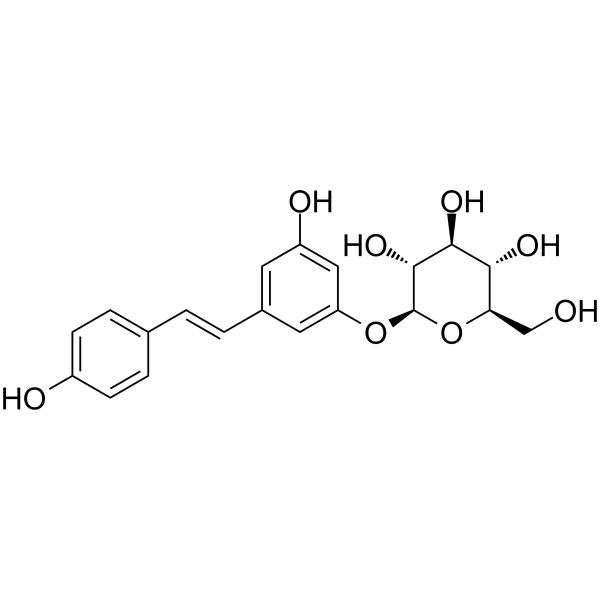
(E/Z)-Polydatin ((E/Z)-Piceid) is a mixture of the E/Z configurations of Polydatin (HY-N0120A). Polydatin can be isolated from Polygonum cuspidatum, grapes, peanuts, red wine, hop pellets, cocoa-containing products and chocolate products. Polydatin exhibits multiple biological properties, such as anti-platelet aggregation, anti-low-density lipoprotein oxidation, cardioprotective activity, anti-inflammatory and immunomodulatory functions. Polydatin shows favorable cytotoxic effects against various tumor cell lines, including cervical cancer cells, liver cancer cells, and nasopharyngeal carcinoma cells .
loading...
    loading...
Cat. No.: HY-119826
CAS No.: 62265-68-3
Purity:  99.69%
Synonyms: WIN-40014
Target:  

Parasite

Research Areas:  

Infection

Quinfamide (WIN-40014) is an orally active class of dichloroacetyl derivative with significant anti-intestinal protozoan, particularly mmoeba histolytica activity. Quinfamide exhibits antiamoebic activity under solvent-free conditions with an IC50 of 28.15 μg/mL in a suspension condition. Quinfamide particles are actively engulfed by the amoebas, then cells are affected, and finally, amoebas are killed and lysed, and this process directly relies on the physical intake of the drug particles. Quinfamide can be used in the research of tropical parasitic infections such as amoebiasis and helminthiasis .
loading...
    loading...
Cat. No.: HY-N12281
CAS No.: 517-43-1
Sennoside is an orally active apoptosis inducer and stimulant laxative, found in Senna (Cassia angustifolia). Sennoside induces overexpression of wild-type p53 and p21/WAF as part of pathways mediating colonic epithelial cell apoptosis. Sennoside stimulates colonic peristalsis, reverses net water, sodium, chloride absorption to secretion and enhances potassium and calcium secretion. Sennoside increases paracellular permeability to small molecules, accelerates colon transit and softens fecal pellets. Sennoside can be used for the research of constipation, melanosis coli, and colorectal cancer .
loading...
    loading...
Cat. No.: HY-N10917
CAS No.: 688360-06-7
Xanthohumol I is a derivative of Chalcone (HY-121054) that can be isolated from Humulus lupulus L. (hops). Xanthohumol I exhibits free radical scavenging activity .
loading...
    loading...
Cat. No.: HY-182340
CAS No.: 143394-68-7
Target:  

Adenosine Receptor

Research Areas:  

Endocrinology

KF20274 is an orally active adenosine A1 receptor antagonist. KF20274 increases the fecal pellet output in rats, and does not affect small intestinal propulsion or gastric emptying at defecation-increasing doses. KF20274 does not induce diarrhea at defecation-increasing doses. KF20274 can be used for the research of constipation .
loading...
    loading...

