
1. Search Result
Search Result
Results for "

Tumor progression and metastasis

" in MedChemExpress (MCE) Product Catalog:

9

Inhibitors & Agonists

3

Peptides

1

Inhibitory Antibodies

1

Oligonucleotides

Cat. No. Product Name Target Research Areas Chemical Structure
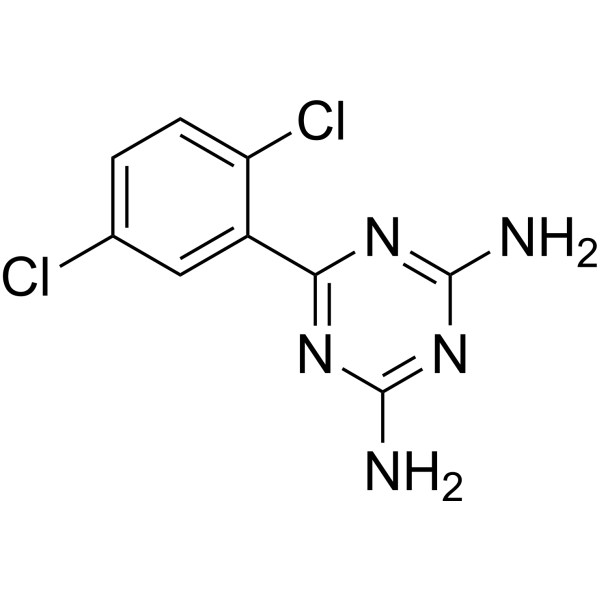
  • HY-B0327
    Irsogladine
    3 Publications Verification

    Dicloguamine

    Phosphodiesterase (PDE) NF-κB AP-1 TRP Channel Interleukin Related Inflammation/Immunology Cancer
    Irsogladine (Dicloguamine) is an orally active gastric mucosal protective agent. Irsogladine inhibits breast cancer recurrence and lung metastasis in nude mice . Irsogladine inhibits the transcriptional activities of NF-κB and AP-1, suppresses the activities of PDE and PDE4 to elevate intracellular cAMP levels, and activates TRPV1 and KATP channels. Irsogladine enhances iNOS expression, NO production, and the activation of cAMP-responsive elements. Irsogladine inhibits the development and progression of intestinal polyps in Apc-mutant mice. Irsogladine alleviates oxidative stress, increases gastric mucosal blood flow, and stimulates the production of endogenous prostaglandins. Irsogladine promotes insulin secretion in MIN6 cells. Irsogladine inhibits tumor angiogenesis, cancer cell proliferation, and the production of proinflammatory cytokines. Irsogladine exerts protective effects on astrocytes in ethanol/hydrochloric acid-induced gastric ulcers in mice. Irsogladine prevents colitis in IL-10 gene-deficient mice by reducing the production of IL-12 and IL-23. Irsogladine upregulates gap junction intercellular communication in pancreatic cancer cells via the PKA pathway. Irsogladine is applicable to research related to breast cancer, intestinal polyposis, gastric ulcer, spontaneous colitis, glioma, liver cancer, and pancreatic cancer [5][6] .
    Irsogladine
  • HY-157693

    Endogenous Metabolite Cancer
    C18:1 Cyclic LPA is a naturally occurring analog of the growth factor-like phospholipid mediator, lysophosphatidic acid (LPA), characterized by the formation of a 5-membered ring between its sn-2 hydroxy group and the sn-3 phosphate. This unique structure allows C18:1 Cyclic LPA to influence a variety of cellular functions, such as inhibiting cell cycle progression, promoting the formation of stress fibers, curtailing tumor cell invasiveness and metastasis, and modulating the differentiation and survival of neuronal cells. Notably, many of these cellular effects elicited by C18:1 Cyclic LPA appear to counter those induced by LPA, despite the activation of seemingly similar receptor populations.
    C18:1 Cyclic LPA
  • HY-12929

    SU093

    Pim Apoptosis Cancer
    NSC756093 (SU093) is a GBP1:PIM1 interaction inhibitor. NSC756093 binds to GBP1-PIM1 with a Kd of 38 nM. NSC756093 suppresses proliferation, reduces migration, induces G1 phase cell-cycle arrest, and increases apoptotic cell death in ovarian cancer cells. NSC756093 reduces cellular proteasomal activity, induces accumulation of ubiquitinated proteins, and restrains tumor progression and lung metastasis in murine ovarian cancer xenograft models. NSC756093 increases sensitivity of prostate cancer cells to Docetaxel (HY-B0011) and sensitizes GBP1-overexpressing ovarian cancer cells to Paclitaxel (HY-B0015). NSC756093 can be used for the research of prostate cancer and ovarian cancer .
    NSC756093
  • HY-176861

    E1/E2/E3 Enzyme Cadherin Cancer
    Hakin-1 is a E3 Ubiquitin-Ligase Hakai inhibitor. Hakin-1 blocks Hakai-mediated global ubiquitination and specific ubiquitination of E-cadherin and inhibits epithelial-mesenchymal transition (EMT) progression. Hakan-1 inhibits tumor progression and cancer metastasis. Hakin-1 can be used for the study of carcinoma such as colorectal cancer .
    Hakin-1
  • HY-P10427

    CXCR Dengue Virus Neurological Disease Inflammation/Immunology Cancer
    DV1 is a CXCR4 inhibitor with anti-proteolytic properties that specifically blocks the binding of SDF-1α to its receptor. DV1 inhibits the migration of breast cancer cells and enables the targeted delivery of avidin-PLGA nanoparticles to CXCR4-expressing cancer cells. DV1 not only effectively suppresses the progression of metastatic breast cancer in mouse models, but also preferentially accumulates in brain tumor tissues rather than normal brain tissues, showing potential for inhibiting intracranial tumor metastasis. As a humoral immune stimulant, DV1 induces the production of specific IgG, neutralizing antibodies and cellular immune responses, thereby providing the host with protection against lethal challenges. DV1 has been applied to studies on CXCR4-expressing cancers, glioblastoma, dengue fever and other related diseases .
    DV1
  • HY-149482
    LN5P45
    1 Publications Verification

    Cathepsin Cancer
    LN5P45 is an OTUB2 inhibitor (IC50: 2.3 μM). LN5P45 induces monoubiquitination of OTUB2 on lysine 31. LN5P45 can be used for research of tumor progression and metastasis .
    LN5P45
  • HY-P10427A

    CXCR Dengue Virus Infection
    DV1 TFA is a CXCR4 inhibitor with anti-proteolytic properties that specifically blocks the binding of SDF-1α to its receptor. DV1 TFA inhibits the migration of breast cancer cells and enables the targeted delivery of avidin-PLGA nanoparticles to CXCR4-expressing cancer cells. DV1 TFA not only effectively suppresses the progression of metastatic breast cancer in mouse models, but also preferentially accumulates in brain tumor tissues rather than normal brain tissues, showing potential for inhibiting intracranial tumor metastasis. As a humoral immune stimulant, DV1 TFA induces the production of specific IgG, neutralizing antibodies and cellular immune responses, thereby providing the host with protection against lethal challenges. DV1 TFA has been applied to studies on CXCR4-expressing cancers, glioblastoma, dengue fever and other related diseases .
    DV1 TFA
  • HY-P991647

    CXCR Cancer
    ALX-0651 is a biparatopic humanized monoclonal antibody inhibitor targeting CXCR4. ALX-0651 inhibits hematopoietic stem cell trafficking, tumor progression and metastasis. ALX-0651 can be used for non-Hodgkin’s lymphoma and multiple myeloma research .
    ALX-0651
  • HY-P11052

    HSP Cancer
    A8 peptide is a Hsp72 antagonist. A8 peptide inhibits tumor progression and metastasis as well as enhances the cancer cells' sensitivity to apoptosis induced by chemotherapeutic agents (such as Cisplatin (HY-17394)) by blocking the Hsp72-TLR2 interaction and the subsequent activation of MDSCs. A8 peptide can be used for cancers research .
    A8 peptide

Inquiry Online

Your information is safe with us. * Required Fields.

Salutation


Country or Region *

Applicant Name *


Organization Name *

Department *


Email Address *


Product Name *

Cat. No.


Requested quantity *

Phone Number *


Remarks

Inquiry Online

Inquiry Information

Product Name:
Cat. No.:
Quantity:
MCE Japan Authorized Agent:

