8 Results for "

Type I photosensitizer

" in MedChemExpress (MCE) Product Catalog:
Products (8)

8 Results for "Type I photosensitizer" in MCE Product Catalog:

Cat. No.: HY-170883
Target:  

Photosensitizer

Research Areas:  

Cancer

Type-I/-II Photosensitizer-1 (compound 8b) is a photosensitizer with anticancer activity. Type-I/-II Photosensitizer-1 exhibits significant phototoxicity against both A549 and 4T1 tumor cells. Type-I/-II Photosensitizer-1 shows a strong oxygen-independent antitumor effect under laser irradiation (IC50=1.50-1.76 μM) .
loading...
    loading...
Cat. No.: HY-162824
CAS No.: 2938922-20-2
Target:  

Apoptosis

Research Areas:  

Cancer

Antitumor photosensitizer-6 (Compound Ru2) shows synergetic type I/II photosensitization and photocatalytic activity upon 595 nm light excitation. Ru2 induces intracellular redox imbalance and affects the biosynthetic and metabolic processes, leading to cell apoptosis. Antitumor photosensitizer-6 can be used for research of photodynamic therapy (PDT) .
loading...
    loading...
Cat. No.: HY-155003
Target:  

Fluorescent Dye

Research Areas:  

Cancer

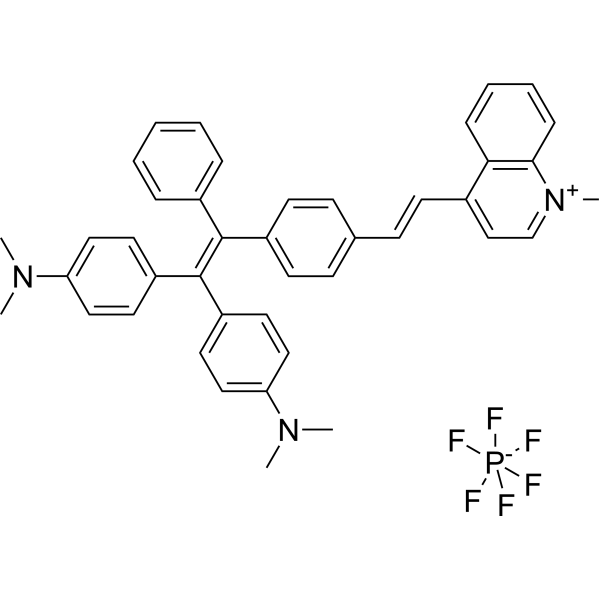
TPEQM-DMA is a NIR-II photosensitizer. TPEQM-DMA accumulates in cancerous mitochondria, and inhibits cancer cell growth. TPEQM-DMA has potent type-I phototherapeutic efficacy to overcome the intrinsic pitfalls of PDT in combating hypoxic tumors .
loading...
    loading...
Cat. No.: HY-168854
CAS No.: 2522115-48-4
Research Areas:  

Cancer

TBC-1 is a chlorophyll-a derivative, is a photosensitizer that can be used in photodynamic therapy (PDT). TBC-1 efficiently generats Type-I ROS and endoplasmic reticulum targeting ability. TBC-1 shows biocompatibility and PDT efficiency in vitro under both normoxia and hypoxia .
loading...
    loading...
Cat. No.: HY-145538
CAS No.: 146877-98-7
Synonyms: 5'-Deoxyguanylic acid disodium hydrate
Target:  

DNA/RNA Synthesis

Research Areas:  

Others

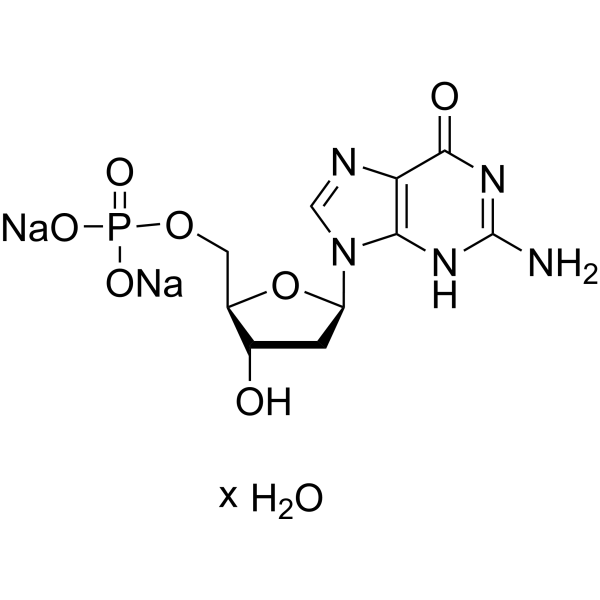
2'-Deoxyguanosine 5'-monophosphate (5'-Deoxyguanylic acid; dGMP) disodium hydrate is an oxidizable target of the photosensitizer pterin (PT) and can be used to evaluate the photosensitizing properties of biopterins (such as Bip, Fop and Cap) . Pterin causes a photosensitive reaction of dGMP under UV-A radiation, causing damage to DNA molecules. There are two main mechanisms for the photosensitive oxidation of purine nucleotides by pterin in vitro: one is the hydrogen abstraction reaction of electron transfer from dGMP to the triplet excited state of pterin (type I mechanism), and the other is the interaction between dGMP and pterin. The reaction produces singlet molecular oxygen (1O2) (Type II mechanism) .
loading...
    loading...
Cat. No.: HY-183570
CAS No.: 2813319-14-9
Research Areas:  

Cancer

Antitumor photosensitizer-11 is a type-I carbazole/benzindolium photosensitizer with antitumor activity. Antitumor photosensitizer-11 induces ROS generation via a type-I pathway, forming superoxide anions and hydroxyl radicals. Antitumor photosensitizer-11 triggers immunogenic cell death in cancer cells via enhanced oxidative stress. Antitumor photosensitizer-11 exhibits antiproliferative activity in normoxic and hypoxic environments, inhibits breast cancer tumor growth in vivo, and promotes dendritic cell maturation and T cell infiltration. Antitumor photosensitizer-11 can be used for the research of cancer, such as breast cancer .
loading...
    loading...
Cat. No.: HY-175163
Target:  

Photosensitizer

Research Areas:  

Cancer

TPAPyN is a nitroreductase(NTR)-responsive type I photosensitizer. TPAPyN facilitates the imaging of hypoxic cancer cells and image-guided photodynamic therapy (PDT). TPAPyN does not emit fluorescence in the aqueous environment, but restores when NTR cleaves the nitrofuran quencher with aggregation-induced emission. TPAPyN can be used as a fluorescent probe for specific imaging of hypoxic cancer .
loading...
    loading...
Cat. No.: HY-181906
Research Areas:  

Cancer

ZnPc-PEG2-VH032 is a VHL-pathway-dependent photodegradation targeting chimera (PDTAC) and cytotoxic agent. ZnPc-PEG2-VH032 (HY-120217) binds to the VHL ligand domain, and then specifically degrades VHL under light irradiation, a process independent of non-specific ROS-mediated protein damage. ZnPc-PEG2-VH032 uses Zinc phthalocyanine (HY-19204) as a photosensitizer, and generates ROS via type I and type II photodynamic pathways under 680 nm LED irradiation. On one hand, it targets and degrades the bound VHL protein through ROS; on the other hand, it exerts direct photodynamic cytotoxicity. Meanwhile, the degradation of VHL downregulates the phosphorylation level of CDK2/4, induces cell cycle arrest in tumor cells, further enhances the sensitivity of tumor cells to oxidative damage caused by ROS, and achieves a synergistic anti-tumor effect. ZnPc-PEG2-VH032 exerts significant in vivo efficacy in an orthotopic mouse model of non-muscle invasive bladder cancer (NMIBC) .
loading...
    loading...

