
11 Results for "

algae cells

" in MedChemExpress (MCE) Product Catalog:
Products (11)

11 Results for "algae cells" in MCE Product Catalog:

1
1 Cited Publications
Cat. No.: HY-Y1667
CAS No.: 608-33-3
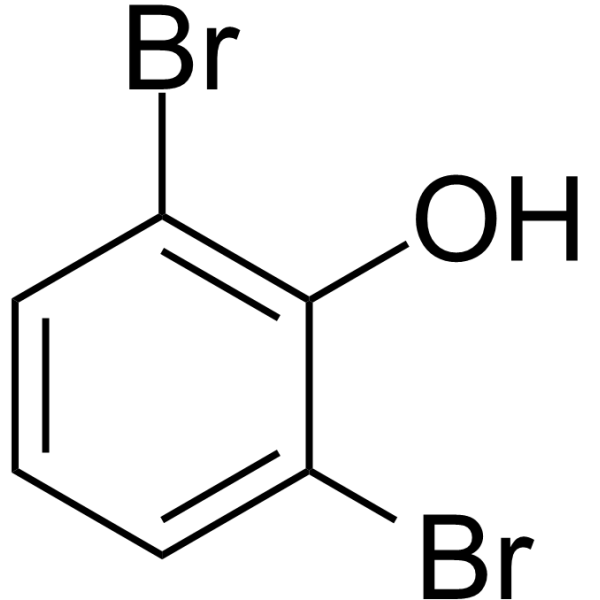
2,6-Dibromophenol (2,6-DBP) is a weak inhibitor targeting voltage-gated Ca 2+ channels. 2,6-Dibromophenol has no significant effect on potassium-induced calcium elevation in PC12 cells. 2,6-Dibromophenol shows a 48 h EC50 of 2.78 mg/L for Daphnia magna and a 96 h EC50 of 9.90 mg/L for algae (Scenedesmus quadricauda) .
loading...
    loading...
Cat. No.: HY-W134423
CAS No.: 9002-18-0
Agar, microbiology tested, for cell culture (powder) is a jelly like substance that contains agarose and agar gel. Agar, microbiology tested, for cell culture (powder) can be isolated from the cell walls of red algae species such as Gelidium and Gracilaria (Ogonori). The gelation and melting of Agar, microbiology tested, for cell culture (powder) is based on the hydrogen bridge (physical gels), so the gelation is reversible. Agar, microbiology tested, for cell culture (powder) is widely used in food additives, plant tissue culture, microorganisms culture media, fingerprint recognition, and medical fields .
loading...
    loading...
Cat. No.: HY-133685
CAS No.: 147852-83-3
Purity:  98.82%
Synonyms: C6-HSL
Target:  

Bacterial

Research Areas:  

Infection Metabolic Disease

N-Hexanoyl-L-homoserine lactone is a short-chained N-acyl homoserine lactone (AHL). N-hexanoyl-L-homoserine lactone is also a mediator of bacterial quorum-sensing regulation. N-hexanoyl-L-homoserine lactone promotes lipid accumulation in algae. AHL is an intercellular communication signal molecule in the quorum sensing system of Gram-negative bacteria and a medium for mediating information exchange between eukaryotic plants and prokaryotic bacteria. AHL can affect bacteria activities, such as biofilm formation, pigment synthesis, and antibiotic synthesis .
loading...
    loading...
Cat. No.: HY-W011916
CAS No.: 1114-41-6
Synonyms: 3-O-Carboxyethyl-D-glucosamine
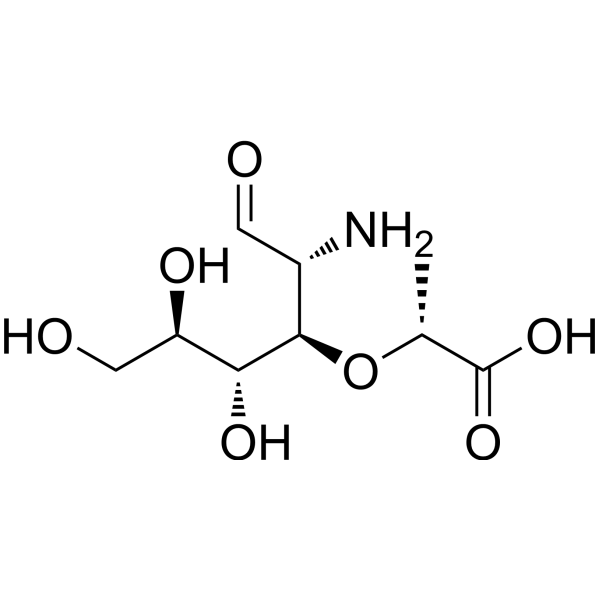
Muramic acid (3-O-Carboxyethyl-D-glucosamine) is a component found only in the cell walls of bacteria and blue-green algae. Muramic acid can be used to measure the biomass of microorganisms in environments such as estuaries, oceans, and soils .
loading...
    loading...
Cat. No.: HY-W423502
CAS No.: 68489-14-5
Synonyms: Menthane carboxamidoethyl acetate
Research Areas:  

Others

WS5 (Menthane carboxamidoethyl acetate) is a cooling agent fragrance ingredient .
loading...
    loading...
Cat. No.: HY-N15688
CAS No.: 31063-73-7
Diatoxanthin is a cytochrome and phycoxanthin byproduct that can be extracted from the algae F. pinnata cells. Diatoxanthin can be used as a biomarker to evaluate the inhibitory effects of biocides on diatom photosystem II (PSII) .
loading...
    loading...
Cat. No.: HY-N15600
CAS No.: 68053-32-7
Synonyms: (-)-Merulidial
Merulidial (Compound 1) is an antibiotic and cytotoxic agent with a sesquiterpene dialdehyde structure. Merulidial significantly inhibits the germination of spores and the hyphal growth of the wood-roting basidiomycete Heterobasidion annosum (H. annosum) and the saprophytic mould Cladosporium cucumerinum (C.cucumerinum). Merulidial also inhibits a variety of bacteria, algae and DNA synthesis of ECA cells. Merulidial shows a strong anticancer activity with IC50 s of 20 and 10 μg/mL for ECA and L1210 cells, respectively .
loading...
    loading...
Cat. No.: HY-Y1667R
CAS No.: 608-33-3
2,6-Dibromophenol (2,6-DBP) is a weak inhibitor targeting voltage-gated Ca2+ channels. 2,6-Dibromophenol has no significant effect on potassium-induced calcium elevation in PC12 cells. 2,6-Dibromophenol shows a 48 h EC50 of 2.78 mg/L for Daphnia magna and a 96 h EC50 of 9.90 mg/L for algae (Scenedesmus quadricauda) .
loading...
    loading...
Cat. No.: HY-N14303
CAS No.: 202863-86-3
16-Methyloxazolomycin is an antibiotic. 16-Methyloxazolomycin has the effect of resisting bacteria and algae. 16-Methyloxazolomycin against leukemia P388 and human lung adenocarcinoma cells .
loading...
    loading...
Cat. No.: HY-17525
CAS No.: 163269-30-5
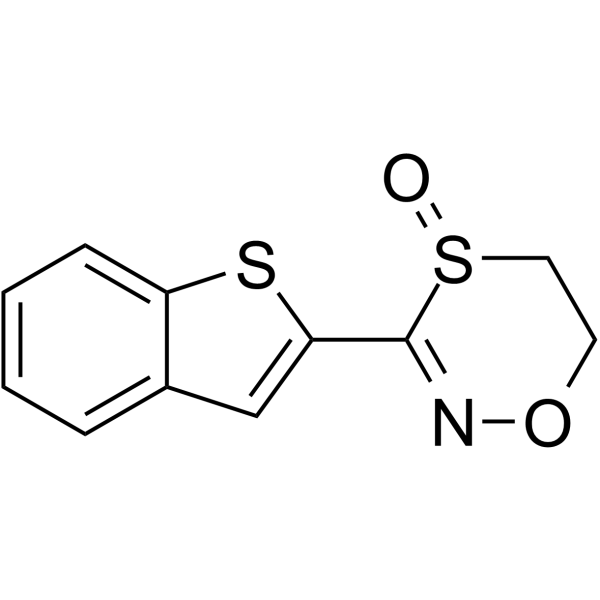
Bethoxazin is a yeast DNA topoisomerase II inhibitor with an IC50 of 5.3 μM, and also a broad-spectrum industrial microbicide and covalent adduct-forming agent. Bethoxazin inhibits the catalytic activity of yeast DNA topoisomerase II by reacting with the key free cysteine thiol group on the enzyme. Bethoxazin forms covalent adducts with molecules containing free thiol groups. Bethoxazin inhibits the growth of yeast cells. Bethoxazin can be used in studies related to the growth of fungi, molds and algae .
loading...
    loading...
Cat. No.: HY-184345
CAS No.: 332858-46-5
Target:  

Parasite

Research Areas:  

Infection Cancer

(+)-Cyclozonarone is a benzoquinone derivative found in brown algae Dictyopteris undulata, with activity against T. cruzi epimastigotes, Tulahuen strains. (+)-Cyclozonarone inhibits growth of cancer and endothelial cells, and exhibits anti-leishmanial activity. (+)-Cyclozonarone can be used for the research of lung carcinoma, colon carcinoma, prostate carcinoma .
loading...
    loading...
  • 1

