
1. Search Result
Search Result
Results for "

and respiratory system diseases

" in MedChemExpress (MCE) Product Catalog:

13

Inhibitors & Agonists

1

Biochemical Assay Reagents

1

Peptides

1

Inhibitory Antibodies

2

Natural
Products

Targets Recommended:
Cat. No. Product Name Target Research Areas Chemical Structure
  • HY-NP004

    CVF

    Complement System Inflammation/Immunology
    Cobra Venom Factor (CVF) is a selective activator targeting complement components C3, C5, and factor B in the complement system. After binding to factor B, Cobra Venom Factor is cleaved by factor D, forming a stable C3/C5 convertase resistant to regulatory proteins H and I. This continuously hydrolyzes C3 and C5, depleting serum complement while inducing neutrophil migration, vascular leakage, and increased TNF-α levels. Cobra Venom Factor can be used to deplete complement and mimic complement activation-related pathological states, and is applied in animal models of complement-mediated diseases such as acute respiratory distress syndrome (ARDS), sepsis, and shock. Cobra Venom Factor can be isolated from the venom of cobras (e.g., Naja atra, Naja melanoleuca, Naja kaouthia, etc.) .
    Cobra Venom Factor
  • HY-P991504

    Anaplastic lymphoma kinase (ALK) TGF-β Receptor TGF-beta/Smad Metabolic Disease Cancer
    LAE-102 is the selective anti-ActRIIA (activin receptor type IIA or ACVR2) monoclonal antibody. LAE-102 increases muscle mass and reduces fat mass. LAE102 can increase serum activin A levels in vivo. LAE-102 is promising for research of obesity .
    LAE-102
  • HY-176949

    STAT Inflammation/Immunology
    STAT6-IN-10 is a STAT6 (signal transducer and activator of transcription 6) inhibitor with an EC50 of 2 nM. STAT6-IN-10 can inhibit the secretion of CCL17 in human peripheral whole blood. STAT6-IN-10 can be used in the research of dermatological and respiratory system diseases .
    STAT6-IN-10
  • HY-B1032

    (±)-Dropropizine; UCB-196

    Histamine Receptor Neurological Disease
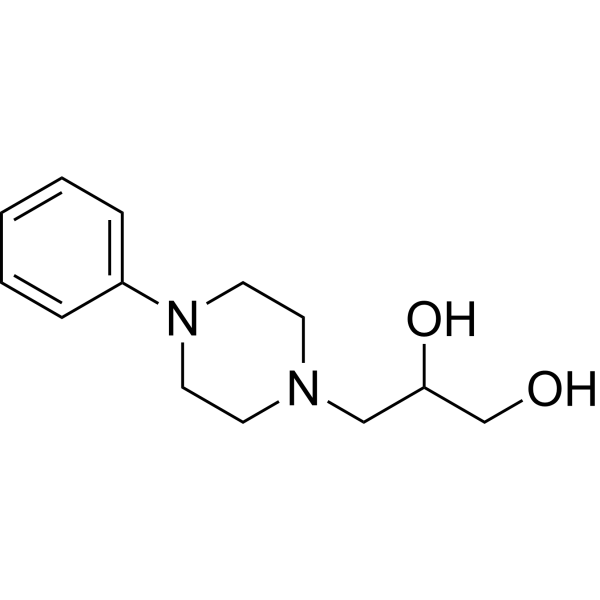
    Dropropizine ((±)-Dropropizine; UCB-196) is an orally effective, peripherally selective antitussive that inhibits the activity of peripheral receptors and afferent nerves in the respiratory tract. Dropropizine acts on the cough reflex pathway, does not pass the blood-brain barrier, and has no central nervous system side effects. Dropropizine mainly regulates the level of sensory neuropeptides and inhibits the afferent signal transmission of the cough reflex, thereby alleviating the symptoms of dry cough, and has both mild local anesthetic and antihistamine activity. Dropropizine is mainly used for symptomatic research on dry cough caused by respiratory diseases .
    Dropropizine
  • HY-U00382

    Neurokinin Receptor Neurological Disease Inflammation/Immunology
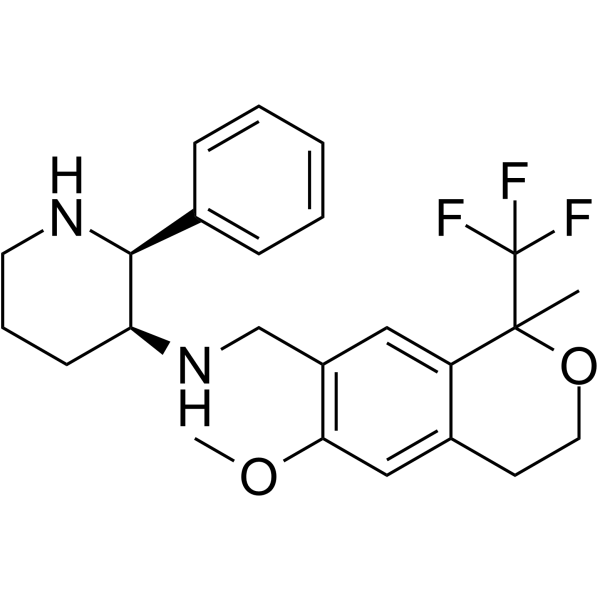
    Substance P Receptor Antagonist 1 has the potential function in central nervous system disorders, respiratory, inflammatory diseases and gastrointestinal disorders.
    Substance P Receptor Antagonist 1
  • HY-P10093

    PI3K Others
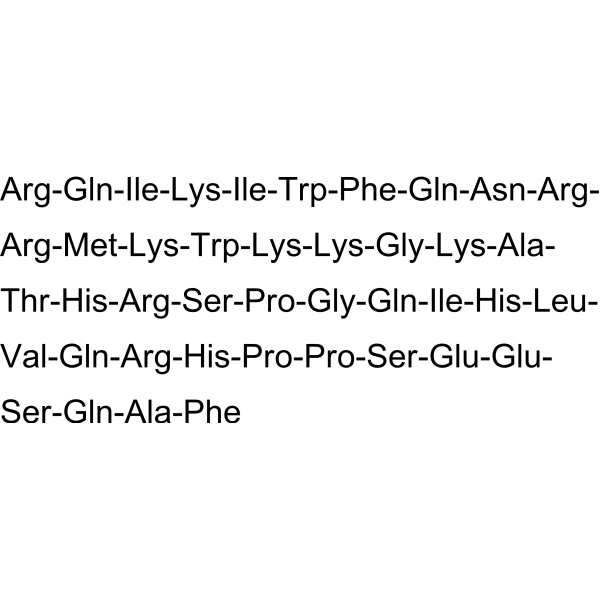
    Penetratin-PI3Kγ(126-150) is a peptide inhibitor of ΡI3Κγ that plays an important role in respiratory system diseases .
    Penetratin-PI3Kγ(126-150)
  • HY-N1474R

    Reference Standards Cholinesterase (ChE) Interleukin Related PGE synthase NF-κB COX Inflammation/Immunology
    Picfeltarraenin IA (Standard) is the analytical standard of Picfeltarraenin IA (HY-N1474). This product is intended for research and analytical applications. Picfeltarraenin IA is an Acetylcholinesterase inhibitor. Picfeltarraenin IA can be extracted from the plant Picria fel-terrae Lour. Picfeltarraenin IA reduces the production of IL-8 and PGE2. Picfeltarraenin IA inhibits COX2 via the NF-κB pathway. Picfeltarraenin IA can be used in the research of respiratory system diseases .
    Picfeltarraenin IA (Standard)
  • HY-163982

    NF-κB FOXO Inflammation/Immunology
    FOXJ1 agonist 1 (compound 16c) is an orally effective small molecule that can effectively enhance the expression of FOXJ1. Foxj1-IN-1 acts on the mammalian airway system composed of multiciliated cells (MCC) to prevent the development and onset of chronic obstructive pulmonary disease (COPD). Foxj1-IN-1 can induce the production of motile cilia in the respiratory system of zebrafish and mammals, and inhibit elastase-induced COPD mouse models. Foxj1-IN-1 has good liver microsomal stability, in vivo PK curve and AUC; it has no significant inhibition of CYP and hERG, and does not have significant cytotoxicity .
    FOXJ1 agonist 1
  • HY-W683409

    1064 Th

    Adrenergic Receptor Cardiovascular Disease Neurological Disease
    Dimorpholamine (1064 Th) is a central nervous system stimulant. Dimorpholamine can increase the excitatory and inhibitory junction potentials at the neuromuscular junctions of crayfish. Dimorpholamine can also exert epinephrine-like pressor effects by promoting the release of catecholamines (mainly epinephrine) from the adrenal medulla. Dimorpholamine can be used in the research of respiratory failure as well as neurological and cardiovascular system diseases .
    Dimorpholamine
  • HY-19080

    Lipoxygenase Inflammation/Immunology
    SC-45662 is a 5-lipoxygenase inhibitor. SC-45662 inhibits the response of monocytes to phytohemagglutinin (PHA). SC-45662 inhibits superoxide production in neutrophils. SC-45662 slows early changes in lung mechanics and pulmonary hypertension in a sheep model of impaired lung function. SC-45662 can be used in research on diseases of the immune system, respiratory system, etc .
    SC-45662
  • HY-125995

    Keap1-Nrf2 Quinone Reductase Inflammation/Immunology
    NFE2L2 activator 3 (Compound 3) is a NFE2L2/NRF2 activator. NFE2L2 activator 3 specifically activates the NAD(P)H:quinone oxidoreductase (NQO1) enzyme, with its EC50 < 1 nM. NFE2L2 activator 3 can be used for research on respiratory system diseases such as chronic obstructive pulmonary disease .
    NFE2L2 activator 3
  • HY-N15754

    Drug Metabolite Metabolic Disease Inflammation/Immunology Endocrinology Cancer
    3-Hydroxy-2-methylglutaric acid is a carboxylic acid metabolite. 3-Hydroxy-2-methylglutaric acid can be isolated from the flower Veronica incana L. 3-Hydroxy-2-methylglutaric acid can be used for upper respiratory tract diseases, malignant neoplasms, gastrointestinal tract and genitourinary system disorders and diabetes mellitus research .
    3-Hydroxy-2-methylglutaric acid
  • HY-14296A

    Adrenergic Receptor Inflammation/Immunology
    PF-610355 hydrochloride is a β2-adrenergic receptor (β2-AR) full agonist with selectivity for β1-adrenergic receptors. PF-610355 hydrochloride increases intracellular cAMP levels, induces sustained tracheal smooth muscle relaxation, and inhibits acetylcholine-induced bronchoconstriction. PF-610355 hydrochloride can be used in research related to chronic obstructive pulmonary disease, asthma, and respiratory system diseases .
    PF-610355 (hydrochloride)

Inquiry Online

Your information is safe with us. * Required Fields.

Salutation


Country or Region *

Applicant Name *


Organization Name *

Department *


Email Address *


Product Name *

Cat. No.


Requested quantity *

Phone Number *


Remarks

Inquiry Online

Inquiry Information

Product Name:
Cat. No.:
Quantity:
MCE Japan Authorized Agent:

