



1. Search Result
Search Result
Results for "

atopic dermatitis (AD)

" in MedChemExpress (MCE) Product Catalog:

17

Inhibitors & Agonists

1

Peptides

6

Inhibitory Antibodies

2

Isotope-Labeled Compounds

Cat. No. Product Name Target Research Areas Chemical Structure
  • HY-P99955

    AMG 451; KHK4083

    Orexin Receptor (OX Receptor) Infection Inflammation/Immunology
    Rocatinlimab (AMG 451) (KHK4083) is a fully human immunoglobulin G1 (IgG1) anti-OX40 monoclonal antibody. Rocatinlimab can be used for the research of atopic dermatitis (AD) .
    Rocatinlimab
  • HY-P99162

    CIM331; CD14152

    Interleukin Related Inflammation/Immunology
    Nemolizumab (CIM331) is a humanized monoclonal antibody that targets the human interleukin-31 receptor a, preventing interleukin-31 (IL-31) from binding to its receptor and the subsequent signaling. Nemolizumab can help reduce itching and sleep disturbances, and it is being studied for atopic dermatitis (AD) .
    Nemolizumab
  • HY-P99301

    Anti-Canine IL31 Recombinant Antibody; CAN34D3-65; PF-06443537

    Interleukin Related Inflammation/Immunology
    Lokivetmab (Anti-Canine IL31 Recombinant Antibody) is an anti-canine IL-31 monoclonal antibody. Lokivetmab inhibits IL-31-mediated activation of pruritogenic signals in peripheral sensory neurons and reduces TH2-weighted inflammation. Lokivetmab demonstrates long-term efficacy in controlling pruritus and improving skin lesions in dogs with canine atopic dermatitis (CAD). Lokivetmab can be used for the research of atopic dermatitis (AD) in dogs .
    Lokivetmab
  • HY-P99673
    Itepekimab
    1 Publications Verification

    REGN-3500; SAR-440340

    Interleukin Related NF-κB Inflammation/Immunology
    Itepekimab (REGN-3500) is an IgG4 monoclonal antibody against IL-33. Itepekimab reduced airway inflammation and related tissue damage in preliminary clinical studies. Itepekimab has potential effects in asthma, chronic obstructive pulmonary disease (COPD), and atopic dermatitis (AD) .
    Itepekimab
  • HY-109085
    Difamilast
    3 Publications Verification

    OPA-15406

    Phosphodiesterase (PDE) Neurological Disease Inflammation/Immunology Cancer
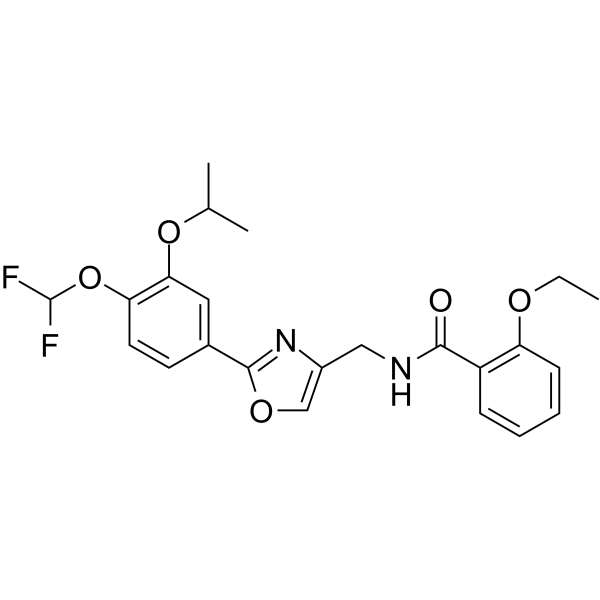
    Difamilast (OPA-15406) is a topical, selective and nonsteroidal phosphodiesterase-4 (PDE4) inhibitor with particularly efficient inhibition of subtype B (IC50=11.2 nM). Difamilast can be used for the research of mild to moderate atopic dermatitis (AD) .
    Difamilast
  • HY-111167

    Phosphodiesterase (PDE) Interleukin Related TNF Receptor IFNAR Inflammation/Immunology
    AN-2898 is a selective PDE4 inhibitor with IC50 of 0.027 μM over other phosphodiesterase enzymes, such as PDE1A, PDE2A and PDE3A. AN-2898 also potently inhibits PDE4 subtypes (PDE4B1, PDE4A1A and PDE4D2). AN-2898 significantly inhibits the production of TNF-α, IL-2, IFN-γ, IL-5 and IL-10. AN-2898 can be used for mild to moderate atopic dermatitis (AD) and psoriasis research .
    AN-2898
  • HY-175022

    PROTACs IRAK Toll-like Receptor (TLR) Interleukin Related Inflammation/Immunology
    PROTAC IRAK4 degrader-13 (Degrader 1) is a selective IRAK4 PROTAC degrader with DC50s of 0.86 and 1.1 nM for monocytes and lymphocytes in PBMCs, respectively. PROTAC IRAK4 degrader-13 significantly induces TIR signal activation, and inhibits the expression of circulating proinflammatory cytokines in Imiquimod (HY-B0180) induced psoriasis mice model. PROTAC IRAK4 degrader-13 can be used for TLR- and IL-1R-driven driven neutrophilic inflammation diseases like hidradenitis suppurativa (HS) and atopic dermatitis (AD) research . Pink: IRAK4 ligand; Blue: E3 ligase ligand; Black: linker
    PROTAC IRAK4 degrader-13
  • HY-P991729

    APG-777

    Interleukin Related Inflammation/Immunology
    Zumilokibart (APG-777) is an anti-IL-13 IgG1κ type humanized antibody. The recommed isotype control is Human IgG1 kappa, Isotype Control (HY-P99001). Zumilokibart can be used for the research of atopic dermatitis (AD) .
    Zumilokibart
  • HY-131707

    Phosphodiesterase (PDE) Inflammation/Immunology
    LEO 39652 is a dual-soft PDE4 inhibitor with IC50s of 1.2 nM, 1.2 nM, 3.0 nM and 3.8 nM for PDE4A, PDE4B, PDE4C and PDE4D, respectively. LEO 39652 also inhibits TNF-α with an IC50 value of 6.0 nM. LEO 39652 is used for topical research of Atopic dermatitis (AD) .
    LEO 39652
  • HY-109085R

    OPA-15406 (Standard)

    Reference Standards Phosphodiesterase (PDE) Inflammation/Immunology
    Difamilast (Standard) is the analytical standard of Difamilast. This product is intended for research and analytical applications. Difamilast (OPA-15406) is a topical, selective and nonsteroidal phosphodiesterase-4 (PDE4) inhibitor with particularly efficient inhibition of subtype B (IC50=11.2 nM). Difamilast can be used for the research of mild to moderate atopic dermatitis (AD) .
    Difamilast (Standard)
  • HY-P991515

    Interleukin Related Inflammation/Immunology
    TQH-2722 is a humanized IgG4 anti-IL-4Rα monoclonal antibody. TQH-2722 targets the IL-4Rα receptor in humans, effectively disrupting the interaction between IL-4Rα and the downstream cytokines IL-4 and IL-13, thereby inhibiting inflammatory response. TQH-2722 can be used for the study of atopic dermatitis (AD) and chronic rhinosinusitis with nasal polyps (CRSwNP) .
    TQH-2722
  • HY-B0426AS

    Isotope-Labeled Compounds Histamine Receptor CXCR Inflammation/Immunology Endocrinology
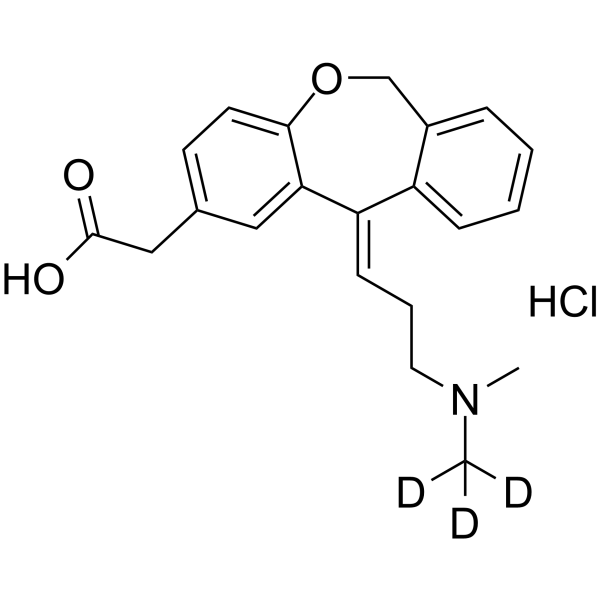
    Olopatadine-d3 hydrochloride (ALO4943A-d3) is the deuterium labeled Olopatadine hydrochloride. Olopatadine hydrochloride (ALO4943A; KW4679) is an orally active histamine H1 receptor antagonist and mast cell stabilizer. Olopatadine hydrochloride exerts antiallergic effects by blocking histamine H1 receptor-mediated activities. Olopatadine hydrochloride inhibits exocytosis, chemokine release, F-actin polymerization, CXCL10-induced calcium influx, and T cell chemotactic activity. Olopatadine hydrochloride also reduces the expression levels of CXCR3 on the surface of CD4 + and CD8 + T cells. Olopatadine hydrochloride inhibits scratching behavior, improves dermatitis scores, and suppresses intraepidermal neurite outgrowth. Olopatadine hydrochloride simultaneously decreases the levels of inflammatory markers, growth factors, histamine, and specific IgE, while increasing the expression of ErbB3A/HER3A. Olopatadine hydrochloride can be used in research related to seasonal pollinosis, chronic rhinitis, urticaria, allergic conjunctivitis, alopecia areata, and atopic dermatitis .
    Olopatadine-d3 hydrochloride
  • HY-W716321

    Drug Metabolite Inflammation/Immunology
    AN7602 is a metabolite of the anti-inflammatory agent/PDE4 inhibitor Crisaborole (HY-10978) and can be used for the study of mild to moderate atopic dermatitis (AD) .
    AN7602
  • HY-P10796

    MAPKAPK2 (MK2) Inflammation/Immunology
    YARA peptide, a cell-penetrating peptide, is a MK2 inhibitor. YARA-loaded nanoparticles decreases the levels of inflammatory cytokines (IL-1β, IL-6, and TNF-α) in an ex vivo skin culture model. YARA peptide is promising for research of atopic dermatitis (AD) .
    YARA peptide
  • HY-170977

    JAK STAT Inflammation/Immunology
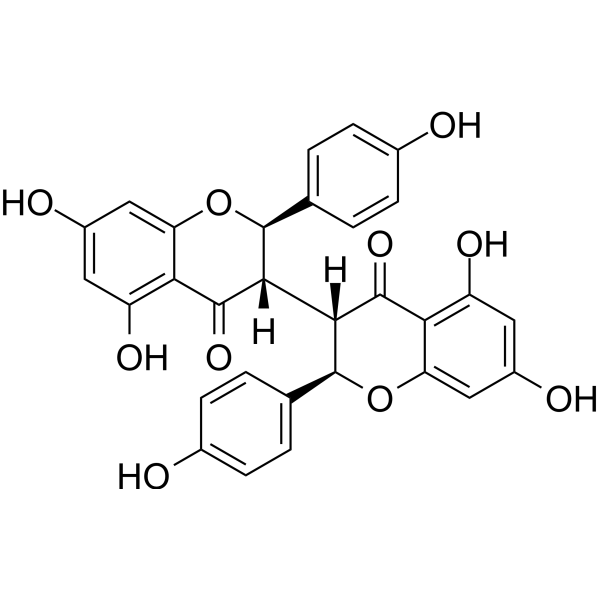
    JAK1/STAT3-IN-1 (compound 4f) is an anti-AD (atopic dermatitis) agent by inhibiting JAK1/STAT3 signaling pathway. JAK1/STAT3-IN-1 inhibits NO generation with an IC50 of 2.17 μM. JAK1/STAT3-IN-1 improves the skin condition of AD-like mice, reduces inflammatory infiltration, inhibits the expressions of p-JAK1/JAK1 and p-STAT3/STAT3, and mitigates the excessive immune response on Calcipotriol (HY-10001) (MC903)-induced AD-like mice .
    JAK1/STAT3-IN-1
  • HY-B0426AS2

    ALO4943A-d6 hydrochloride; KW4679-d6 hydrochloride

    Isotope-Labeled Compounds Histamine Receptor CXCR Inflammation/Immunology
    Olopatadine-d6 (ALO4943A-d6; KW4679-d6) hydrochloride is deuterium-labeled Olopatadine (hydrochloride) (HY-B0426A). Olopatadine hydrochloride (ALO4943A; KW4679) is an orally active histamine H1 receptor antagonist and mast cell stabilizer. Olopatadine hydrochloride exerts antiallergic effects by blocking histamine H1 receptor-mediated activities. Olopatadine hydrochloride inhibits exocytosis, chemokine release, F-actin polymerization, CXCL10-induced calcium influx, and T cell chemotactic activity. Olopatadine hydrochloride also reduces the expression levels of CXCR3 on the surface of CD4 + and CD8 + T cells. Olopatadine hydrochloride inhibits scratching behavior, improves dermatitis scores, and suppresses intraepidermal neurite outgrowth. Olopatadine hydrochloride simultaneously decreases the levels of inflammatory markers, growth factors, histamine, and specific IgE, while increasing the expression of ErbB3A/HER3A. Olopatadine hydrochloride can be used in research related to seasonal pollinosis, chronic rhinitis, urticaria, allergic conjunctivitis, alopecia areata, and atopic dermatitis .
    Olopatadine-d6 hydrochloride
  • HY-181576

    ROCK Inflammation/Immunology
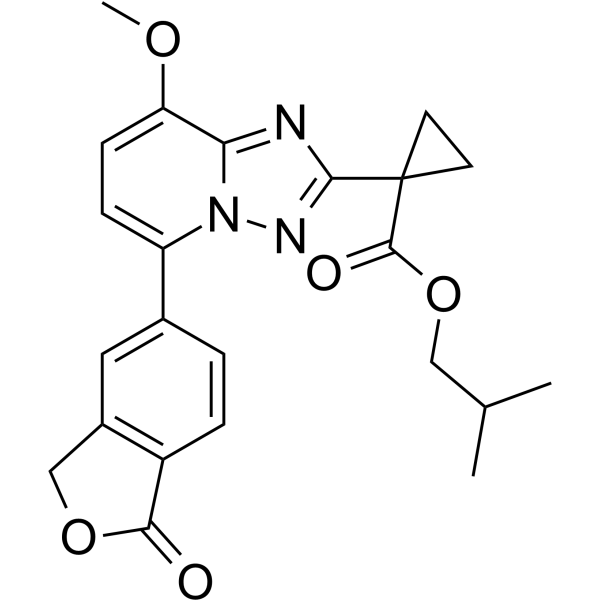
    ROCK2-IN-14 is an orally active, selective ROCK2 inhibitor (IC50=4.8 nM) with 212-fold selectivity over ROCK1 (IC50=1.01 μM). By inhibiting the ROCK2/S100A9 signaling pathway, ROCK2-IN-14 downregulates S100A9 expression, inhibits NM2 phosphorylation and restores cytoskeletal abnormalities. Furthermore, ROCK2-IN-14 reduces inflammatory cytokine levels, alleviates skin inflammation and exerts anti-inflammatory activity. ROCK2-IN-14 also significantly inhibits ear thickening in a mouse model of atopic dermatitis (AD), and decreases the levels of IgE, TNF-α, IL-6 and TSLP. ROCK2-IN-14 can be used for research on atopic dermatitis .
    ROCK2-IN-14

Inquiry Online

Your information is safe with us. * Required Fields.

Salutation


Country or Region *

Applicant Name *


Organization Name *

Department *


Email Address *


Product Name *

Cat. No.


Requested quantity *

Phone Number *


Remarks

Inquiry Online

Inquiry Information

Product Name:
Cat. No.:
Quantity:
MCE Japan Authorized Agent:

