

1. Search Result
Search Result
Results for "

biotin ligand

" in MedChemExpress (MCE) Product Catalog:

19

Inhibitors & Agonists

6

Fluorescent Dyes

5

Biochemical Assay Reagents

1

Peptides

2

Oligonucleotides

Cat. No. Product Name Target Research Areas Chemical Structure
  • HY-D1056F

    biotin-LPS, from Escherichia coli (O111:B4)

    Biochemical Assay Reagents Inflammation/Immunology
    Biotin-Lipopolysaccharide, from E.coli O111:B4 (Biotin-LPS, from Escherichia coli (O111:B4)) is a biotin-conjugated Lipopolysaccharide (LPS) (HY-D1056A1) that can be coupled with streptavidin protein. Biotin-Lipopolysaccharide, from E.coli O111:B4 can be used to identify Lipopolysaccharide ligands. Lipopolysaccharides, from E. coli O111:B4 (LPS, from Escherichia coli (O111:B4)) are endotoxins and TLR4 activators extracted from Escherichia coli (E. coli O111:B4) and are classified as S (smooth) type LPS. Lipopolysaccharides, from E. coli O111:B4 possess the typical three-part structure: O-antigen, R3-type core oligosaccharide, and lipid A. Lipopolysaccharides, from E. coli O111:B4 activate TLR-4 in immune cells and can cause significant gastric diseases. Lipopolysaccharides, from E. coli O111:B4 can also induce M1-type polarization in mouse macrophages .
    It is recommended to prepare a solution with concentration ≥2 mg/mL. Vortex thoroughly for more than 10 minutes. Due to the adsorption characteristics of LPS, silanized container or low adsorption centrifuge tubes should be used for aliquoting and storage, and mix thoroughly before use.
    Biotin-Lipopolysaccharide, from E.coli O111:B4
  • HY-147102

    LYTACs Metabolic Disease
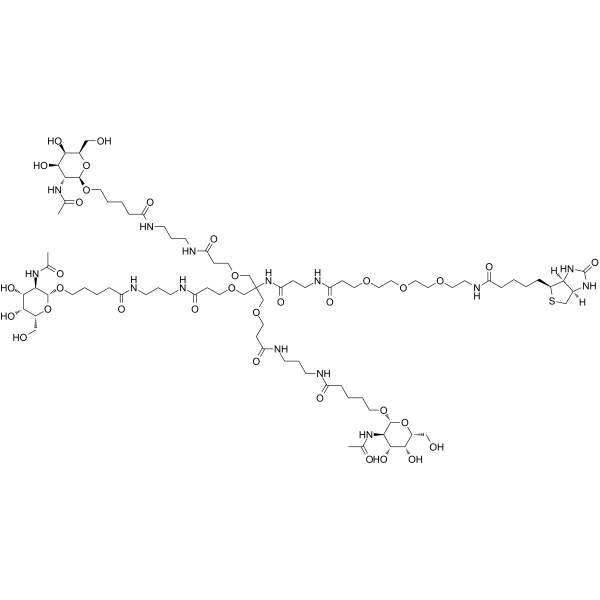
    tri-GalNAc biotin is a biotinylated ASGPR (Asialoglycoprotein receptor) ligand. tri-GalNAc biotin promotes cellular uptake of neutravidin (NA) via ASGPR. tri-GalNAc biotin delivers neutravidin to lysosomes for degradation. tri-GalNAc biotin can be used for research of LYsosome TArgeting Chimera (LYTAC) .
    tri-GalNAc biotin
  • HY-W1048661E

    Biochemical Assay Reagents Others
    Biotin-PEG2000-maleimide is a PEG derivative consisting of a linear PEG chain with biotin attached to one end and maleimide modified to the other end. Biotin-PEG2000-maleimide anchors drugs or targeting ligands to liposomes or polymer nanocarriers through the maleimide end, and the biotin end is used for in vitro purification or in vivo targeted release .
    Biotin-PEG2000-maleimide
  • HY-150741A

    Toll-like Receptor (TLR) Inflammation/Immunology
    Biotin-labeled ODN 2216 (sodium) is a human-specific TLR9 (toll-like receptor 9) ligand or agonist. Biotin-labeled ODN 2216 (sodium) can be used to evaluate CpG ODN cellular uptake and localization using a biotin detection system and light microscopy.
    Biotin-labeled ODN 2216 sodium
  • HY-W1048661A

    Biochemical Assay Reagents Others
    Biotin-PEG5000-maleimide is a PEG derivative consisting of a linear PEG chain with biotin attached to one end and maleimide modified to the other end. Biotin-PEG5000-maleimide anchors drugs or targeting ligands to liposomes or polymer nanocarriers through the maleimide end, and the biotin end is used for in vitro purification or in vivo targeted release .
    Biotin-PEG5000-maleimide
  • HY-W1048661

    Biochemical Assay Reagents Others
    Biotin-PEG1000-maleimide is a PEG derivative consisting of a linear PEG chain with biotin attached to one end and maleimide modified to the other end. Biotin-PEG1000-maleimide anchors drugs or targeting ligands to liposomes or polymer nanocarriers through the maleimide end, and the biotin end is used for in vitro purification or in vivo targeted release .
    Biotin-PEG1000-maleimide
  • HY-N0437F

    Pregn-4-ene-3,20-dione-biotin

    Progesterone Receptor Drug Derivative Cardiovascular Disease Cancer
    Progesterone 3-biotin (Pregn-4-ene-3,20-dione-biotin) is a biotin-labeled probe that allows progesterone to be detected or immobilized using the biotin ligand. Progesterone 3-biotin is the biotinylated derivative of Progesterone (HY-N0437) .
    Progesterone 3-biotin
  • HY-P4863

    CGRP Receptor Neurological Disease Metabolic Disease
    Biotinyl-Amylin (human) is a biotin-labeled derivative of Amylin, amide, human (HY-P1070). Biotinyl-Amylin (human) acts as a competitive agonist for the Calcitonin Receptor (CTR) and for the Amylin receptors (AMY1, AMY2, and AMY3) formed by the association of CTR with RAMP1/2/3. By mimicking endogenous human amylin, Biotinyl-Amylin (human) binds to and activates CTR and AMY receptors, thereby initiating downstream signaling pathways involving cAMP, CREB, and ERK1/2, while retaining high-affinity receptor binding and activation capabilities. Biotinyl-Amylin (human) is primarily utilized in studies investigating the metabolic regulatory mechanisms underlying obesity and diabetes; it is also applicable to pharmacological research, receptor localization studies, and ligand-binding assays related to Amylin receptors in the context of Alzheimer's disease .
    Biotinyl-Amylin (human)
  • HY-111879

    SNIPERs Cancer
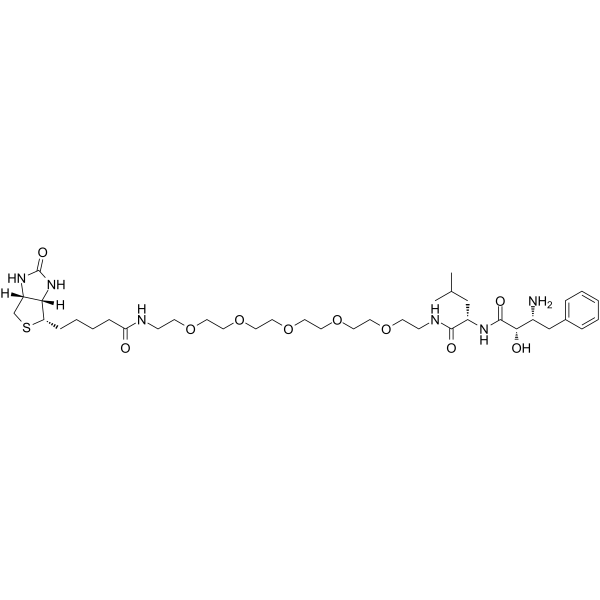
    Biotin-BS contains two different ligands, methyl-bestatin (MeBS) for cIAP1 and biotin, which are connected by linkers. MeBS as a ligand for cellular inhibitor of apoptosis protein 1 (cIAP1) ubiquitin ligase .
    Biotin-BS
  • HY-W1048661H

    Biochemical Assay Reagents Others
    Biotin-PEG3400-maleimide is a PEG derivative consisting of a linear PEG chain with biotin attached to one end and maleimide modified to the other end. Biotin-PEG3400-maleimide anchors drugs or targeting ligands to liposomes or polymer nanocarriers through the maleimide end, and the biotin end is used for in vitro purification or in vivo targeted release .
    Biotin-PEG3400-maleimide
  • HY-145502

    Biochemical Assay Reagents Others
    1,2-Dipalmitoyl-sn-glycero-3-PE-N-(cap biotin) sodium is used in the composition of lipid vesicles for supported lipid bilayer (SLB) formation. 1,2-Dipalmitoyl-sn-glycero-3-PE-N-(cap biotin) sodium can be used as a probe for understanding the interactions between proteins and lipid-tethered ligands .
    1,2-Dipalmitoyl-sn-glycero-3-PE-N-(cap biotin) sodium
  • HY-175147

    Biochemical Assay Reagents Endocrinology
    Progesterone 3-PEG11-biotin is an affinity probe. Progesterone 3-PEG11-biotin allows progesterone to be detected or immobilized using the biotin ligand.
    Progesterone 3-PEG11-biotin
  • HY-113331F

    Biochemical Assay Reagents Others
    Thromboxane B2-biotin is an affinity probe that allows detection of thromboxane B2 through an interaction with the biotin ligand. Thromboxane B2-biotin is designed to allow thromboxane B2 to be detected in complexes with protein binding partners .
    Thromboxane B2-biotin
  • HY-172666F

    biotin ceramide (d18:0/6:0)

    Fluorescent Dye Neurological Disease
    C6 Biotin dihydro ceramide is an affinity probe that allows C6 dihydro ceramide to be detected or immobilized through interaction with the biotin ligand.
    C6 Biotin dihydro ceramide (d18:0/6:0)
  • HY-175142

    Biochemical Assay Reagents Others
    Prostaglandin E2-PEG11-biotin is a ligand. Prostaglandin E2-PEG11-biotin can be immobilized on flow cells. The immobilized Prostaglandin E2-PEG11-biotin binds to BtOCT1. Prostaglandin E2-PEG11-biotin can be used in SPR .
    Prostaglandin E2-PEG11-biotin
  • HY-D3303

    8-iso PGA2-biotin

    Biochemical Assay Reagents Metabolic Disease
    8-iso Prostaglandin A2-biotin (8-iso PGA2-biotin) is an affinity probe conjugated with biotin, consisting of 8-iso Prostaglandin A2 (8-iso PGA2). 8-iso PGA2 is an isoprostaglandane produced by the radical-catalyzed peroxidation of arachidonic acid. 8-iso Prostaglandin A2-biotin can be detected by its interaction with a biotin ligand .
    8-iso Prostaglandin A2-biotin
  • HY-175133

    biotin ceramide (t18:0/6:0)

    Fluorescent Dye Others
    C6 Biotin phytoceramide (t18:0/6:0) is an affinity probe that allows C6 phytoceramide to be detected or immobilized through interaction with the biotin ligand .
    C6 Biotin phytoceramide (t18:0/6:0)
  • HY-173643

    biotin-C6:0-gm3 ammonium; N-Hexanoyl-biotin-monosialoganglioside gm3 ammonium

    Drug Derivative Metabolic Disease
    C6 Biotin ganglioside gm3 (d18:1/6:0) (Biotin-C6:0-gm3) ammonium is a derivative of ganglioside GM3. C6 Biotin ganglioside gm3 (d18:1/6:0) ammonium can be used to detect or immobilize ganglioside GM3 through interaction with the biotin ligand .
    C6 Biotin ganglioside gm3 (d18:1/6:0) ammonium
  • HY-W130607

    Biochemical Assay Reagents Others
    Biotinyl-8-amino-3,6-dioxaoctanoic acid is a biotinylating reagent linked with a PEG chain for improved water solubility. Biotin is an affinity ligand and it is used in biochemical applications such as pull-down assays or for ligating with streptavidin proteins. The carboxylic group can react with amine-containing molecules in the presence of activators such as HATU.
    Biotinyl-8-amino-3, 6-dioxaoctanoic acid

Inquiry Online

Your information is safe with us. * Required Fields.

Salutation


Country or Region *

Applicant Name *


Organization Name *

Department *


Email Address *


Product Name *

Cat. No.


Requested quantity *

Phone Number *


Remarks

Inquiry Online

Inquiry Information

Product Name:
Cat. No.:
Quantity:
MCE Japan Authorized Agent:

