7 Results for "

cytochrome P450 enzymes 3A4

" in MedChemExpress (MCE) Product Catalog:
Products (7)

7 Results for "cytochrome P450 enzymes 3A4" in MCE Product Catalog:

15
15 Cited Publications
Cat. No.: HY-N6972
CAS No.: 481-49-2
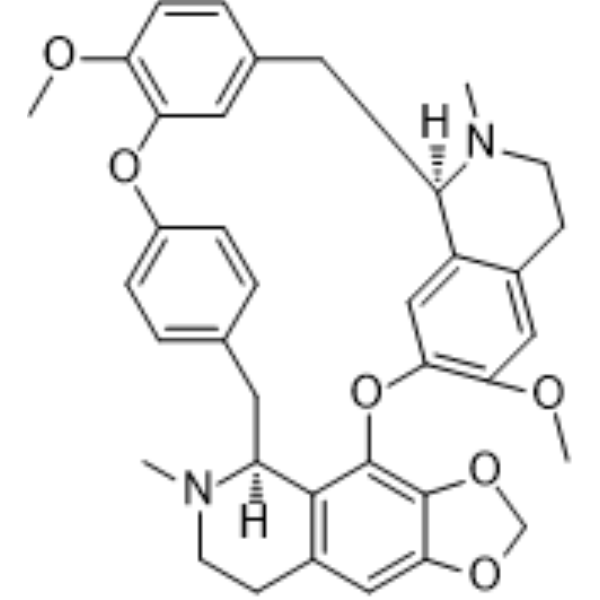
Cepharanthine is a natural product that can be isolated from the plant Stephania cephalantha Hayata. Cepharanthine has anti-severe acute respiratory syndrome coronavirus 2 (anti-SARS-CoV-2) activities. Cepharanthine has good effective in suppressing viral proliferation (half maximal (50%) inhibitory concentration (IC50) and 90% inhibitory concentration (IC90) values of 1.90 and 4.46 μM . Cepharanthine can also effectively reverses P-gp-mediated multidrug resistance in K562 cells and increase enhances the sensitivity of anticancer agents in xenograft mice model . Cepharanthine shows inhibitory effects of human liver cytochrome P450 enzymes CYP3A4, CYP2E1 and CYP2C9. Cepharanthine has antitumor, anti-inflammatory and antinociceptive effects .
loading...
    loading...
Cat. No.: HY-N5132
CAS No.: 7787-20-4
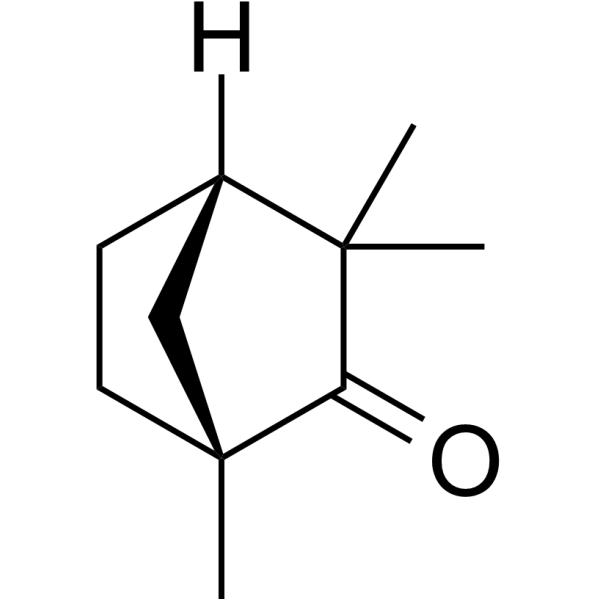
(-)-Fenchone is a bicyclic monoterpene and serves as a substrate for human liver microsomal cytochrome P450 enzymes CYP2A6 and CYP2B6. (-)-Fenchone is not metabolized by human CYP1A1, CYP1A2, CYP1B1, CYP2C8, CYP2C9, CYP2C19, CYP2D6, CYP2E1, or CYP3A4 enzymes. (-)-Fenchone undergoes hydroxylation to produce 6-exo-hydroxyfenchone, 6-endo-hydroxyfenchone, and 10-hydroxyfenchone. During the metabolism of (-)-Fenchone, CYP2A6 may play a more important role than CYP2B6 .
loading...
    loading...
Cat. No.: HY-E72102
Target:  

Cytochrome P450

Research Areas:  

Others

Human CYP3A4, Reductase+b5 refers to a near-physiological recombinant microsomal system co-expressed in insect cells, consisting of human cytochrome P450 3A4, NADPH-P450 oxidoreductase (CPR) and cytochrome b5. Human CYP3A4 is a human cytochrome P450 subtype belonging to the CYP3 family, as well as a major metabolic enzyme. It is predominantly expressed in human liver and intestine, metabolizes a variety of active compounds, and activates multiple procarcinogens .
loading...
    loading...
Cat. No.: HY-N6972R
CAS No.: 481-49-2
Cepharanthine (Standard) is the analytical standard of Cepharanthine. This product is intended for research and analytical applications. Cepharanthine is a natural product that can be isolated from the plant Stephania?cephalantha?Hayata. Cepharanthine has anti-severe acute respiratory syndrome coronavirus 2 (anti-SARS-CoV-2) activities. Cepharanthine has good effective in suppressing viral proliferation (half maximal (50%) inhibitory concentration (IC50) and 90% inhibitory concentration (IC90) values of 1.90 and 4.46?μM . Cepharanthine can also effectively reverses P-gp-mediated multidrug resistance in K562 cells and increase enhances the sensitivity of anticancer agents in xenograft mice model . Cepharanthine shows inhibitory effects of human liver cytochrome P450 enzymes CYP3A4, CYP2E1 and CYP2C9. Cepharanthine has antitumor, anti-inflammatory and antinociceptive effects .
loading...
    loading...
Cat. No.: HY-14294
CAS No.: 178979-85-6
Synonyms: S-1153
Research Areas:  

Infection

Capravirine (S-1153) is an orally active non-nucleoside reverse transcriptase inhibitor (NNRTI) with potent antiviral activity. Capravirine inhibits replication of HIV-1 strains that are resistant to nucleoside/nucleotide reverse transcriptase inhibitors and other NNRTIs. Capravirine is metabolized by the cytochrome P450 enzyme CYP3A4 .
loading...
    loading...
Cat. No.: HY-135390
CAS No.: 253688-62-9
Synonyms: Ro 64-1056
Target:  

Drug Metabolite

Research Areas:  

Cardiovascular Disease

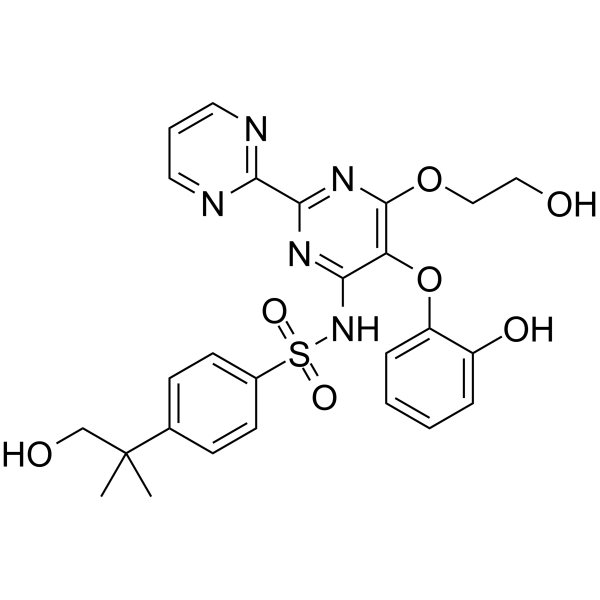
Hydroxy desmethyl Bosentan (Ro 64-105) is a Bosentan metabolism produced by the cytochrome P450 enzymes CYP2C9 and CYP3A4 in the liver . Bosentan is a competitive and dual antagonist of endothelin-1 (ET) for the ETA and ETB receptors with Ki of 4.7 nM and 95 nM in human SMC, respectively. Bosentan can be used in treatment of pulmonary arterial hypertension .
loading...
    loading...
Cat. No.: HY-L922
25000 compounds

A diverse compound library with favorable ADMET properties (Absorption, Distribution, Metabolism, Excretion, and Toxicity) is crucial in drug discovery. Early evaluation of ADMET properties allows for the exclusion of molecules with unfavorable profiles at the initial stages, thereby reducing the risk of late-stage development failures, lowering R&D costs, and accelerating optimization of lead compounds. Based on predictions from ADMET-related AI algorithms, the compounds in this library are predicted to exhibit favorable oral bioavailability (F > 30%), reasonable plasma protein binding (PPB < 98%), minimized CYP3A4 inhibition potential (inhibition probability < 50%, CYP3A4 is the most critical drug-metabolizing enzyme in the cytochrome P450 family) , low toxicity profiles, with 140 potentially toxic substructures pre-identified and excluded via substructure searching to eliminate compounds containing hazardous fragments. The diversity library enables broad applicability in high-throughput screening (HTS) and high-content screening (HCS).

