



Hydroxy desmethyl Bosentan
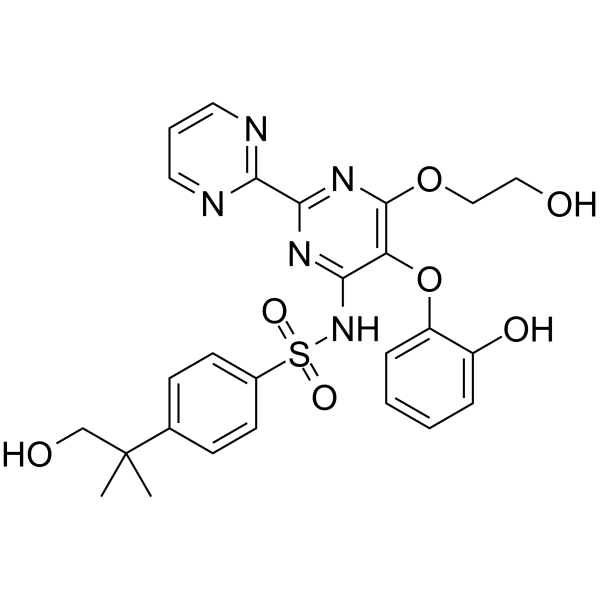
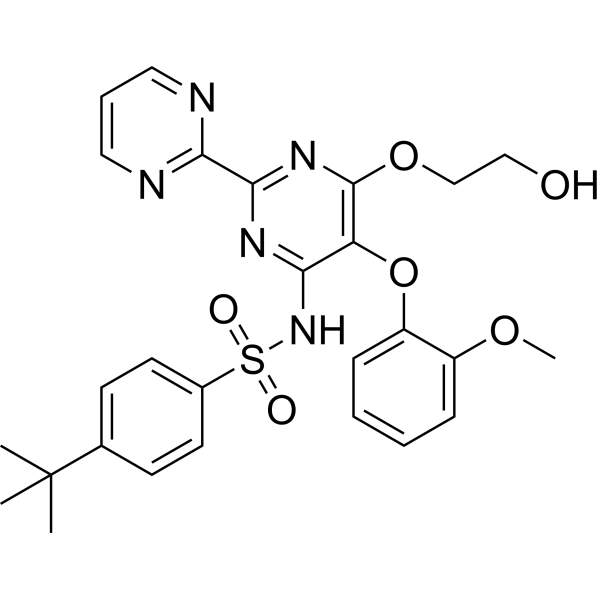
Hydroxy desmethyl Bosentan (Ro 64-105) is a Bosentan metabolism produced by the cytochrome P450 enzymes CYP2C9 and CYP3A4 in the liver. Bosentan is a competitive and dual antagonist of endothelin-1 (ET) for the ETA and ETB receptors with Ki of 4.7 nM and 95 nM in human SMC, respectively. Bosentan can be used in treatment of pulmonary arterial hypertension.
For research use only. We do not sell to patients.
- CAS No.: 253688-62-9
- Formula: C26H27N5O7S
- Molecular Weight:553.59
-
Storage:
Please store the product under the recommended conditions in the Certificate of Analysis.

To place orders, for customer services and technical support, please contact: MedChemExpress USA
Tel: 609-228-6898 E-mail: [email protected] [email protected]


-
 Biological Activity
-
Chemical Information
- Protocols
- Purity & Documentation
- References
-
 Help & FAQs




Biological Activity
Description


Chemical Information
-
CAS No. 253688-62-9
-
Molecular Weight 553.59
-
Formula C26H27N5O7S
-
SMILES
O=S(C1=CC=C(C(C)(C)CO)C=C1)(NC2=NC(C3=NC=CC=N3)=NC(OCCO)=C2OC4=CC=CC=C4O)=O
-
Synonyms
Ro 64-1056
-
Shipping
Room temperature in continental US; may vary elsewhere.
-
Storage
Please store the product under the recommended conditions in the Certificate of Analysis.


Purity & Documentation
References
[1]. Lepri S, et al. Metabolism study and biological evaluation of bosentan derivatives. Eur J Med Chem. 2016 Oct 4;121:658-670. [Content Brief]
[2]. Dhillon S, et al. Bosentan: a review of its use in the management of mildly symptomatic pulmonary arterial hypertension. Am J Cardiovasc Drugs. 2009;9(5):331-50. [Content Brief]

Calculators
Concentration (start) × Volume (start) = Concentration (final) × Volume (final)


Hydroxy desmethyl Bosentan Related Classifications
HY-135390 Related Classifications
 Powered by Bioz