11 Results for "

dysfunctional

" in MedChemExpress (MCE) Product Catalog:
Products (11)

11 Results for "dysfunctional" in MCE Product Catalog:

1
1 Cited Publications
Cat. No.: HY-10932
CAS No.: 72432-10-1
Purity:  99.94%
Synonyms: Ro 13-5057
Target:  

nAChR iGluR

Research Areas:  

Neurological Disease

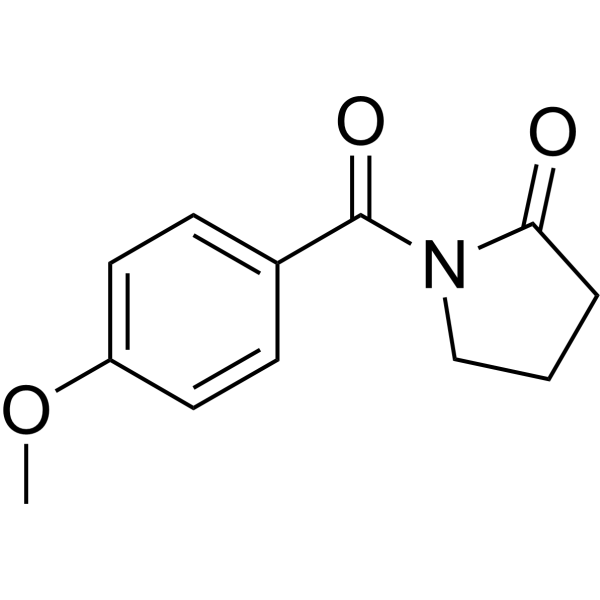
Aniracetam (Ro 13-5057) is an orally active neuroprotective agent, possessing nootropics effects. Aniracetam potentiates the ionotropic quisqualate (iQA) responses in the CA1 region of rat hippocampal slices. Aniracetam also potentiates the excitatory post synaptic potentials (EPSPs) in Schaffer collateral-commissural synapses. Aniracetam can prevents the CO2-induced impairment of acquisition in hypercapnia model rats. Aniracetam can be used to research cerebral dysfunctional disorders .
loading...
    loading...
1
1 Cited Publications
Cat. No.: HY-108022A
CAS No.: 1314533-27-1
Purity:  99.53%
Synonyms: MSDC-0602K
Target:  

Insulin Receptor PPAR

Research Areas:  

Metabolic Disease

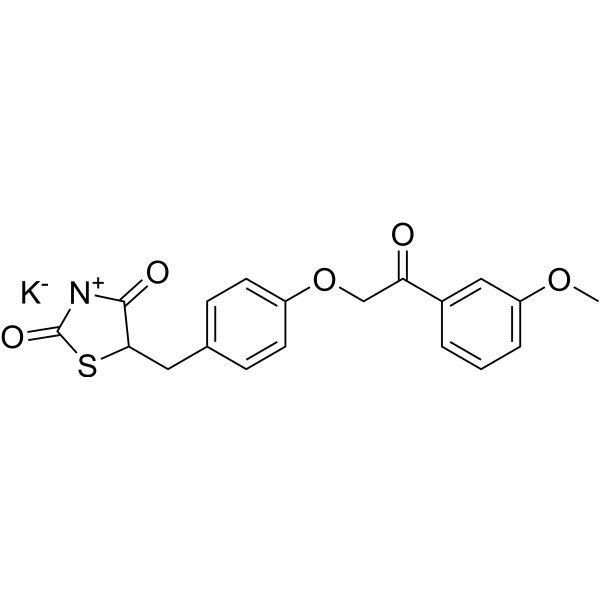
Azemiglitazone potassium (MSDC-0602K), a PPARγ-sparing thiazolidinedione (Ps-TZD), binds to PPARγ with the IC50 of 18.25 μM . Azemiglitazone potassium modulates the mitochondrial pyruvate carrier (MPC). Azemiglitazone potassium can be used for the research of fatty liver including dysfunctional lipid metabolism, inflammation, and insulin resistance . Azemiglitazone potassium, an insulin sensitizer, improves insulinemia and fatty liver disease in mice, alone and in combination with Liraglutide .
loading...
    loading...
Cat. No.: HY-141582
CAS No.: 34354-88-6
Purity:  ≥98.0%
Synonyms: N-Stearoyl phytosphingosine
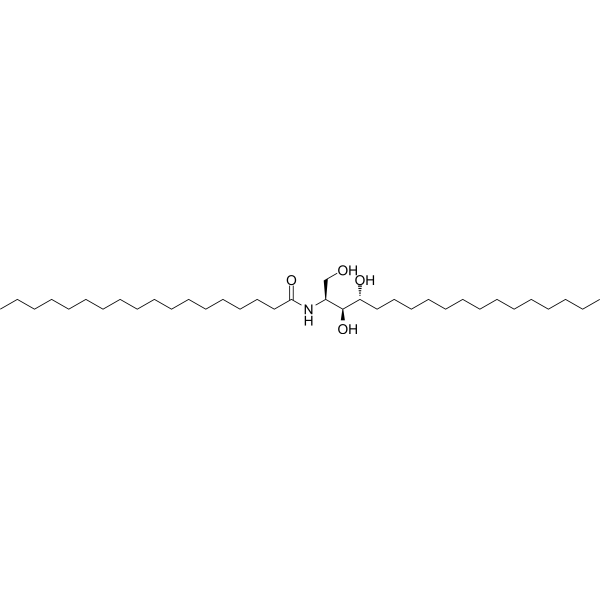
Ceramide 3 (N-Stearoyl phytosphingosine) is an orally active major component of intercellular lipids in the stratum corneum of the skin, and belongs to the ceramide family. Ceramide 3 inhibits c-jun and NF-κB activation induced by Histamine (HY-B1204), and suppresses the expression of IL-4 and TNF-α. Ceramide 3 inhibits scratching behavior and vascular permeability in mice, and exhibits antihistamine effects in guinea pig ileum. Ceramide 3 improves skin barrier function, reduces transepidermal water loss, erythema and the number of circulating epidermal cells, and accelerates barrier repair of irritated or dysfunctional skin .
loading...
    loading...
Cat. No.: HY-103592
CAS No.: 1644158-57-5
Purity:  99.29%
Target:  

Ceramidase

Research Areas:  

Cancer

ARN14974, a benzoxazolone carboxamide, is a potent and systemically active inhibitors of intracellular acid ceramidase (IC50=79 nM) .
loading...
    loading...
Cat. No.: HY-114333
CAS No.: 876150-14-0
Synonyms: 1-Octyl 2-oxopentanedioate
Research Areas:  

Metabolic Disease Cancer

Octyl-α-ketoglutarate (1-Octyl 2-oxopentanedioate) is a stable, cell-permeable form of α-ketoglutarate which accumulates rapidly in HEK293 cells with a dysfunctional tricarboxylic acid (TCA) cycle, stimulating prolyl hydroxylase (PHD) activity. In addition, Octyl-α-ketoglutarate competitively blocks succinate- or fumarate-mediated inhibition of PHD .
loading...
    loading...
Cat. No.: HY-141582S
CAS No.: 1354806-91-9
Synonyms: N-Stearoyl phytosphingosine-d3
Ceramide 3-d3 (N-Stearoyl phytosphingosine-d3) is deuterium labeled Ceramide 3. Ceramide 3 is an orally active major component of intercellular lipids in the stratum corneum of the skin, and belongs to the ceramide family. Ceramide 3 inhibits c-jun and NF-κB activation induced by Histamine (HY-B1204), and suppresses the expression of IL-4 and TNF-α. Ceramide 3 inhibits scratching behavior and vascular permeability in mice, and exhibits antihistamine effects in guinea pig ileum. Ceramide 3 improves skin barrier function, reduces transepidermal water loss, erythema and the number of circulating epidermal cells, and accelerates barrier repair of irritated or dysfunctional skin.
loading...
    loading...
Cat. No.: HY-10932R
CAS No.: 72432-10-1
Synonyms: Ro 13-5057 (Standard)
Research Areas:  

Neurological Disease

Aniracetam (Standard) is the analytical standard of Aniracetam. This product is intended for research and analytical applications. Aniracetam (Ro 13-5057) is an orally active neuroprotective agent, possessing nootropics effects. Aniracetam potentiates the ionotropic quisqualate (iQA) responses in the CA1 region of rat hippocampal slices. Aniracetam also potentiates the excitatory post synaptic potentials (EPSPs) in Schaffer collateral-commissural synapses. Aniracetam can prevents the CO2-induced impairment of acquisition in hypercapnia model rats. Aniracetam can be used to research cerebral dysfunctional disorders .
loading...
    loading...
Cat. No.: HY-172808
CAS No.: 2836313-12-1
Research Areas:  

Metabolic Disease

BNS808 is an orally active and selective cannabinoid-1 receptor (CB1R) antagonist (IC50 = 0.8 nM) with notable CB2R selectivity and minimal brain penetration. BNS808 is studied in research on obesity and its associated metabolic complications, such as metabolic dysfunctional-associated steatotic liver disease (MASLD). BNS808 has reduced free drug availability for CNS entry, enhancing safety and minimizing drug-drug interactions through high plasma binding .
loading...
    loading...
Cat. No.: HY-P11075
CAS No.: 2770688-04-3
Target:  

Neurokinin Receptor

Research Areas:  

Metabolic Disease

[Lys5,Tyr6,mLeu9,Nle10]-Neurokinin A (4-10) (ID 305) is a selective NK2R agonist with an EC50 of 3.7  nM for hNK2R. [Lys5,Tyr6,mLeu9,Nle10]-Neurokinin A (4-10) significantly inhibits weight loss in diet-induced obese (DIO) mice model and improves Loperamide (HY-156131)-induced dysfunctional voiding in wild-type mice. [Lys5,Tyr6,mLeu9,Nle10]-Neurokinin A (4-10) can be used for neurokinin receptor mediated disorders, such as obesity, insulin resistance and type 2 diabetes research .
loading...
    loading...
Cat. No.: HY-103592R
CAS No.: 1644158-57-5
Research Areas:  

Cancer

ARN14974 (Standard) is the analytical standard of ARN14974 (HY-103592). This product is intended for research and analytical applications. ARN14974, a benzoxazolone carboxamide, is a potent and systemically active inhibitors of intracellular acid ceramidase (IC50=79 nM) .
loading...
    loading...
Cat. No.: HY-L008
728 compounds

The Janus kinase (JAK)/signal transducer and activator of transcription (STAT) pathway is central to signaling by cytokine receptors, a superfamily of more than 30 transmembrane proteins that recognize specific cytokines, and is critical in blood formation and immune response. Canonical JAK/STAT signaling begins with the association of cytokines and their corresponding transmembrane receptors. Activated JAKs then phosphorylate latent STAT monomers, leading to dimerization, nuclear translocation, and DNA binding. In mammals, there are four JAKs (JAK1, JAK2, JAK3, TYK2) and seven STATs (STAT1, STAT2, STAT3, STAT4, STAT5a, STAT5b, STAT6). Since the JAK/STAT pathway plays a major role in many fundamental processes, such as apoptosis and inflammation, dysfunctional proteins in the pathway may lead to a number of diseases. For example, alterations in JAK/STAT signalling can result in cancer and diseases affecting the immune system, such as severe combined immunodeficiency disorder (SCID).

MCE provides 728 compounds that can be used in the study of the JAK/STAT signaling pathway and related diseases.

  • 1

