1. Search Result
Search Result
Pathways Recommended: Membrane Transporter/Ion Channel
Results for "

extracellular vesicle membranes

" in MedChemExpress (MCE) Product Catalog:

7

阻害剤およびアゴニスト

1

スクリーニングライブラリ

2

蛍光色素

2

生化学アッセイ試薬

3

ペプチド

1

クリックケミストリー

1

オリゴヌクレオチド

製品番号 製品名 Target 研究分野 構造式
  • HY-D1736

    Fluorescent Dye Others
    BODIPY FL-C16 is a BODIPY-labeled analog of Palmitic acid (HY-N0830), which serves as a fluorescent lipid tracer. BODIPY FL-C16 also acts as a ligand for liver fatty acid-binding protein (L-FABP) and intestinal fatty acid-binding protein (I-FABP) , with Kd values of 270 nM and 330 nM, respectively. BODIPY FL-C16 is rapidly taken up by cells, and after metabolic conversion to phospholipids, it is incorporated into the membrane structures of intracellular organelles and extracellular vesicles .
    BODIPY FL-C16
  • HY-W440896

    Liposome Others
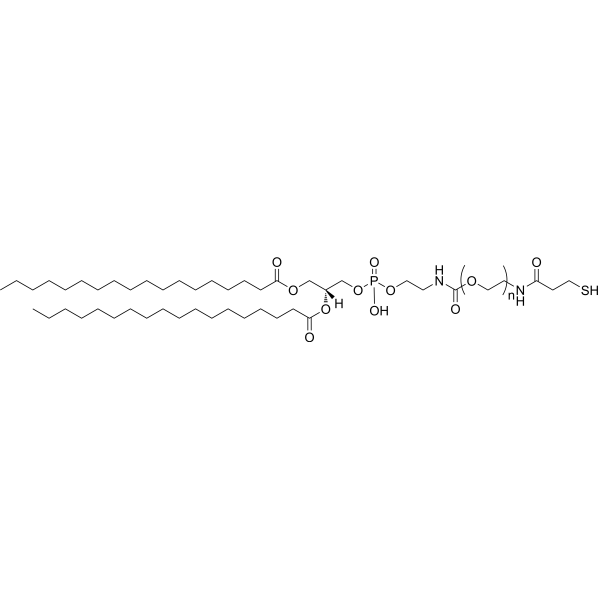
    DSPE-PEG2000-SH is an amphiphilic thiol-functionalized DSPE-PEG molecule. DSPE-PEG2000-SH inserts into extracellular vesicle (EV) bilayer membranes via hydrophobic interactions, displaying surface thiol groups to form EV-SH crosslinkers.DSPE-PEG2000-SH enables crosslinking of EV-SH with 8-arm PEG-norbornene via thiol-ene photochemistry to construct hydrogels, with hydrogel mechanical properties tunable via PEG segment molecular weight variation.DSPE-PEG2000-SH can be used to encapsulate agents for drug delivery system, such as mRNA vaccine .
    DSPE-PEG2000-SH
  • HY-P10932A

    Fluorescent Dye Neurological Disease
    pGk13a TFA is an azide (azide group can be combined with fluorophore)-containing amphiphilic membrane labeling probe. pGk13a TFA enables high-resolution imaging of cell membranes in the ultrastructural membrane expansion microscopy (umExM) technique, facilitating the observation of membrane-associated structures and proteins. pGk13a TFA can be used for neuronal structural studies .
    pGk13a TFA
  • HY-P10932

    Fluorescent Dye Neurological Disease
    pGk13a is an amphipathic membrane-labeling probe containing an azide group, which can bind to fluorophores. pGk13a enables high-resolution imaging of cell membranes in the ultrastructure expansion microscopy (umExM) technique, facilitating the observation of membrane-associated structures and proteins. pGk13a is applicable to neuronal structure research .
    pGk13a
  • HY-W127487

    Biochemical Assay Reagents Others
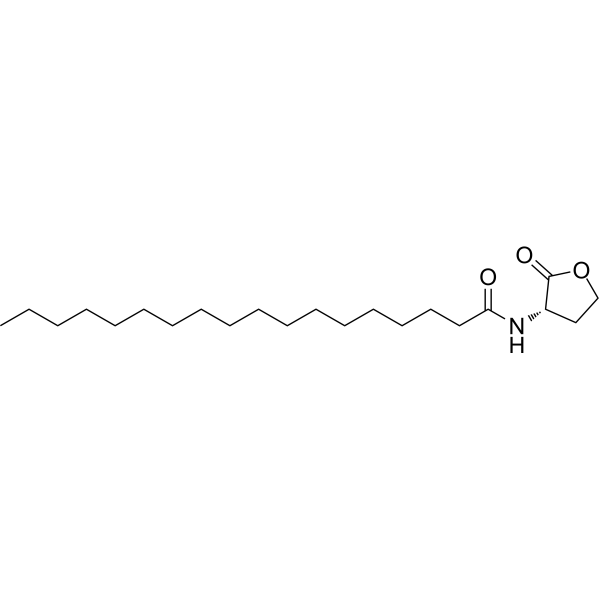
    Quorum sensing is a regulatory system used by bacteria to control gene expression in response to increased cell density. This regulatory process manifests itself in a variety of phenotypes, including biofilm formation and virulence factor production. Coordinated gene expression is achieved through the production, release and detection of small diffusible signaling molecules called autoinducers. N-acylated homoserine lactones (AHLs) comprise a class of such autoinducers, each of which generally consists of a fatty acid coupled to a homoserine lactone (HSL). Modulation of bacterial quorum-sensing signaling systems to suppress pathogenesis represents a new approach to antimicrobial research for infectious diseases. AHLs differ in acyl length (C4-C18), C3 substitution (hydrogen, hydroxyl, or oxo group), and the presence or absence of one or more carbon-carbon double bonds in the fatty acid chain. These differences confer signaling specificity through the affinity of the LuxR family of transcriptional regulators. C18-HSL, one of four lipophilic long acyl side chain AHLs produced by the LuxI AHL synthase homolog SinI, is involved in quorum-sensing signaling in strains of Rhizobium meliloti (a nitrogen-fixing bacterial symbiont of the legume M. sativa) . C18-HSL and other hydrophobic AHLs tend to localize in the relatively lipophilic environment of bacterial cells and cannot diffuse freely across the cell membrane. Long-chain N-acyl homoserine lactones can be exported from cells by efflux pumps, or can be transported between communicating cells by extracellular outer membrane vesicles.
    N-Octadecanoyl-L-homoserine lactone
  • HY-P11766

    GALA-cholesterol

    Biochemical Assay Reagents Cancer
    GALA-chol is a cholesterol-conjugated pH-responsive fusion peptide that can serve as a delivery adjuvant. GALA-chol enhances the endocytosis of siRNA RET/PTC1-SQ nanoparticles, inhibits cell viability, and undergoes pH-responsive charge conversion in the acidic lysosomal environment, thereby promoting lysosomal escape of small extracellular vesicle (sEV) cargo. GALA-chol anchors to the sEV membrane and maintains the structural integrity and intrinsic homing activity of sEVs. GALA-chol can be used in studies related to adjuvant delivery .
    GALA-chol
  • HY-DY1102

    Fluorescent Dye Others
    BODIPY FL-C16 (solution) is a BODIPY-labeled analog of Palmitic acid (HY-N0830), which serves as a fluorescent lipid tracer. BODIPY FL-C16 (solution) also acts as a ligand for liver fatty acid-binding protein (L-FABP) and intestinal fatty acid-binding protein (I-FABP) , with Kd values of 270 nM and 330 nM, respectively. BODIPY FL-C16 (solution) is rapidly taken up by cells, and after metabolic conversion to phospholipids, it is incorporated into the membrane structures of intracellular organelles and extracellular vesicles .
    Solvent and concentration: DMSO: 5 mM
    BODIPY FL-C16 (solution)

オンラインお問い合わせ

入力情報は安全に管理されます. 必須入力項目.

タイトル


国或いは地域 *

お名前 *


組纖名 *

デパートメント *


メールアドレス *


製品名 *

製品番号


カスタマ需要量 *

電話番号 *


必ず会社名を記載ください。個人への返信は行いません。

備考

バルクお問い合わせ

Inquiry Information

製品名:
製品番号:
数量:
MCE 日本正規代理店:

