12 Results for "

fingerling rainbow trout

" in MedChemExpress (MCE) Product Catalog:
Products (12)

12 Results for "fingerling rainbow trout" in MCE Product Catalog:

Cat. No.: HY-W014566
CAS No.: 88-30-2
Synonyms: 3-(Trifluoromethyl)-4-Nitrophenol; TFM
4-Nitro-3-(trifluoromethyl)phenol (TFM) is a piscicide that is toxic to lampreys (P. marinus) (LC50 values are 1.97-2.11 for cysts, 2.05-2.21 for fry, 1.6-2.45 for juveniles, and 1.6-1.63 for adults, respectively). 4-Nitro-3-(trifluoromethyl)phenol is also toxic to juvenile lake sturgeons (A. fulvescens) less than 100 mm, but is nontoxic to a variety of other fish species. 4-Nitro-3-(trifluoromethyl)phenol (50 μM) dissociates oxidative phosphorylation by 22% and 28% in isolated livers of lampreys and rainbow trout (O. mykiss), respectively. 4-Nitro-3-(trifluoromethyl)phenol can be used to control lamprey larval populations.
loading...
    loading...
Cat. No.: HY-W587733
CAS No.: 1662-06-2
Synonyms: 17,20β-P; 17,20β-DHP
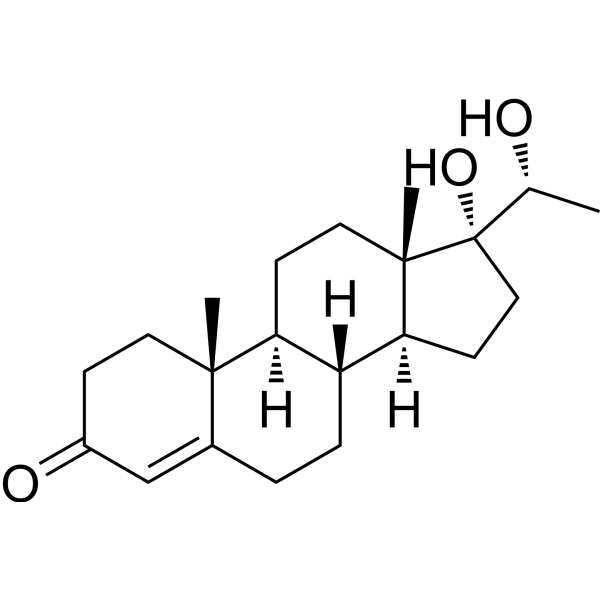
17α,20β-Dihydroxy-4-pregnen-3-one (17,20β-P; 17,20β-DHP) acts as the maturation-inducing hormone (MIH) in salmonid fish and rainbow trout. 17α,20β-Dihydroxy-4-pregnen-3-one binds to oocyte-specific plasma membrane receptors and pertussis toxin-sensitive inhibitory G proteins in fish, inhibits Adenylate Cyclase and reduces intracellular cAMP via the membrane receptor-G protein coupling pathway, thereby initiating downstream signal transduction. 17α,20β-Dihydroxy-4-pregnen-3-one induces de novo synthesis of cyclin B, mediates the translation of cyclin B mRNA and the phosphorylation of cdc2, and promotes the production of maturation-promoting factor (MPF). 17α,20β-Dihydroxy-4-pregnen-3-one drives meiotic maturation of fish oocytes. 17α,20β-Dihydroxy-4-pregnen-3-one is applicable for development-related research .
loading...
    loading...
Cat. No.: HY-121779
CAS No.: 3424-82-6
Synonyms: 2,4'-DDE; 2,4-Dichlorodiphenyldichloroethylene; 2,4'-DDE; o,p'-Dichlorodiphenyldichloroethylene
Target:  

Insecticide

Research Areas:  

Endocrinology

o,p'-DDE (2,4-Dichlorodiphenyldichloroethylene) is a metabolite and degradation product of the organochlorine pesticide DDT. It accumulates in smallmouth buffalo, channel catfish, and largemouth bass, and in sediments from DDT manufacturing plants around the Huntsville Spring Branch-Indian Creek tributary system, where it is considered a persistent organic pollutant (POP). o,p'-DDE inhibits estrogen binding to the rainbow trout estrogen receptor (rtER) with an IC50 value of 3.2 μM. It induces concentration-dependent estradiol secretion in co-cultures of granulosa and theca cells isolated from porcine follicles. In ovo exposure to o,p'-DDE increases follicular degeneration and reduces testis size in Japanese medaka (O. latipes).
loading...
    loading...
Cat. No.: HY-W100410
CAS No.: 140-39-6
Synonyms: p-Cresyl Acetate
Research Areas:  

Others

p-Tolyl Acetate (p-Cresyl Acetate) is a synthetic fragrance chemical with high metabolic stability in trout and human hepatocytes .
loading...
    loading...
Cat. No.: HY-W250160
CAS No.: 100403-24-5
Synonyms: Polydeoxyribonucleotide
PDRN (Polydeoxyribonucleotide) is a deoxynucleotide polymer mainly derived from the sperm of rainbow trout or salmon. PDRN inhibits pro-inflammatory factors and promotes VEGF expression via the cAMP-PKA pathway by activating the adenosine A2A receptor (A2AR), thereby driving angiogenesis and collagen deposition in fibroblasts. Degradation products of PDRN provide DNA raw materials for proliferating cells through the salvage synthesis pathway, accelerating re-epithelialization. PDRN reduces melanin synthesis and cell apoptosis by upregulating ERK/AKT phosphorylation and inhibiting the activities of MITF and tyrosinase, and resists skin aging by attenuating nuclear autophagy and blocking the interaction between LC3-SIRT1. PDRN is mainly used for wound repair, post-aesthetic surgery recovery and anti-aging research .
loading...
    loading...
Cat. No.: HY-B1567
CAS No.: 1715-40-8
Synonyms: SD 2774; ENT 23393; Alugan
Target:  

Insecticide

Research Areas:  

Others

Bromocyclen is a pesticide found in the muscle tissue of rainbow trout from Danish fisheries and in three species of fish (grill, crucian carp and pike) from the River Stell in northern Germany. High concentrations were detected ranging from 0.09 to 1.23 mg/kg fat .
loading...
    loading...
Cat. No.: HY-B1567R
CAS No.: 1715-40-8
Synonyms: SD 2774 (Standard); ENT 23393 (Standard); Alugan (Standard)
Research Areas:  

Others

Bromocyclen (Standard) is the analytical standard of Bromocyclen. This product is intended for research and analytical applications. Bromocyclen is a pesticide found in the muscle tissue of rainbow trout from Danish fisheries and in three species of fish (grill, crucian carp and pike) from the River Stell in northern Germany. High concentrations were detected ranging from 0.09 to 1.23 mg/kg fat .
loading...
    loading...
Cat. No.: HY-133002
CAS No.: 3220-60-8
Synonyms: Sterculic acid methyl ester; Methyl Sterculate
Target:  

Bacterial

Research Areas:  

Infection

Sterculic acid methyl ester is an ester form of sterculic acid, which is an inhibitor of Δ9 desaturase. Sterculic acid methyl ester (0.75 mM) inhibits the growth of, and is toxic to, the bacteria R. opacus. It decreases the fatty acid content, increases the ratio of palmitate to other fatty acids, and decreases the levels of stearate and oleate in R. opacus when used at concentrations of 0.25 or 0.5 mM. Sterculic acid methyl ester (50 ppm) has a synergistic effect on increased tumor growth induced by aflatoxin Q1 in rainbow trout.
loading...
    loading...
Cat. No.: HY-119694
CAS No.: 509-96-6
Purity:  ≥97.0%
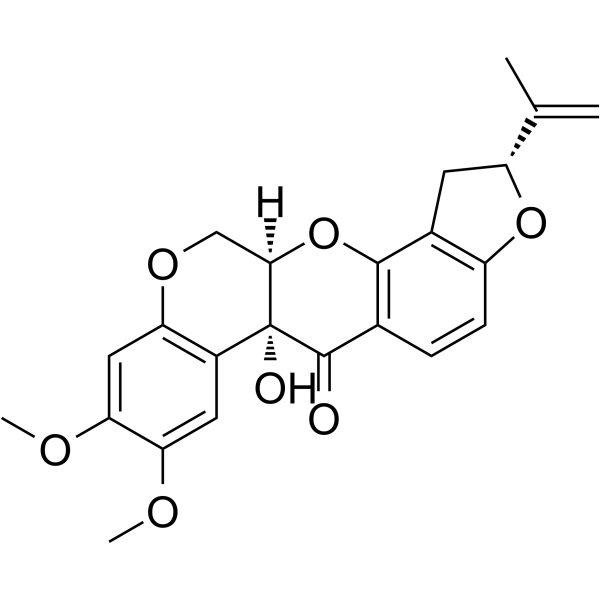
Rotenolone is a metabolite of Rotenone (HY-B1756), inhibitor of Mitochondrial complex I, and antiproliferative agent, with an IC50 of 137 nM against bovine complex I. Rotenolone undergoes biotransformation via multiple cytochrome P450 isoenzymes in rainbow trout liver microsomes. Rotenolone exhibits anticancer activity against ovarian cancer, breast cancer, prostate cancer, non-small cell lung cancer, and colon cancer. Rotenolone can be used in studies related to ovarian cancer, breast cancer, prostate cancer, non-small cell lung cancer, and colon cancer .
loading...
    loading...
Cat. No.: HY-W750672
CAS No.: 112421-21-3
Target:  

Drug Derivative

Research Areas:  

Others

Astaxanthin dipalmitate is a carotenoid. Astaxanthin dipalmitate can be used for pigmentation of rainbow trout and sea trout. Carotenoids are important biological active, and may regulate cellular differentiation, growth control, photooxidative protection, cell membrane stability, photosynthesis, vision process and nutrition .
loading...
    loading...
Cat. No.: HY-182543
CAS No.: 148717-47-9
Target:  

CaSR

Research Areas:  

Others

NPS-467 is a calcium-sensing receptor (CaR) activator and stereospecific agent with only its R-enantiomer active. NPS-467 increases the sensitivity of the CaR to activation by extracellular calcium. NPS-467 stimulates stanniocalcin (STC) secretion in trout and induces inhibition of gill calcium transport in trout. NPS-467 has no effect on serum calcitonin levels in trout .
loading...
    loading...
Cat. No.: HY-W459577
CAS No.: 17949-65-4
Zinc picolinate is an orally effective zinc supplement. Zinc picolinate reduces the expression of Hsp70, inhibits oxidative DNA damage, increases serum ALP activity, decreases MDA concentration, elevates SOD levels, and raises zinc concentrations in serum, whole body and plasma. Zinc picolinate does not alter copper and manganese contents in rainbow trout. Zinc picolinate exerts a protective effect against Acetic acid (HY-Y0319)-induced experimental colitis in Sprague Dawley rats. Zinc picolinate reduces uterine fibroid volume, alleviates colonic oxidative damage, relieves colonic inflammation, and enhances intestinal barrier integrity. Zinc picolinate can be used in research related to uterine fibroids, ulcerative colitis and chronic obstructive pulmonary disease .
loading...
    loading...
  • 1

