







24 Results for "

intracellular stores

" in MedChemExpress (MCE) Product Catalog:
Products (24)

24 Results for "intracellular stores" in MCE Product Catalog:

1
1 Cited Publications
Cat. No.: HY-P1852
CAS No.: 277302-47-3
Target:  

Adenylate Cyclase PTHR

Research Areas:  

Neurological Disease

TIP 39, Tuberoinfundibular Neuropeptide is an endogenous PTH2 receptor agonist and antihypertensive agent. TIP 39, Tuberoinfundibular Neuropeptide selectively activates the PTH2 receptor with no activity on the PTH1 receptor, stimulates cAMP production, activates adenylate cyclase, and elevates intracellular calcium levels via mobilization from intracellular stores. TIP 39, Tuberoinfundibular Neuropeptide is highly conserved in humans, mice, and rats. TIP 39, Tuberoinfundibular Neuropeptide is applicable to research related to nociception and inflammation-induced pain .
loading...
    loading...
1
1 Cited Publications
Cat. No.: HY-N4237
CAS No.: 5573-16-0
Saikogenin D is isolated from?Bupleurum chinense, has anti-inflammatory effects. Saikogenin D activates epoxygenases that converts arachidonic acid to epoxyeicosanoids and dihydroxyeicosatrienoic acids, and the metabolites secondarily inhibit prostaglandin E2 (PGE2) production. Saikogenin D results in an elevation of [Ca 2+]i due to Ca 2+ release from intracellular stores .
loading...
    loading...
Cat. No.: HY-W039315
CAS No.: 41107-82-8
2,5-Anhydro-D-mannitol, 97% is an antimetabolic fructose analogue. 2,5-Anhydro-D-mannitol, 97% depletes intracellular ATP, reduces oxygen consumption, regulates substrate oxidation, increases phosphomonoester levels, decreases inorganic phosphate levels, and promotes the release of intracellular calcium from intracellular calcium stores via phospholipase C-dependent activity in hepatocytes .
loading...
    loading...
Cat. No.: HY-113273A
CAS No.: 4097-04-5
Purity:  97%
Synonyms: Ap5A pentasodium; P1,P5-Di(adenosine-5'-)pentaphosphate pentasodium
Target:  

P2X Receptor

Diadenosine pentaphosphate (Ap5A; P1,P5-Di(adenosine-5'-)pentaphosphate) pentasodium is an endogenous generated diadenosine polyphosphate, possessing the dual identities of intracellular alarm signal and extracellular signaling molecule. Diadenosine pentaphosphate regulates calcium signaling in the nervous, cardiac and peripheral sensory systems by activating P2X1/P2X3/P2Y receptor and RyR2 channels (EC50 = 140 μM). Diadenosine pentaphosphate can be used in studies related to intracellular calcium release channels, cardiovascular diseases and nociception (pain) .
loading...
    loading...
Cat. No.: HY-142117
CAS No.: 149091-92-9
Research Areas:  

Others

Adenophostin A is an IP3 receptor (inositol 1,4,5-trisphosphate receptors) modulator and Ca 2+ releaser, with an IC50 of 1.3 nM, an EC50 of 1.4 nM, and a Ki of 0.18 nM in rats, and an IC50 of 0.95 nM in humans. Adenophostin A activates IP3 receptors, stimulates Ca 2+ release from intracellular stores and microsomes, inhibits the binding of [ 3H]IP3 to plasma membrane receptors, and activates chloride channels. Adenophostin A resists phosphorylation and dephosphorylation by IP3 metabolic enzymes to maintain its activity, and increases cytoplasmic [Ca 2+] levels via calcium mobilization from the endoplasmic reticulum of vascular smooth muscle cells. Adenophostin A is applicable to research related to hemorrhagic shock .
loading...
    loading...
Cat. No.: HY-N3320
CAS No.: 14957-38-1
Marmin is a histamine receptor inhibitor and tracheal smooth muscle relaxant. Marmin antagonizes histamine- and methacholine-induced contraction of tracheal smooth muscle. Marmin inhibits histamine release from mast cells, and also blocks extracellular calcium influx via voltage-dependent calcium channels as well as calcium release from intracellular calcium stores, thereby effectively inhibiting calcium-mediated smooth muscle contraction. Marmin slightly enhances the relaxant effect of isoprenaline, and induces epithelial-dependent tracheal smooth muscle relaxation independent of nitric oxide, cGMP or β2-adrenergic pathways through the release of prostaglandin E2 .
loading...
    loading...
Cat. No.: HY-NP007
CAS No.: 100684-32-0
Myoglobin is an oxygen-binding heme protein. Myoglobin scavenges ROS via its peroxidase activity, and binds to and inactivates NO in the heart and oxidative skeletal muscle. Myoglobin stores, buffers and facilitates intracellular oxygen diffusion, maintains aerobic metabolism under hypoxic/anoxic conditions, and provides oxygen supply support for mitochondria. Myoglobin alleviates oxidative stress, protects cardiac function and affects cardiac redox pathways. Myoglobin can be used in studies related to ischemia-reperfusion injury, oxidative stress-induced cardiac dysfunction and acute myocardial infarction .
loading...
    loading...
Cat. No.: HY-113273
CAS No.: 41708-91-2
Synonyms: Ap5A; P1,P5-Di(adenosine-5'-)pentaphosphate
Diadenosine pentaphosphate (Ap5A; P1,P5-Di(adenosine-5'-)pentaphosphate) is an endogenous generated diadenosine polyphosphate, possessing the dual identities of intracellular alarm signal and extracellular signaling molecule. Diadenosine pentaphosphate regulates calcium signaling in the nervous, cardiac and peripheral sensory systems by activating P2X1/P2X3/P2Y receptor and RyR2 channels (EC50 = 140 μM). Diadenosine pentaphosphate can be used in studies related to intracellular calcium release channels, cardiovascular diseases and nociception (pain) .
loading...
    loading...
Cat. No.: HY-117099
CAS No.: 53464-72-5
Target:  

Calcium Channel

Research Areas:  

Neurological Disease

TMB-8 is a novel Ca 2+ antagonist. TMB-8 may exert inhibitory effects in smooth muscle by blocking Ca 2+ release from intracellular bound stores.
loading...
    loading...
Cat. No.: HY-120985
CAS No.: 123000-02-2
Target:  

Calcium Channel

Research Areas:  

Neurological Disease

Xestospongins and araguspongins are marine natural products first isolated from Pacific basin sponges, and noted to have vasodilatory properties.1 Inositol phosphates (IP) are important signal transduction messengers acting via IP3 receptors to promote the mobilization of Ca2+ from intracellular stores.2 Araguspongin B antagonizes the calcium-releasing action of inositol 1,4,5-trisphosphate at the receptor level in cerebral microsomes, with an IC50 of 0.6 μM. It is nearly as potent as xestospongin C as an antagonist of the IP3 receptor.
loading...
    loading...
Cat. No.: HY-121966
CAS No.: 112356-54-4
Purity:  98.00%
Synonyms: Riparin III
Target:  

Calcium Channel

Research Areas:  

Neurological Disease

Riparin is a nonspecific smooth muscle relaxant. Riparin exerts spasmolytic effect by inhibiting Ca 2+ influx and inhibiting the release of intracellular calcium ion stores .
loading...
    loading...
Cat. No.: HY-B1558
CAS No.: 90293-01-9
Synonyms: MCI-2016 free base
Target:  

Calcium Channel

Research Areas:  

Neurological Disease

Bifemelane is a nootropic compound. Bifemelan causes the first peak by stimulating release from intracellular Ca 2+ stores and the second by capacitive entry through store–operated Ca 2+ channels. Bifemelane will be provided as a pharmacological tool for basic studies on astrocytes .
loading...
    loading...
Cat. No.: HY-113273B
CAS No.: 102783-61-9
Purity:  ≥96.0%
Synonyms: Ap5A pentaammonium; P1,P5-Di(adenosine-5'-)pentaphosphate pentaammonium
Target:  

Endogenous Metabolite

Diadenosine pentaphosphate (Ap5A; P1,P5-Di(adenosine-5'-)pentaphosphate) pentaammonium is an endogenous generated diadenosine polyphosphate, possessing the dual identities of intracellular alarm signal and extracellular signaling molecule. Diadenosine pentaphosphate regulates calcium signaling in the nervous, cardiac and peripheral sensory systems by activating P2X1/P2X3/P2Y receptor and RyR2 channels (EC50 = 140 μM). Diadenosine pentaphosphate can be used in studies related to intracellular calcium release channels, cardiovascular diseases and nociception (pain) .
loading...
    loading...
Cat. No.: HY-113273C
CAS No.: 94108-02-8
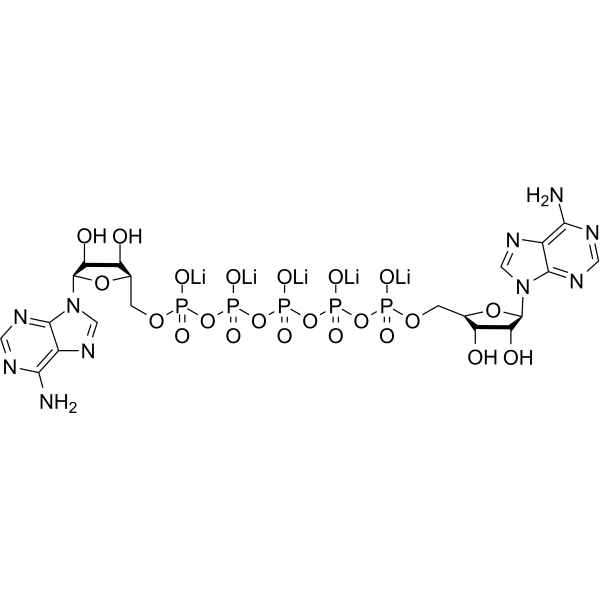
Synonyms: Ap5A pentalithium; P1,P5-Di(adenosine-5'-)pentaphosphate pentalithium
Target:  

Endogenous Metabolite

Diadenosine pentaphosphate (Ap5A; P1,P5-Di(adenosine-5'-)pentaphosphate) pentalithium is an endogenous generated diadenosine polyphosphate, possessing the dual identities of intracellular alarm signal and extracellular signaling molecule. Diadenosine pentaphosphate regulates calcium signaling in the nervous, cardiac and peripheral sensory systems by activating P2X1/P2X3/P2Y receptor and RyR2 channels (EC50 = 140 μM). Diadenosine pentaphosphate can be used in studies related to intracellular calcium release channels, cardiovascular diseases and nociception (pain) .
loading...
    loading...
Cat. No.: HY-100168R
CAS No.: 85233-19-8
BAPTA (Standard) is the analytical standard of BAPTA. This product is intended for research and analytical applications. BBAPTA is a selective and cell-impermeant chelator for calcium. BAPTA, as calcium indicator, has high selectivity against magnesium and calcium. BAPTA is widely used as an intracellular buffer for investigating the effects of Ca 2+ release from intracellular stores or influx via Ca 2+-permeable channels in the plasma membrane. BAPTA can also inhibit phospholipase C activity independently of their role as Ca 2+ chelators .
loading...
    loading...
Cat. No.: HY-100168AR
CAS No.: 126824-24-6
Research Areas:  

Others

BAPTA tetrasodium (Standard) is the analytical standard of BAPTA tetrasodium. This product is intended for research and analytical applications. BAPTA tetrasodium is a selective and cell-impermeant chelator for calcium. BAPTA tetrasodium, as calcium indicator, has high selectivity against magnesium and calcium. BAPTA tetrasodium is widely used as an intracellular buffer for investigating the effects of Ca 2+ release from intracellular stores or influx via Ca 2+-permeable channels in the plasma membrane. BAPTA tetrasodium can also inhibit phospholipase C activity independently of their role as Ca 2+ chelators .
loading...
    loading...
Cat. No.: HY-105521A
CAS No.: 94096-42-1
Synonyms: (S)-Nafenodone; LU-43706
Research Areas:  

Neurological Disease

Dexnafenodone hydrochloride ((S)-Nafenodone; LU-43706) is a novel antidepressant candidate molecule that selectively inhibits the norepinephrine synaptosomal uptake transporter. Dexnafenodone hydrochloride inhibits the fast inward Na + current and slow inward Ca 2+ current in cardiomyocytes. Dexnafenodone hydrochloride inhibits voltage-gated and receptor-activated Ca 2+ influx in vascular smooth muscle, depletes norepinephrine-sensitive intracellular Ca 2+ stores, suppresses agonist-stimulated Ca 2+ influx, relaxes precontracted vascular smooth muscle, inhibits spontaneous myogenic activity, and modulates cardiac electrophysiology, exerting negative chronotropic and negative inotropic effects. Dexnafenodone hydrochloride can be used in the research of depression .
loading...
    loading...
Cat. No.: HY-100168BR
CAS No.: 73630-08-7
BAPTA tetrapotassium (Standard) is the analytical standard of BAPTA tetrapotassium (HY-100168B). This product is intended for research and analytical applications. BAPTA tetrapotassium is a selective and cell-impermeant chelator for calcium. BAPTA tetrapotassium, as calcium indicator, has high selectivity against magnesium and calcium. BAPTA tetrapotassium is widely used as an intracellular buffer for investigating the effects of Ca 2+ release from intracellular stores or influx via Ca 2+-permeable channels in the plasma membrane. BAPTA tetrapotassium can also inhibit phospholipase C activity independently of their role as Ca 2+ chelators .
loading...
    loading...
Cat. No.: HY-E71616
Research Areas:  

Others

2'-Phospho-ADP-ribosyl cyclase/2'-phospho-cyclic-ADP-ribose transferase (EC 2.4.99.20) catalyses both the removal of nicotinamide from NADP+, forming 2'-phospho-cyclic ADP-ribose, and the addition of nicotinate to the cyclic product, forming NAADP+, a calcium messenger that can mobilize intracellular Ca2+ stores and activate Ca2+ influx to regulate a wide range of physiological processes.
loading...
    loading...
Cat. No.: HY-105521
CAS No.: 92629-87-3
Synonyms: (S)-Nafenodone free base; LU-43706 free base
Research Areas:  

Neurological Disease

Dexnafenodone ((S)-Nafenodone free base; LU-43706 free base) is a novel antidepressant candidate molecule that selectively inhibits the norepinephrine synaptosomal uptake transporter. Dexnafenodone inhibits the fast inward Na + current and slow inward Ca 2+ current in cardiomyocytes. Dexnafenodone inhibits voltage-gated and receptor-activated Ca 2+ influx in vascular smooth muscle, depletes norepinephrine-sensitive intracellular Ca 2+ stores, suppresses agonist-stimulated Ca 2+ influx, relaxes precontracted vascular smooth muscle, inhibits spontaneous myogenic activity, and modulates cardiac electrophysiology, exerting negative chronotropic and negative inotropic effects. Dexnafenodone can be used in the research of depression .
loading...
    loading...

