7 Results for "

ionic complex

" in MedChemExpress (MCE) Product Catalog:
Products (7)

7 Results for "ionic complex" in MCE Product Catalog:

6
6 Cited Publications
Art. -Nr.: HY-128974
CAS. Nr.: 69227-93-6
Reinheit:  99.97%
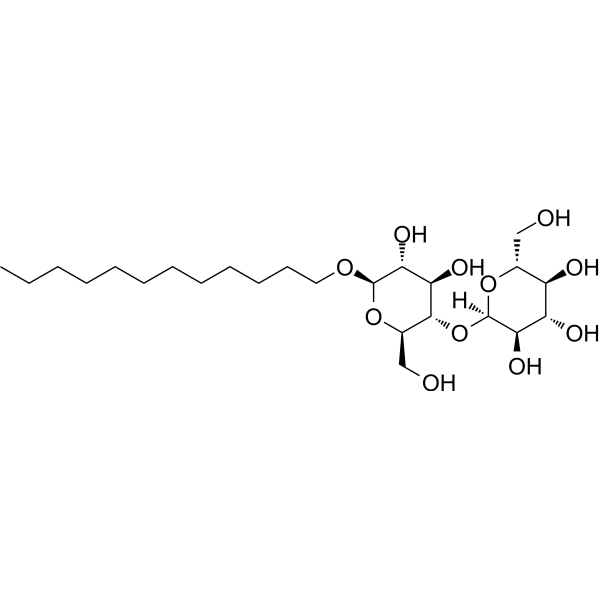
Synonyms: Lauryl Maltoside
Target:  

DNA/RNA Synthesis

Forschungsgebiete:  

Others

N-Dodecyl-β-D-maltoside (Lauryl Maltoside) is a non-ionic detergent. N-Dodecyl-β-D-maltoside has strong adsorption on alumina, titanium dioxide and hematite. N-Dodecyl-β-D-maltoside can promote the reactivation of various proteins. N-Dodecyl-β-D-maltoside can effectively stabilize photoactive reaction center complexes (RCs) and inhibit the degradation of Rhodopseudomonas spheroides R-26 reaction center in solution. N-Dodecyl-β-D-maltoside can be used for purification and stabilization of RNA polymerase and for detection of protein-lipid interactions .
loading...
    loading...
Art. -Nr.: HY-W099536
CAS. Nr.: 5274-68-0
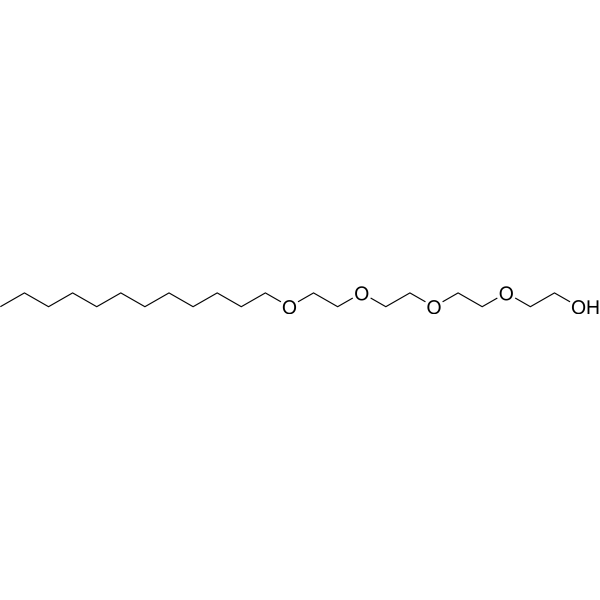
Synonyms: Tetraoxyethylene glycol monododecyl ether
Forschungsgebiete:  

Others

PEG-4 lauryl ether is a non-ionic detergent that can be used as an excipient or for the isolation of functional membrane complexes .
loading...
    loading...
Art. -Nr.: HY-W142692
CAS. Nr.: 59122-55-3
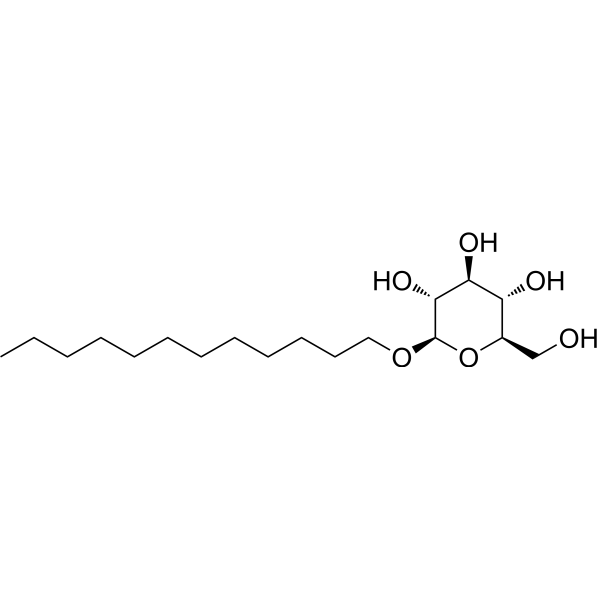
Dodecyl β-D-glucopyranoside is a non-ionic detergent and surfactant commonly used to solubilize and purify membrane proteins in biochemical research. Dodecyl β-D-glucopyranoside also interacts with bovine serum albumin (BSA) to quench its intrinsic fluorescence. The critical micelle concentration (CMC) of Dodecyl β-D-glucopyranoside (DG) and DG/BSA complex is 2.0 mM and 2.34 mM, respectively. Micelles can be formed in aqueous solutions above this concentration .
loading...
    loading...
Art. -Nr.: HY-128974S
CAS. Nr.: 849110-74-3
Synonyms: Lauryl Maltoside-d25
N-Dodecyl-β-D-maltoside-d25 (Lauryl Maltoside-d25) is deuterium labeled N-Dodecyl-β-D-maltoside (HY-128974). N-Dodecyl-β-D-maltoside is a non-ionic detergent. N-Dodecyl-β-D-maltoside has strong adsorption on alumina, titanium dioxide and hematite. N-Dodecyl-β-D-maltoside can promote the reactivation of various proteins. N-Dodecyl-β-D-maltoside can effectively stabilize photoactive reaction center complexes (RCs) and inhibit the degradation of Rhodopseudomonas spheroides R-26 reaction center in solution. N-Dodecyl-β-D-maltoside can be used for purification and stabilization of RNA polymerase and for detection of protein-lipid interactions .
loading...
    loading...
Art. -Nr.: HY-W721612
CAS. Nr.: 5711-40-0
Target:  

Drug Metabolite

Forschungsgebiete:  

Cancer

Bromobric acid is a derivative of bromoacrylic acid with cytostatic and antineoplastic activity that can form ionic complexes with glucosamine to achieve controlled-release oral administration
loading...
    loading...
Art. -Nr.: HY-184755
CAS. Nr.: 25087-26-7
Synonyms: PMAA
Forschungsgebiete:  

Others

Poly(methacrylic acid) (PMAA) is a pH/ionic strength-responsive swelling agent and polycation complexing agent. Poly(methacrylic acid) undergoes reversible swelling and size changes through carboxylic acid ionization and sodium ion charge shielding. As a weak polyacid, Poly(methacrylic acid) forms cross-linked hydrogels and hollow capsules for the entrapment and storage of macromolecules. Poly(methacrylic acid) forms electrostatic complexes with polycations to reduce capsule permeability, and high-salt conditions disrupt such complexes to enable macromolecule release .
loading...
    loading...
Art. -Nr.: HY-184820
CAS. Nr.: 54193-36-1
Synonyms: PMAA sodium
Forschungsgebiete:  

Others

Poly(methacrylic acid) sodium is a pH/ionic strength-responsive swelling agent and polycation complexing agent. Poly(methacrylic acid) sodium undergoes reversible swelling and size changes through carboxylic acid ionization and sodium ion charge shielding. As a weak polyacid, Poly(methacrylic acid) sodium forms cross-linked hydrogels and hollow capsules for the entrapment and storage of macromolecules. Poly(methacrylic acid) sodium forms electrostatic complexes with polycations to reduce capsule permeability, and high-salt conditions disrupt such complexes to enable macromolecule release .
loading...
    loading...

