7 Results for "

nitric acid solutions

" in MedChemExpress (MCE) Product Catalog:
Products (7)

7 Results for "nitric acid solutions" in MCE Product Catalog:

2
2 Cited Publications
Cat. No.: HY-101394
CAS No.: 136587-13-8
Purity:  ≥98.0%
Target:  

NO Synthase

Research Areas:  

Others

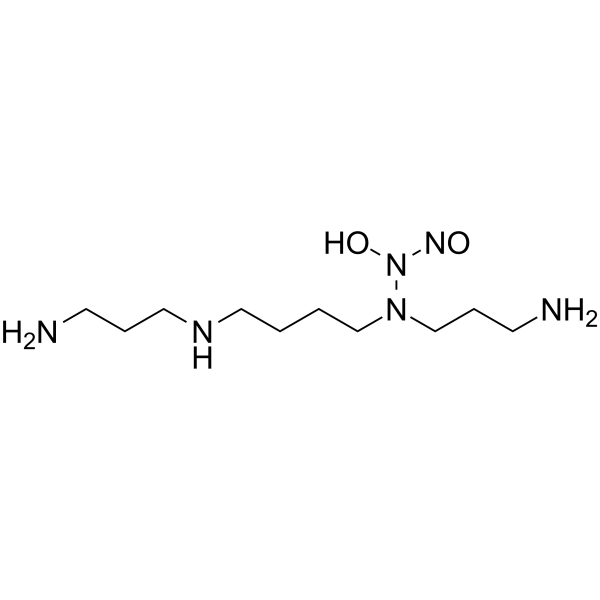
Spermine NONOate is a complex of nitric oxide (NO) with spermine and acts as a NO donor. Spermine NONOate can be used for NO aqueous solutions preparing .
loading...
    loading...
Cat. No.: HY-DY1048
CAS No.: 254109-22-3
DAF-FM DA (Diaminofluorescein-FM diacetate) (solution) is a fluorescent probe for the detection and bioimaging of nitric oxide (NO). DAF-FM DA spontaneously crosses the plasma membrane and is subsequently cleaved by esterases to generate intracellular DAF-FM (Ex/Em=495/515 nm) .
Solvent and concentration: DMSO: 2 mM
loading...
    loading...
Cat. No.: HY-W009048
CAS No.: 16069-36-6
Synonyms: DCH18C6; Perhydrodibenzo-18-crown-6
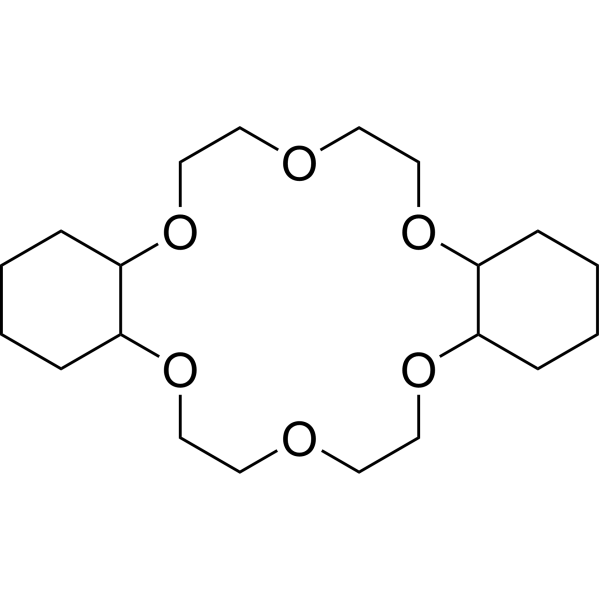
Dicyclohexano-18-crown-6-ether (DCH18C6) is an excellent strontium chelating agent. Dicyclohexano-18-crown-6-ether exhibits favorable extraction capacity and selectivity toward Sr (II). After chemical modification, Dicyclohexano-18-crown-6-ether is covalently bonded to an organosilicon matrix via co-condensation. DCH18C6-functionalized organosilicon materials are expected to be applied to the extraction and separation of strontium from radioactive waste liquid .
loading...
    loading...
Cat. No.: HY-130229
CAS No.: 213126-92-2
Synonyms: (±)5,6-DiHETrE lactone
Target:  

Drug Derivative

Research Areas:  

Cardiovascular Disease

5,6-DiHET lactone ((±)5,6-DiHETrE lactone) is a lactonized form of 5,6-EET and 5,6-DiHET. In solution, 5(6)-EET degrades into 5(6)-DiHET and 5(6)-δ-lactone, which can be converted to 5(6)-DiHET and quantified by GC-MS.1 5,6-DiHET potently induces vasodilation of isolated canine coronary arterioles, with 41 and 100% inhibition occurring at 0.01 and 100 pM, respectively. It also induces vasodilation in isolated human microvessels and increases intracellular calcium levels in a dose-dependent manner, an effect that can be blocked by the nitric oxide scavenger L-NAME.
loading...
    loading...
Cat. No.: HY-B0167E
Salicylic acid Sterile Solution (1 mg/mL) is a sterile solution suitable for plant culture. Salicylic acid (HY-B0167) is a weak acid that, once inside the plant, can activate growth regulators such as nitric oxide, thereby influencing plant growth and development. Salicylic acid can also regulate plant cell metabolism and membrane permeability, improving the plant's resistance to adverse conditions.
loading...
    loading...
Cat. No.: HY-DY2050
Methylene Blue Staining Solution (1%) (Basic Blue 9) is a guanylyl cyclase (sGC), monoamine oxidase A (MAO-A) and NO synthase (NOS) inhibitor. Methylene Blue Staining Solution (1%) is a vasopressor and is often used as a dye in several medical procedures. Methylene Blue Staining Solution (1%) through the nitric oxide syntase/guanylate cyclase signalling pathway to reduce prepulse inhibition. Methylene Blue Staining Solution (1%) is a REDOX cycling compound and able to cross the blood-brain barrier. Methylene Blue Staining Solution (1%) is a Tau aggregation inhibitor. Methylene Blue Staining Solution (1%) is a photosensitizer and redox agent. Methylene Blue Staining Solution (1%) reduces cerebral edema, attenuated microglial activation and reduced neuroinflammation .
loading...
    loading...
Cat. No.: HY-D3351
CAS No.: 2668963-61-7
Target:  

Fluorescent Dye

Research Areas:  

Inflammation/Immunology

PNO1 is a fluorescent probe for pulmonary fibrosis detection. The detection mechanism of PNO1 relies on sensing upregulated nitric oxide (NO) in the pulmonary fibrosis (PF) microenvironment. PNO1 contains an aniline group that reacts with NO or its derivatives under acidic conditions to form an N-nitrosylated intermediate, which is subsequently converted into a diazonium salt and undergoes deamination, eliminating the intramolecular electron transfer quenching effect and triggering a fluorescence turn-on response. The excitation wavelength of PNO1 includes 545 nm in in vitro solution studies, while an excitation range of 520-550 nm is used for cell, tissue and in vivo imaging; its emission wavelength centers at 572 nm in the unreacted state, and shifts to 559 nm with enhanced fluorescence intensity upon binding to NO. PNO1 can be used for pulmonary fibrosis research .
loading...
    loading...

