18 Results for "

phencyclidine receptor

" in MedChemExpress (MCE) Product Catalog:
Products (18)

18 Results for "phencyclidine receptor" in MCE Product Catalog:

13
13 Publications Verification
Cat. No.: HY-16996A
CAS No.: 138356-21-5
Target:  

Sigma Receptor

Research Areas:  

Neurological Disease

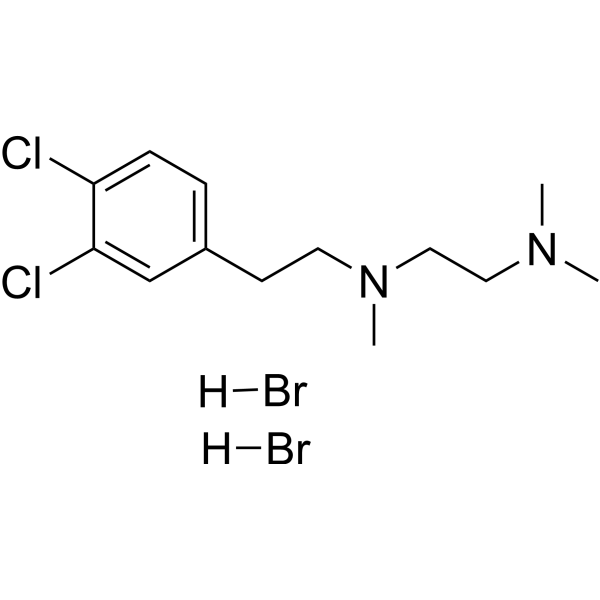
BD-1047 dihydrobromide is a selective functional antagonist of sigma receptors. BD-1047 dihydrobromide attenuates Apomorphine (HY-12723)-induced climbing and Phencyclidine-induced head twitches .
loading...
    loading...
2
2 Cited Publications
Cat. No.: HY-15543A
CAS No.: 1215721-40-6
Purity:  99.37%
Target:  

5-HT Receptor

Research Areas:  

Neurological Disease

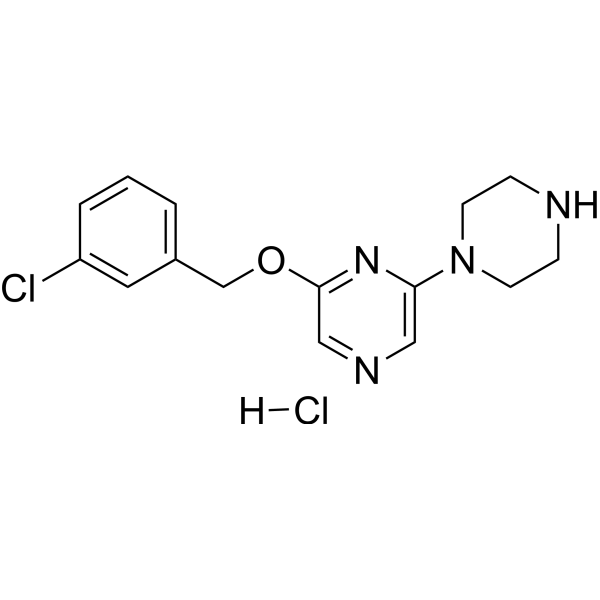
CP-809101 hydrochloride is a potent and highly selective 5-HT2C receptor agonist, with pEC50s of 9.96, 7.19 and 6.81 M for human 5HT2C, 5HT2B and 5HT2A receptor. CP-809101 hydrochloride inhibits conditioned avoidance responding in rats and antagonizes both PCP (phencyclidine hydrochloride)- and d-amphetamine-induced hyperactivity. CP-809101 hydrochloride also reduces food and nicotine dependence in rats, can be used in studies of antipsychotic and nicotine dependence .
loading...
    loading...
Cat. No.: HY-157959
CAS No.: 83-98-7
Synonyms: (±)-Orphenadrine
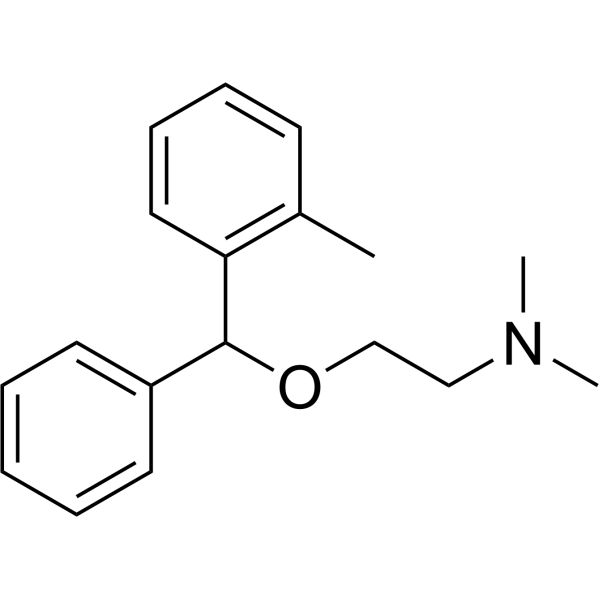
Orphenadrine ((±)-Orphenadrine) is a skeletal muscle relaxant and NMDA antagonist that also has antiparkinsonian, antihistamine, antitremor, antispasmodic, and analgesic effects. Orphenadrine inhibits the binding of [3H]MK-801 to the phencyclidine (PCP) binding site of the NMDA receptor. Orphenadrine is also an anticholinergic and CYP2B inducer. Orphenadrine may exert pro-tumor effects, causing CAR nuclear translocation, resulting in microsomal reactive oxygen species (ROS) production and oxidative stress. Orphenadrine also exerts neuronal protection, protecting rat cerebellar granule cells (CGC) from 3-NPA-induced death and has inhibitory potential against neurodegenerative diseases mediated by NMDA receptor overactivation .
loading...
    loading...
Cat. No.: HY-N2125
CAS No.: 174972-80-6
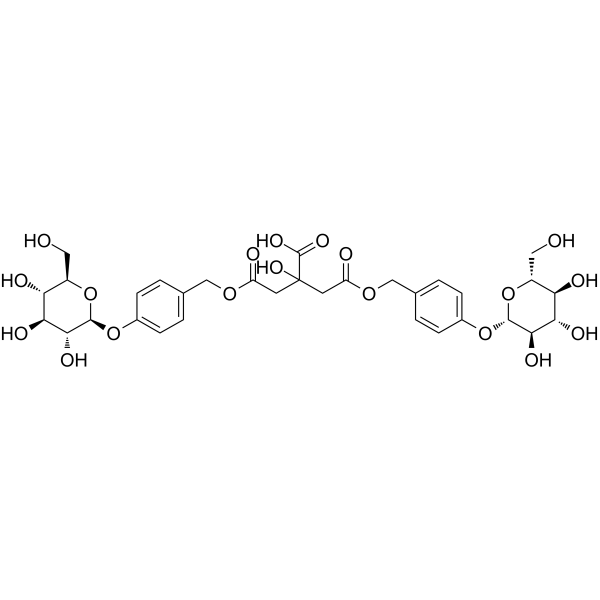
Parishin C is a brain-penetrant major bioactive component found in Gastrodia elata Blume. Parishin C is a 5-HT1A receptor agonist with an EC50 of 34 nM. Parishin C has antipsychotic and neuroprotective effects. Parishin C protects against Aβ-induced long-term potentiation damage and NMDA receptor current impairment. Parishin C reduces oxidative stress, pro-inflammatory cytokine levels, caspase activity, brain water content, and cerebral infarct volume; increases antioxidant enzyme activity and BDNF levels; improves nerve function and histopathological brain damage. Parishin C attenuates phencyclidine-induced immobility time increases, sociability deficits, and visual recognition memory impairment. Parishin C can be used for the research of ischemic stroke, Alzheimer's disease, and schizophrenia-like psychosis .
loading...
    loading...
Cat. No.: HY-103405A
CAS No.: 179333-18-7
Target:  

Dopamine Receptor

Research Areas:  

Neurological Disease

NGD 94-1 (dimaleate) is a potent and selective dopamine D4 receptor antagonist. NGD 94-1 (dimaleate) shows high affinity for the cloned human D4.2 receptor (Ki = 3.6 nM). NGD 94-1 (dimaleate) modulates the cognitive functions of the frontostriatal system and regulates dopaminergic transmission in Phencyclidine (PCP)-induced monkeys. NGD 94-1 (dimaleate) can be used for neurological disease research [1][2].
loading...
    loading...
Cat. No.: HY-114753
CAS No.: 163000-63-3
Synonyms: CR-2249; XY-2401
Target:  

iGluR

Research Areas:  

Neurological Disease

Neboglamine (CR-2249; XY-2401) is a modulator for N-methyl-D-aspartate (NMDA) receptor. Neboglamine increases the levels of fos-like immunoreactivity (FLI)-positive cells in the prefrontal cortex, nucleus accumbens, and lateral septal nucleus in rat models, .restores NMDA (HY-17551) -mediated neurotransmitter release, and inhibits phencyclidine-induced hyperlocomotion .
loading...
    loading...
Cat. No.: HY-15543
CAS No.: 479683-64-2
Target:  

5-HT Receptor

Research Areas:  

Neurological Disease

CP-809101 is a potent and highly selective 5-HT2C receptor agonist, with pEC50s of 9.96, 7.19 and 6.81 M for human 5HT2C, 5HT2B and 5HT2A receptor. CP-809101 inhibits conditioned avoidance responding in rats and antagonizes both PCP (phencyclidine hydrochloride)- and d-amphetamine-induced hyperactivity. CP-809101 also reduces food and nicotine dependence in rats, can be used in studies of antipsychotic and nicotine dependence .
loading...
    loading...
Cat. No.: HY-113981
CAS No.: 635318-20-6
Target:  

mGluR

Research Areas:  

Neurological Disease

LY459477 is a potent, selective and orally active metabotropic glutamate 2/3 receptor (mGluR2/3) agonist. LY459477 can effectively suppress Phencyclidine-evoked locomotor activity at doses that do not impair neuromuscular coordination. LY459477 can be used for the research of neurological disease .
loading...
    loading...
Cat. No.: HY-103405
CAS No.: 178928-68-2
Target:  

Dopamine Receptor

Research Areas:  

Neurological Disease

NGD94-1 is a potent and selective dopamine D4 receptor antagonist. NGD94-1 shows high affinity for the cloned human D4.2 receptor (Ki = 3.6 nM). NGD94-1 modulates the cognitive functions of the frontostriatal system and regulates dopaminergic transmission in Phencyclidine (PCP)-induced monkeys. NGD94-1 can be used for neurological disease research [1][2].
loading...
    loading...
Cat. No.: HY-W724221
Target:  

iGluR

Research Areas:  

Neurological Disease

3-Methoxyeticyclidine hydrochloride is a phencyclidine-type compound that has binding affinity for the N-methyl-D-aspartate receptor. 3-Methoxyeticyclidine hydrochloride has a certain degree of toxicity .
loading...
    loading...
Cat. No.: HY-16996
CAS No.: 138356-20-4
Target:  

Sigma Receptor

Research Areas:  

Neurological Disease

BD-1047 is a selective functional antagonist of sigma receptors. BD-1047 attenuates Apomorphine (HY-12723)-induced climbing and Phencyclidine-induced head twitches .
loading...
    loading...
Cat. No.: HY-16996AR
CAS No.: 138356-21-5
Target:  

Sigma Receptor

Research Areas:  

Neurological Disease

BD-1047 (dihydrobromide) (Standard) is the analytical standard of BD-1047 (dihydrobromide). This product is intended for research and analytical applications. BD-1047 dihydrobromide is a selective functional antagonist of sigma receptors. BD-1047 dihydrobromide attenuates Apomorphine (HY-12723)-induced climbing and Phencyclidine-induced head twitches .
loading...
    loading...
Cat. No.: HY-N2125R
CAS No.: 174972-80-6
Parishin C (Standard) is the analytical standard of Parishin C (HY-N2125). This product is intended for research and analytical applications. Parishin C is a brain-penetrant major bioactive component found in Gastrodia elata Blume. Parishin C is a 5-HT1A receptor agonist with an EC50 of 34 nM. Parishin C has antipsychotic and neuroprotective effects. Parishin C protects against Aβ-induced long-term potentiation damage and NMDA receptor current impairment. Parishin C reduces oxidative stress, pro-inflammatory cytokine levels, caspase activity, brain water content, and cerebral infarct volume; increases antioxidant enzyme activity and BDNF levels; improves nerve function and histopathological brain damage. Parishin C attenuates phencyclidine-induced immobility time increases, sociability deficits, and visual recognition memory impairment. Parishin C can be used for the research of ischemic stroke, Alzheimer's disease, and schizophrenia-like psychosis .
loading...
    loading...
Cat. No.: HY-W070884
CAS No.: 3000-75-7
Target:  

nAChR

Research Areas:  

Infection

nAChR-IN-2 (Compound 2) is an inhibitor of insect nicotinic acetylcholine receptors (nAChR). nAChR-IN-2 inhibits the binding of α-bungarotoxin (HY-P1264) to the ACh site of insect nAChR in honeybee heads, with an IC50 of 360 μM. nAChR-IN-2 also inhibits the binding of Phencyclidine to the NCB/PCP site of insect nAChR in honeybee heads, with an IC50 of 84 μM .
loading...
    loading...
Cat. No.: HY-187585
CAS No.: 104639-01-2
Fourphit is a dopamine transporter (DAT) inhibitor and phencyclidine (PCP) receptor binding agent. Fourphit irreversibly acylates the DAT [ 3H]methylphenidate binding site, reversibly binds to the PCP receptor, and sensitizes neuronal L-type DHP calcium channels. Fourphit attenuates K +-stimulated 45Ca 2+ uptake at high concentrations, and after its pretreatment, Nifedipine (HY-B0284) effectively inhibits this uptake without affecting resting calcium uptake. Fourphit reduces cocaine-induced hyperactivity, decreases cocaine-induced rearing frequency, enhances cocaine-induced thigmotaxis, elicits an acute increase in locomotor activity, and suppresses dark-cycle activity. Fourphit is used in research related to cocaine abuse and addiction .
loading...
    loading...
Cat. No.: HY-121285
CAS No.: 6495-46-1
Dioxadrol is an uncompetitive NMDA receptor (PCP binding site) antagonist, with a Ki value of 10.9 nM in pigs. Dioxadrol binds to the phencyclidine (PCP) binding site within the cation channel associated with the NMDA receptor, thereby blocking cation influx. Dioxadrol possesses local anesthetic, spasmolytic and central nervous system activities, including phencyclidine-like dissociative anesthetic properties. Dioxadrol can be used in the research of Alzheimer's disease, Parkinson's disease, Huntington's disease, HIV-associated dementia, multiple sclerosis, amyotrophic lateral sclerosis, neuropathic pain, ischemic stroke, central nervous system trauma, and epilepsy .
loading...
    loading...
Cat. No.: HY-179724
PZ-1657 (Compound 57) is an orally active, blood-brain barrier permeable, highly selective, and metabolically stable 5-HT7 receptor inverse agonist with a Ki value of 5 nM. PZ-1657 inhibits constitutive cyclic adenosine monophosphate (cAMP) production mediated by the Gs signaling pathway (EC50 value of 2.93 nM). PZ-1657 inhibits CYP3A4 P450 (IC50 = 12.2 μM) and hERG channels. PZ-1657 reduces 5-HT7 receptor-mediated MMP-9 activity. PZ-1657 reverses Phencyclidine-induced cognitive impairment. PZ-1657 possesses antidepressant properties .
loading...
    loading...
Cat. No.: HY-179724A
PZ-1657 hydrochloride (Compound 57) is a potent, selective and orally active 5-HT7 receptor inverse agonist with a Ki of 5 nM. PZ-1657 hydrochloride can inhibit the constitutive cAMP production mediated by the Gs signaling pathway (EC50 = 2.93 nM). PZ-1657 hydrochloride can significantly reduce the MMP-9 activity mediated by 5-HT7 receptors in the hippocampus of mice, and the effect is comparable to that of SB-269970 (HY-15370). PZ-1657 hydrochloride can reverse the cognitive deficits observed in the rat novel object recognition test induced by Phencyclidine without affecting the animals' spontaneous activities. PZ-1657 hydrochloride can be used for the research of emotional disorders, such as depression and bipolar disorder .
loading...
    loading...
  • 1

