


1. Search Result
Search Result
Results for "

phosphatidylinositol lipid

" in MedChemExpress (MCE) Product Catalog:

15

Inhibitors & Agonists

3

Biochemical Assay Reagents

2

Peptides

4

Natural
Products

1

Oligonucleotides

Targets Recommended:
Cat. No. Product Name Target Research Areas Chemical Structure
  • HY-P1902

    Apoptosis Cardiovascular Disease
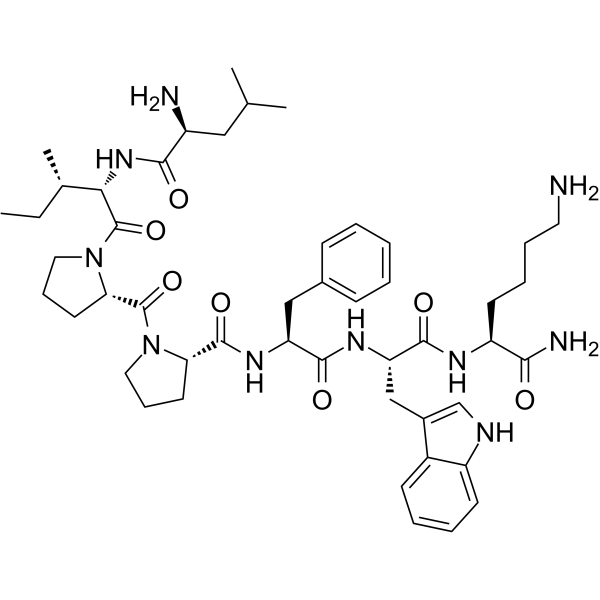
    Cardiotoxin Analog (CTX) IV (6-12) is a membrane active peptide that specifically targets negatively charged phospholipid membranes (such as phosphatidylserine and phosphatidylinositol). Cardiotoxin Analog (CTX) IV (6-12) was discovered in the venom of the Taiwan cobra. Cardiotoxin Analog (CTX) IV (6-12) is a chemically synthesized snake venom cardiotoxin that binds to cell membranes and embeds into lipid bilayers through hydrophobic interactions and electrostatic attraction, thereby destroying the stability of membrane structure. Cardiotoxin Analog (CTX) IV (6-12) can induce membrane lipid disorder and cell lysis, exhibiting hemolysis and cytotoxicity .
    Cardiotoxin Analog (CTX) IV (6-12)
  • HY-P1902A

    Apoptosis Cardiovascular Disease
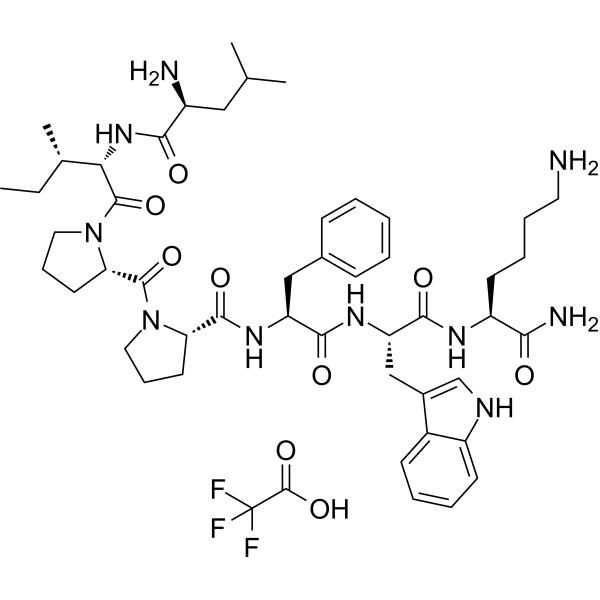
    Cardiotoxin Analog (CTX) IV (6-12) TFA is a membrane active peptide that specifically targets negatively charged phospholipid membranes (such as phosphatidylserine and phosphatidylinositol). Cardiotoxin Analog (CTX) IV (6-12) TFA was discovered in the venom of the Taiwan cobra. Cardiotoxin Analog (CTX) IV (6-12) TFA is a chemically synthesized snake venom cardiotoxin that binds to cell membranes and embeds into lipid bilayers through hydrophobic interactions and electrostatic attraction, thereby destroying the stability of membrane structure. Cardiotoxin Analog (CTX) IV (6-12) TFA can induce membrane lipid disorder and cell lysis, exhibiting hemolysis and cytotoxicity .
    Cardiotoxin Analog (CTX) IV (6-12) TFA
  • HY-158790

    Ferroptosis Cancer
    (R)-HTS-3 is an lysophosphatidylcholine acyltransferase 3 (LPCAT3) inhibitor, with an IC50 of 0.09 μM. (R)-HTS-3 suppresses the C20:4 content of PE, PC, and PS, while promoting a correspondingelevation in C22:4 phospholipids and a paradoxical increase in C20:4 phosphatidylinositol (PI) lipids .
    (R)-HTS-3
  • HY-139533

    Biochemical Assay Reagents Others
    Phosphatidylinositols, soya, sodium salts is a mixture of phosphatidylinositols. Phosphoinositides are lipids involved in the vesicular transport of proteins and lipids between the different compartments of eukaryotic cells. They act by recruiting and/or activating effector proteins and thus are involved in regulating various cellular functions, such as vesicular budding, membrane fusion and cytoskeleton dynamics .
    Phosphatidylinositols, soya, sodium salts
  • HY-142989

    Liposome HIV HCV HBV Infection Cancer
    1,2-Didocosahexaenoyl-sn-glycero-3-phosphocholine is a polyunsaturated phospholipid that serves as a component of lipid monolayers and small unilamellar vesicles. 1,2-Didocosahexaenoyl-sn-glycero-3-phosphocholine can be used to prepare endoplasmic reticulum-targeted liposomes (PERLs), which are composed of 1,2-didocosahexaenoyl-sn-glycero-3-phosphoethanolamine, l-α-phosphatidylinositol and l-α-phosphatidylserine at a molar ratio of 1.5:1.5:1:1. PERLs reduce cholesterol levels in human peripheral blood mononuclear cells (PBMCs) and decrease HIV-1 particle secretion from HIV-1-infected PBMCs. Liposomes formed from 1,2-Didocosahexaenoyl-sn-glycero-3-phosphocholine exhibit cytotoxicity against leukemia cells. 1,2-Didocosahexaenoyl-sn-glycero-3-phosphocholine is applicable to studies related to hepatitis C virus infection, HIV infection, hepatitis B virus infection and leukemia .
    1,2-Didocosahexaenoyl-sn-glycero-3-phosphocholine
  • HY-114457

    L-alpha-phosphatidylinositol-4,5-bisphosphate; (PtdIns)-(4,5)-P2

    Phospholipase Inflammation/Immunology
    Phosphatidylinositol 4,5-bisphosphate (L-alpha-Phosphatidylinositol-4,5-bisphosphate) is a plasma membrane lipid that is enriched in the cytoplasmic leaflet of the plasma membrane. Phosphatidylinositol 4,5-bisphosphate serves as a substrate for phospholipase C and class I PI3K, generating diacylglycerol, inositol (1,4,5)-trisphosphate, and phosphatidylinositol (3,4,5)-trisphosphate. Phosphatidylinositol 4,5-bisphosphate contributes to lamellipodial protrusion, directional cell migration, focal adhesion lipid generation, and trafficking of the GABAA receptor. Phosphatidylinositol 4,5-bisphosphate can be used in research related to acute lung injury and pulmonary edema .
    Phosphatidylinositol 4,5-bisphosphate
  • HY-167548

    PKC Potassium Channel Others
    L-α-Phosphatidylinositol-4,5-bisphosphate ammonium is a key signaling lipid. L-α-Phosphatidylinositol-4,5-bisphosphate ammonium is an activator of PKC in the presence of calcium ions and phospholipid serine. L-α-Phosphatidylinositol-4,5-bisphosphate ammonium is also an antagonist of the KIR3.4 (ATP-sensitive potassium, KATP) channel. L-α-Phosphatidylinositol-4,5-bisphosphate ammonium can be used in research related to signal transduction, ion channel regulation, and membrane transport.
    L-α-Phosphatidylinositol-4,5-bisphosphate ammonium
  • HY-174296

    PI5P4K Others
    TMX-4102 is a highly selective phosphatidylinositol 5-phosphate 4-kinase type II gamma (PIP4K2C) binder. TMX-4102 has binding activity to PIP4K2C (Kd = 0.45 nM) and has no significant effect on other lipid and non-lipid kinases.TMX-4102 specifically binds to PIP4K2C, regulating its scaffold function rather than its enzymatic activity. TMX-4102 can be used as a tool molecule to study the biological function and potential therapeutic value of PIP4K2C .
    TMX-4102
  • HY-124187

    Ethyl pinolenate

    Biochemical Assay Reagents Others
    Pinolenic acid is a polyunsaturated fatty acid found in the seed oils of red pine (Pinus orientalis) and maritime pine (Pinus pinaster). Both oils were found to have lipid-lowering properties. A diet containing marine pine nut oil (MPSO) reduces HDL and ApoA1 levels in transgenic mice expressing human ApoA1. MPSO was found to reduce cholesterol efflux in vitro. Korean pine nut oil supplements may help obesity by reducing appetite. People who take this oil experience an increase in the satiety hormones CCK and GLP-1 and a decrease in appetite. The activity of the oil is attributed to pinolenic acid. Pinolenic acid is not metabolized to arachidonic acid and can reduce the level of arachidonic acid in the phosphatidylinositol fraction of HepG2 cells from 15.9% to 7.0%. Pinolenic acid ethyl ester is a neutral, more lipophilic form of the free acid.
    Pinolenic acid ethyl ester
  • HY-E70633

    PI4P5K Neurological Disease
    PIP5K1C Recombinant Human Active Lipid Kinase is a phosphatidylinositol 4-phosphate 5-kinase (PIP5K) with nociceptive sensitization. PIP5K1C Recombinant Human Active Lipid Kinase can be used to study the role of PIP5K1C in nociceptive signaling and sensitization .
    PIP5K1C Recombinant Human Active Lipid Kinase
  • HY-179760

    Others Others
    16:0-7 Doxyl PC is a phosphocholine with a Doxyl group, which can be used as a membrane probe and a fluorescence quencher in the study of lipid bilayer structures, and is employed to study the membrane transport mediated by phosphatidylinositol translocase.
    16:0-7 Doxyl PC
  • HY-179883

    Others Others
    16:0-5 Doxyl PC is a phosphocholine with a Doxyl group, which can be used as a membrane probe and a fluorescence quencher in the study of lipid bilayer structures, and is employed to study the membrane transport mediated by phosphatidylinositol translocase.
    16:0-5 Doxyl PC
  • HY-179879

    Others Others
    16:0-16 Doxyl PC is a phosphocholine with a Doxyl group, which can be used as a membrane probe and a fluorescence quencher in the study of lipid bilayer structures, and is employed to study the membrane transport mediated by phosphatidylinositol translocase.
    16:0-16 Doxyl PC
  • HY-179543

    Endogenous Metabolite Others
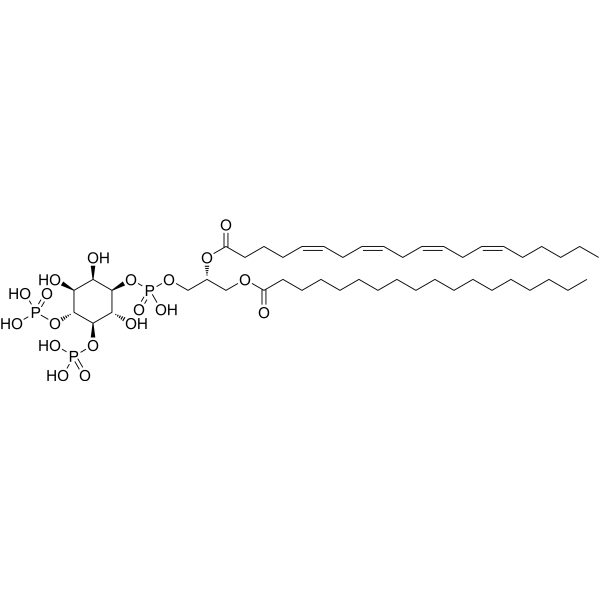
    PtdIns-(3,4,5)-P3-(1-stearoyl, 2-arachidonoyl) sodium is a specific molecular form of phosphatidylinositol-3,4,5-trisphosphate (PIP3). PIP3 is the core lipid messenger in the tyrosine kinase pathway, regulating cell proliferation, survival and metabolism by recruiting effector proteins. Its abnormality is associated with cancer. PtdIns-(3,4,5)-P3-(1-stearoyl, 2-arachidonoyl) sodium can be used for studying lipid signal transduction .
    PtdIns-(3,4,5)-P3-(1-stearoyl, 2-arachidonoyl) sodium
  • HY-N19037

    PI4P5K Others
    1,2-Dilinoleoyl phosphatidylinositol is a phosphatidylinositol. 1,2-Dilinoleoyl phosphatidylinositol acts as a substrate for phosphorylation by Phosphatidylinositol-4-phosphate 5-kinase (PI4P5K) isoforms α, β, and γ in in vitro assays .
    1,2-Dilinoleoyl phosphatidylinositol

Inquiry Online

Your information is safe with us. * Required Fields.

Salutation


Country or Region *

Applicant Name *


Organization Name *

Department *


Email Address *


Product Name *

Cat. No.


Requested quantity *

Phone Number *


Remarks

Inquiry Online

Inquiry Information

Product Name:
Cat. No.:
Quantity:
MCE Japan Authorized Agent:

