1. Search Result
Search Result
Pathways Recommended: Membrane Transporter/Ion Channel
Results for "

phospholipid model membranes

" in MedChemExpress (MCE) Product Catalog:

10

Inhibitors & Agonists

2

Biochemical Assay Reagents

1

Peptides

1

Natural
Products

2

Isotope-Labeled Compounds

3

Oligonucleotides

Cat. No. Product Name Target Research Areas Chemical Structure
  • HY-143202

    Liposome Biochemical Assay Reagents Others
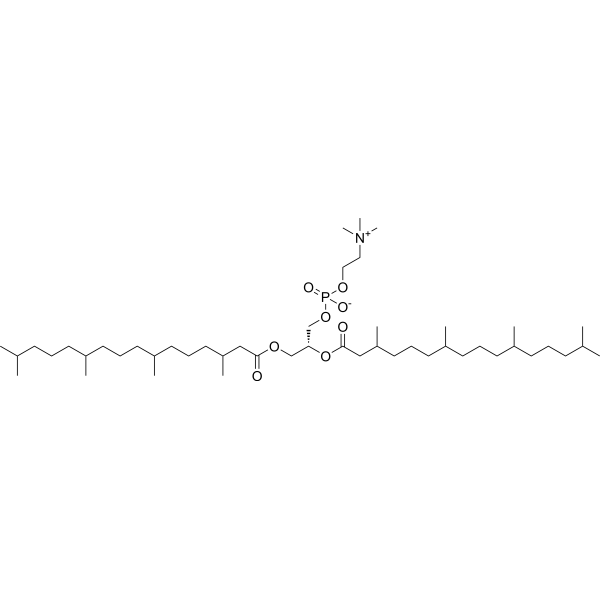
    DPhPC is a phospholipid compound characterized by high mechanical and chemical stability, broad temperature phase stability, and high electrical resistance. DPhPC readily forms unilamellar vesicles and solid-supported bilayers. DPhPC is commonly used as a component of nanoliposomal drug carriers or as a model membrane material for studies on membrane proteins/ion channels .
    DPhPC
  • HY-N1136

    Bacterial Infection
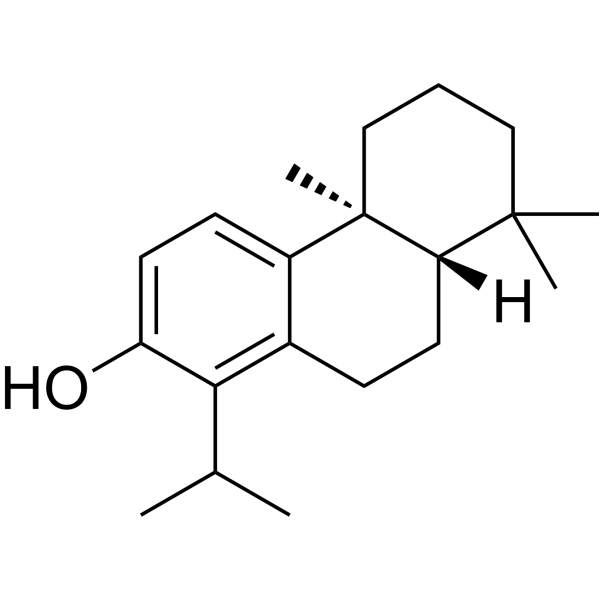
    (+)-Totarol is a diterpenoid membrane-disrupting agent and membrane structure regulator found in plants of the genus Podocarpus spp. (+)-Totarol inserts into phospholipid model membranes, disrupts phospholipid packing, and impairs the functional integrity of membranes. (+)-Totarol exhibits antibacterial activity against a variety of bacterial species and β-lactam-resistant strains, and its action is associated with changes in membrane physical properties. (+)-Totarol can be used in studies related to bacterial infections .
    (+)-Totarol
  • HY-W035091
    Tetrachloroauric acid
    1 Publications Verification

    Biochemical Assay Reagents Cardiovascular Disease Neurological Disease
    Tetrachloroauric acid is an Au (III) compound and bilayer disruptor that can be used to damage red blood cells. Tetrachloroauric acid specifically disrupts the bilayer structure of representative phospholipids (dimyristoylphosphatidylcholine and dimyristoylphosphatidylethanolamine) in human red blood cell membranes, and induces morphological changes in intact human red blood cells. Tetrachloroauric acid causes downregulation of MT I-II and GFAP expression in the mouse brain following chronic treatment. Tetrachloroauric acid is being used in studies related to neurotoxicity and hematotoxicity, including analyses of human red blood cells and molecular models of red blood cell membranes, as well as immunohistochemical evaluation of the mouse brain .
    Tetrachloroauric acid
  • HY-165029

    PLPC

    Liposome Others
    1-Palmitoyl-2-linoleoyl-sn-glycero-3-PC (PLPC) is a phospholipid used as a major component in lipid bilayer system models. 1-Palmitoyl-2-linoleoyl-sn-glycero-3-PC can serve as an untreated control, mixed with oxidized lipids such as 1-palmitoyl-2-(13-hydroxy-9,11-octadecanedienoyl)-lecithin (OHPLPC) and 1-palmitoyl-2-(13-hydroperoxy-9,11-octadecanedienoyl)-lecithin (HpPLPC), to study the effects of oxidation on membrane properties .
    1-Palmitoyl-2-linoleoyl-sn-glycero-3-PC
  • HY-142991

    POPG

    Liposome Others
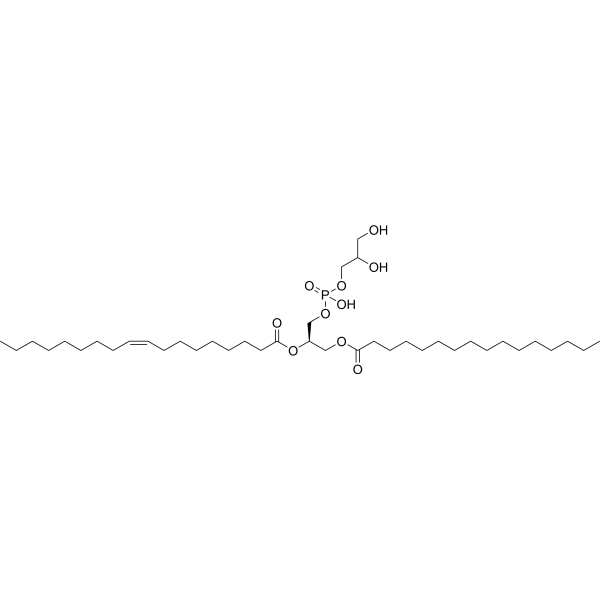
    1-Palmitoyl-2-oleoyl-sn-glycero-3-phosphatidylglycerol (POPG) is an anionic phosphatidylglycerol that often serves as a key component to co-construct model phospholipid bilayers with phosphatidylcholine (e.g., at a 3:1 POPC:POPG ratio) for investigating the structure and dynamics of transmembrane proteins. 1-Palmitoyl-2-oleoyl-sn-glycero-3-phosphatidylglycerol acts as a fundamental material for mimicking the physicochemical properties of biological membranes and enables the elucidation of membrane protein interaction mechanisms .
    1-Palmitoyl-2-oleoyl-sn-glycero-3-phosphatidylglycerol
  • HY-P11430

    Biochemical Assay Reagents Infection
    UBI (31-38) is a Ubiquicidin-derived octapeptide and anti-bacterial agent. UBI (31-38) selectively interacts with anionic phospholipid membranes and restricts lipid lateral motion. UBI (31-38) induces anionic vesicle aggregation via electrostatic repulsion screening, and undergoes conformational changes in membrane-mimicking environments. UBI (31-38) can be used for the research of infection imaging probes .
    UBI (31-38)
  • HY-179542

    Drug Derivative Others
    PtdIns-(4)-P1-(1,2-dihexanoyl) sodium is a synthetic phosphatidylinositol (PtdIns) derivative. PtdIns-(4)-P1-(1,2-dihexanoyl) sodium can be used as a membrane phospholipid model in in vitro enzymology studies .
    PtdIns-(4)-P1-(1,2-dihexanoyl) sodium
  • HY-179541

    Drug Derivative Others
    PtdIns-(5)-P1-(1,2-dioctanoyl) ammonium is a synthetic phosphatidylinositol (PtdIns) derivative. PtdIns-(5)-P1-(1,2-dioctanoyl) ammonium can be used as a membrane phospholipid model in in vitro enzymology studies .
    PtdIns-(5)-P1-(1,2-dioctanoyl) ammonium
  • HY-143202S1

    Isotope-Labeled Compounds Others
    DPhPC-d78 is the deuterium labeled DPhPC (HY-143202). DPhPC is a phospholipid compound characterized by high mechanical and chemical stability, broad temperature phase stability, and high electrical resistance. DPhPC readily forms unilamellar vesicles and solid-supported bilayers. DPhPC is commonly used as a component of nanoliposomal drug carriers or as a model membrane material for studies on membrane proteins/ion channels .
    DPhPC-d78
  • HY-143202S

    Isotope-Labeled Compounds Biochemical Assay Reagents Liposome Others
    DPhPC-d87 is the deuterium labeled DPhPC (HY-143202). DPhPC is a phospholipid compound characterized by high mechanical and chemical stability, broad temperature phase stability, and high electrical resistance. DPhPC readily forms unilamellar vesicles and solid-supported bilayers. DPhPC is commonly used as a component of nanoliposomal drug carriers or as a model membrane material for studies on membrane proteins/ion channels .
    DPhPC-d87

Inquiry Online

Your information is safe with us. * Required Fields.

Salutation


Country or Region *

Applicant Name *


Organization Name *

Department *


Email Address *


Product Name *

Cat. No.


Requested quantity *

Phone Number *


Remarks

Inquiry Online

Inquiry Information

Product Name:
Cat. No.:
Quantity:
MCE Japan Authorized Agent:

