
18 Results for "

photoacoustic imaging

" in MedChemExpress (MCE) Product Catalog:
Products (18)

18 Results for "photoacoustic imaging" in MCE Product Catalog:

Cat. No.: HY-P11051
CAS No.: 1259031-31-6
Research Areas:  

Cancer

GE11, Cys Conjugated is a peptide conjugate. GE11, Cys Conjugated consists of GE11 (HY-P10128) conjugated to a GGGGC sequence. GE11, Cys Conjugated can be used to synthesize stimulus-responsive peptide nanomaterials (SRPNs) for photoacoustic imaging and cancer research, such as studies on triple-negative breast cancer (TNBC) .
loading...
    loading...
Cat. No.: HY-137006
CAS No.: 57360-69-7
Target:  

Fluorescent Dye

Research Areas:  

Others

MTT Formazan is a purple water-insoluble product formed by the reduction of yellow soluble MTT by succinate dehydrogenase in the mitochondria of viable cells. The amount of MTT Formazan produced is proportional to cellular metabolic activity, and it can serve as an indicator for evaluating cell viability and proliferation. MTT Formazan exhibits solvent-dependent solubility properties, and its absorbance value can be measured by spectrophotometry to reflect cellular status. MTT Formazan also supports the assessment of cell viability in bacterial MTT assays. MTT Formazan can be used in photoacoustic microscopy to enhance the imaging effect of viable cells, especially in applications in the fields of three-dimensional cell culture and tissue engineering .
loading...
    loading...
Cat. No.: HY-106594A
CAS No.: 14038-43-8
Purity:  99.00%
Synonyms: Iron(III) ferrocyanide; Milori blue
Research Areas:  

Infection Cancer

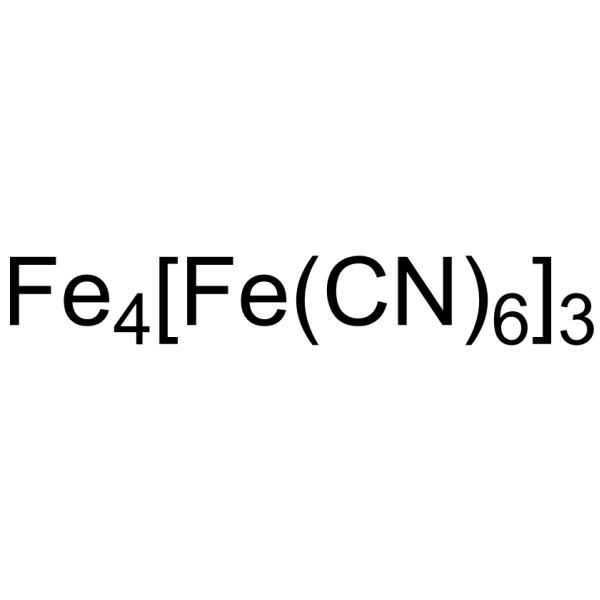
Prussian blue soluble is a good adsorbent to be used as antidotes for poisoning with cesium or thallium ions. Prussian blue soluble has anticancerous and antibacterial properties. Prussian blue soluble can be used as a contrast agent in photoacoustic and magnetic resonance imaging (MRI) .
loading...
    loading...
Cat. No.: HY-W250149
CAS No.: 1914-99-4
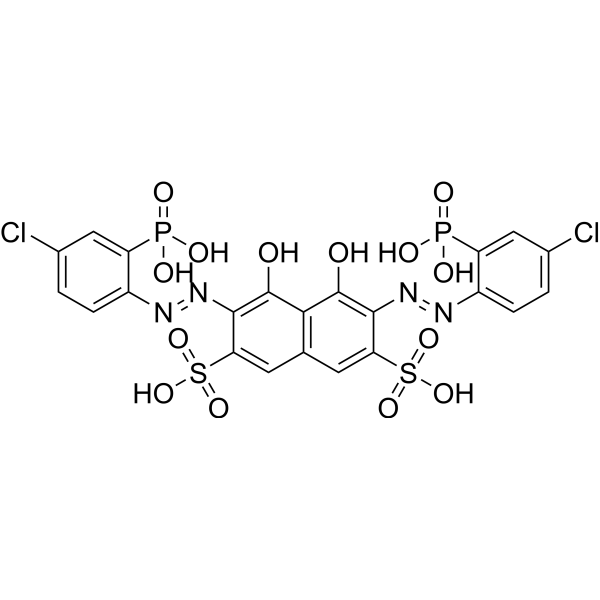
Chlorophosphonazo III is a cell membrane-permeable contrast agent and spectrophotometric reagent. Chlorophosphonazo III forms stable 1:1 complexes with intracellular calcium, magnesium, uranium, titanium, zirconium, thorium, scandium, equivalent actinides and protactinium. Chlorophosphonazo III generates photoacoustic signals correlated with Ca 2+ concentrations, which is applicable for imaging 3D tumor cell cultures and tumor spheroids. Chlorophosphonazo III exhibits no cytotoxicity, can be used for spectrophotometric detection of target ions, and the absorbance of its complexes remains stable for up to one week within the pH range of 2.2 to 7.0 .
loading...
    loading...
Cat. No.: HY-D2062
CAS No.: 1448146-89-1
ATTO 740 NHS ester is a near-infrared fluorescent dye and a multimodal fluorescence/photoacoustic contrast agent with excellent near-infrared emission properties and extremely high photostability. The photoacoustic signal of ATTO 740 NHS ester shows no significant decrease after continuous irradiation with a 750 nm laser for 30 min, making it suitable for in vivo fluorescence imaging and photoacoustic contrast imaging. When conjugated with the cystine knot peptide R01, ATTO 740 NHS ester enables precise detection of integrin αvβ6-positive cells and tumors in nude mouse xenograft models .
loading...
    loading...
Cat. No.: HY-106594B
CAS No.: 12240-15-2
Synonyms: Pigment blue 27
Prussian blue soluble is a good adsorbent to be used as antidotes for poisoning with cesium or thallium ions. Prussian blue soluble has anticancerous and antibacterial properties. Prussian blue soluble can be used as a contrast agent in photoacoustic and magnetic resonance imaging (MRI) .
loading...
    loading...
Cat. No.: HY-P11339
CAS No.: 841255-57-0
Target:  

Integrin

Research Areas:  

Cancer

c-RGD-SH is a ligand for integrin αvβ3 (Integrin αvβ3). Conjugation of c-RGD-SH with core-crosslinked polymeric micelles (CCPM) enables the synthesis of a bimodal nanoprobe, which can be labeled with Cy7 and 111In for SPECT and NIRF imaging of tumors .
loading...
    loading...
Cat. No.: HY-176513
Target:  

Fluorescent Dye

Research Areas:  

Others

Cy-OH-LP is a turn-on fluorescent and photoacoustic probe that can detect lipid-associated hydroxyl radicals. Cy-OH-LP can be oxidized to Cy7 in the presence of hydroxyl radicals, which displays weak fluorescent and photoacoustic signals in water-soluble environments and strong fluorescent and photoacoustic signals in lipid-rich environments due to its lipid solubility. Cy-OH-LP can be used for in vivo photoacoustic imaging of hydroxyl radicals .
loading...
    loading...
Cat. No.: HY-D1450
CAS No.: 155613-98-2
Synonyms: S01448
Target:  

Fluorescent Dye

Research Areas:  

Cancer

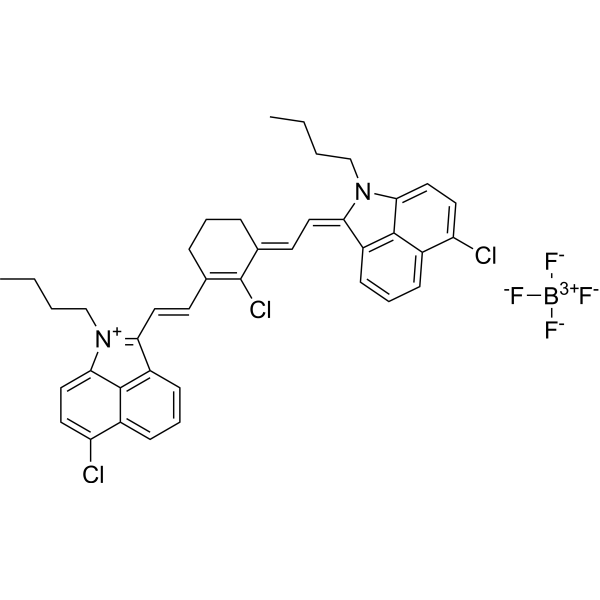
IR-1048 is a nitroreductase (NTR)-responsive near-infrared fluorescence (NIR)/photoacoustic (PA) imaging probe and photothermal agent. IR-1048 is coupled with a nitroimidazole group to form IR-1048-MZ. IR-1048-MZ is catalytically reduced by NTR in a hypoxic environment, restoring strong near-infrared absorption and fluorescence emission (NIR II window), while activating the photothermal effect. IR-1048 relies on NTR-mediated electron transfer to relieve intramolecular fluorescence quenching, achieving specific imaging and photothermal ablation of tumor hypoxic areas. IR-1048 is mainly used for high-contrast NIR II/photoacoustic imaging and photothermal therapy research and tumor diagnosis of the tumor hypoxic microenvironment .
loading...
    loading...
Cat. No.: HY-D3000
NIR-RED ROS-H2O2 Probe is a near-infrared fluorescent probe used for detecting hydrogen peroxide (H₂O₂) and featuring dual-modal fluorescence/photoacoustic imaging capabilities. NIR-RED ROS-H2O2 Probe successfully detects the upregulated fluorescence signal of H₂O₂ in HepG2 cells and a mouse liver injury model. NIR-RED ROS-H2O2 Probe can be used as a biomarker detection tool for drug-induced liver injury (DILI) .
loading...
    loading...
Cat. No.: HY-162051
CAS No.: 2952712-68-2
CYP1B1-IN-6 (compound 19) is a fluorescence molecular probes which inhibits CYP1B1 activity. CYP1B1-IN-6 can identify tumor sites in fluorescence imaging and photoacoustic imaging modes .
loading...
    loading...
Cat. No.: HY-155486
Target:  

Fluorescent Dye

Research Areas:  

Cancer

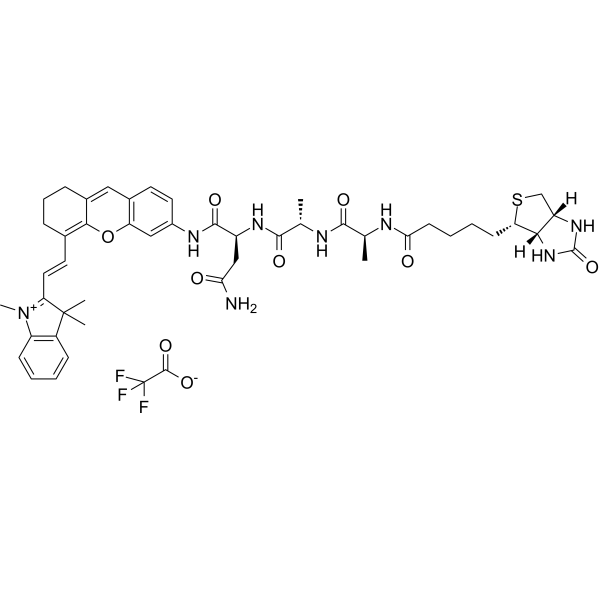
HCy-AAN-Bio is a tumor-targeted hemicyanine (HCy) probe for Fluorescent/photoacoustic (FL/PA) imaging of legumain in vivo. Legumain can specifically cleave HCy-AAN-Bio with the generation of FL/PA signal. HCy-AAN-Bio is a powerful tool for early diagnosis of associated cancer .
loading...
    loading...
Cat. No.: HY-D3136
Target:  

Fluorescent Dye

Research Areas:  

Cancer

MC-PSE is a fluorescent probe that can be used for glutathione (GSH) detection, NIR-II fluorescence imaging and ratiometric photoacoustic imaging. MC-PSE spontaneously forms J-aggregates in aqueous solution through π-π stacking, and its phenylselenyl group acts as a fluorescence quencher and GSH recognition receptor, thereby eliminating intrinsic fluorescence and generating a maximum absorption peak at 1000 nm. The excitation/emission wavelengths of MC-PSE are Ex = 808 nm and Em = 940 nm. MC-PSE can be applied in tumor-related research .
loading...
    loading...
Cat. No.: HY-D3133
CAS No.: 2410296-16-9
Target:  

Fluorescent Dye

Research Areas:  

Others

HS-CyBz is a Fluorescent probe for H₂S detection, enabling ratiometric optical/photoacoustic dual-modality in/ex vivo imaging. Its detection mechanism relies on nucleophilic substitution of its benzoic ester group by HS⁻, which releases an enolic meso-hydroxyltricarboheptamethine cyanine that then undergoes keto-enol tautomerization to form Cy-ketone; this tautomerization causes distinct shifts in absorption and emission spectra, producing a ratiometric response that reduces interferences from tissue scattering, autofluorescence, and probe concentration. In its initial state, HS-CyBz has an excitation wavelength of 595 nm, with emission bands centered at 805 nm (main) and 630 nm (minor); upon reaction with H₂S, the 805 nm emission band decreases while the 630 nm band drastically increases, and its absorption spectrum shows a sharp band at 775 nm and a shoulder band at 708 nm, which decrease upon H₂S reaction with a minor increase at 850 nm and an isosbestic point at 825 nm. For in vivo optical imaging, excitation at 560 nm is used with emission channels at 620 nm and 790 nm, while in vivo photoacoustic imaging uses excitation at 775 nm and 825 nm. The detection limit of HS-CyBz for H₂S is 0.5 μM, and it shows high selectivity, with only H₂S inducing a distinct enhancement of the emission ratio F₆₃₀/F₈₀₅ and PA ratio PA₈₂₅/PA₇₇₅, while other biochemical species including cations, anions, reactive oxygen species, biothiols, and carboxylesterase trigger only minor changes and do not interfere with H₂S sensing. Tail intravenous injection of HS-CyBz leads to accumulation in the liver of mice, and it can be used to verify endogenous H₂S upregulation triggered by S-adenosyl-L-methionine via ratiometric optical/photoacoustic imaging .
loading...
    loading...
Cat. No.: HY-106594BR
CAS No.: 12240-15-2
Synonyms: Pigment blue 27 (Standard)
Prussian blue soluble (Standard) is the analytical standard of Prussian blue soluble (HY-106594B). This product is intended for research and analytical applications. Prussian blue soluble is a good adsorbent to be used as antidotes for poisoning with cesium or thallium ions. Prussian blue soluble has anticancerous and antibacterial properties. Prussian blue soluble can be used as a contrast agent in photoacoustic and magnetic resonance imaging (MRI) .
loading...
    loading...
Cat. No.: HY-P11936
CAS No.: 2244402-11-5
Research Areas:  

Cancer

GPC3 targeting peptide 2 is a glypican-3 (GPC3) targeting peptide that binds specifically to GPC3 with a Kd of 39.5 nM. GPC3 targeting peptide 2 can be conjugated to IRDye800 via a GGGSC linker for near-infrared fluorescence and photoacoustic imaging, with a tumor-to-adjacent liver fluorescence intensity ratio of approximately 2-fold. GPC3 targeting peptide 2 shows high specificity for immunofluorescence staining of HCC specimens. GPC3 targeting peptide 2 can be used in studies related to GPC3-targeted molecular imaging and early detection of hepatocellular carcinoma .
loading...
    loading...
Cat. No.: HY-D3235
CAS No.: 2540586-21-6
FDOCl-22 is a HOCl-responsive probe. FDOCl-22 reacts with hypochlorous acid to significantly enhance near-infrared emission and absorption signals, enabling the detection of HOCl levels associated with reagent-induced acute kidney injury. FDOCl-22 can be used in studies related to reagent-induced acute kidney injury .
loading...
    loading...
Cat. No.: HY-D3080
Target:  

Fluorescent Dye

Research Areas:  

Others

CR-1 is a ratiometric photoacoustic (PA) probe for in-situ real-time imaging of Zn 2+ in deep living tissues. CR-1 is formed by coupling the near-infrared cyanine dye IR825 with the Zn 2+ ligand tris (2-pyridylmethyl) amine (TMPA). Upon binding to Zn 2+, the five N atoms on TMPA coordinate with Zn 2+, leading to double bond rearrangement of IR825 and attenuation of its π-electron conjugated system. The absorption peak of CR-1 blue-shifts from 710 nm to 532 nm, enabling quantitative detection of Zn 2+ via the PA532/PA710 ratio. Free CR-1 generates a strong PA signal at 710 nm, while CR-1 bound to Zn 2+ produces a strong PA signal at 532 nm .
loading...
    loading...
  • 1

