



Prussian blue insoluble

Based on 1 Customer Validation
Prussian blue soluble is a good adsorbent to be used as antidotes for poisoning with cesium or thallium ions. Prussian blue soluble has anticancerous and antibacterial properties. Prussian blue soluble can be used as a contrast agent in photoacoustic and magnetic resonance imaging (MRI).
For research use only. We do not sell to patients.
- CAS No.: 14038-43-8
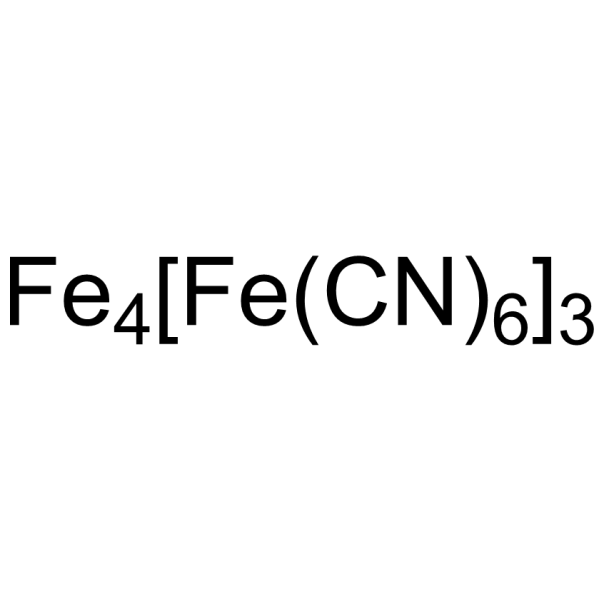
- Formula: Fe4[Fe(CN)6]3
- Molecular Weight:859.23
-
Storage:Powder -20°C, 3 years , 4°C, 2 years ; In solvent -80°C, 6 months , -20°C, 1 month

To place orders, for customer services and technical support, please contact: MedChemExpress USA
Tel: 609-228-6898 E-mail: [email protected] [email protected]


-
 Biological Activity
-
Chemical Information
- Protocols
- Purity & Documentation
- References
-
 Help & FAQs






Biological Activity
Description
In Vitro
Prussian blue insoluble (Iron(III) ferrocyanide) (0.1-3.0μg/mL; 24 hours; HUVECs) has photo-thermal effect and inhibits cell viabilities[1]. Prussian blue insoluble (Iron(III) ferrocyanide) (0.07 mM; 0-24 hours) act as a metabolic indicator, being reduced by bacterial metabolism, producing a visible color change from blue to colorless[2].
MedChemExpress (MCE) has not independently confirmed the accuracy of these methods. They are for reference only. Further protocols information, click here.
-
Cell Line:HUVECs
-
Concentration:24 hours
-
Incubation Time:0.1, 0.2, 0.5, 1.0, 2.0 and 3.0 μg/mL
-
Result:Decreased the cell viabilities as the time of NIR laser irradiation
In Vivo
MedChemExpress (MCE) has not independently confirmed the accuracy of these methods. They are for reference only.
-
Animal Model:Rats[3]
-
Dosage:3 g/day
-
Administration:Oral administration; 8 days
-
Result:Increased excretion of cesium-134.


Chemical Information
-
CAS No. 14038-43-8
-
Appearance Solid
-
Molecular Weight 859.23
-
Formula Fe4[Fe(CN)6]3
-
Color Blue to dark blue
-
SMILES
[Fe][Fe][Fe][Fe].N#C[Fe](C#N)(C#N)(C#N)(C#N)C#N.N#C[Fe](C#N)(C#N)(C#N)(C#N)C#N.N#C[Fe](C#N)(C#N)(C#N)(C#N)C#N
-
Synonyms
Iron(III) ferrocyanide; Milori blue
-
Shipping
Room temperature in continental US; may vary elsewhere.
-
Storage
Powder -20°C 3 years 4°C 2 years In solvent -80°C 6 months -20°C 1 month

Protocols
-
Research Protocol for Infectious Diseases
Infectious-disease experiments test how pathogens interact with host barriers, innate immune receptors, inflammatory signaling, pathogen replication, and tissue injury; pattern-recognition receptors such as TLRs, RIG-I-like receptors, NOD-like receptors, and inflammasomes detect microbial molecules and activate NF-κB, interferon, and cytokine responses. The central hypothesis is that infection severity reflects the balance between pathogen burden and host response: protective inflammation restricts pathogen growth, whereas excessive or mislocalized inflammation contributes to tissue damage and disease phenotype. Unresolved questions include which host pathways are protective versus pathogenic, why some infection models fail to translate to human disease, and which combined readouts best predict clinically relevant infection outcomes.


Purity & Documentation
-
Data Sheet (270 KB)
-
SDS (393 KB)
- English - EN (393 KB)
- Français - FR (393 KB)
- Deutsch - DE (393 KB)
- Norwegian - NO (393 KB)
- Español - ES (393 KB)
- Swedish - SV (393 KB)
- Italian - IT (393 KB)
- Korean - KR (393 KB)
- Portuguese - PT (393 KB)
-
Handling Instructions (2659 KB)
References
[1]. Chen HJ, et, al. Facile synthesis of Prussian blue nanoparticles as pH-responsive drug carriers for combined photothermal-chemo treatment of cancer. RCS advances. 2016 Oct 9; 7:248-255. [Content Brief]
[2]. Ferrer-Vilanova A, et, al. Electrochromogenic Detection of Live Bacteria Using Soluble and Insoluble Prussian Blue. ACS Omega. 2021 Nov 11;6(46):30989-30997. [Content Brief]
[3]. Thompson DF, et, al. Soluble or insoluble prussian blue for radiocesium and thallium poisoning? Ann Pharmacother. 2004 Sep;38(9):1509-14. [Content Brief]
[4]. Busquets MA, et, al. Prussian blue nanoparticles: synthesis, surface modification, and biomedical applications. Drug Discov Today. 2020 Aug;25(8):1431-1443. [Content Brief]

Calculators
Concentration (start) × Volume (start) = Concentration (final) × Volume (final)


Prussian blue insoluble Related Classifications
HY-106594A Related Classifications
 Powered by Bioz