9 Results for "

physicochemical analysis

" in MedChemExpress (MCE) Product Catalog:
Products (9)

9 Results for "physicochemical analysis" in MCE Product Catalog:

Cat. No.: HY-N11562
CAS No.: 55610-00-9
Aristololactam II is an aristololactam-related blue-fluorescent compound found in the callus tissue of Stephania cepharantha .
loading...
    loading...
Cat. No.: HY-107213
CAS No.: 280755-12-6
Synonyms: CP 547272
Target:  

Antibiotic Bacterial

Research Areas:  

Infection

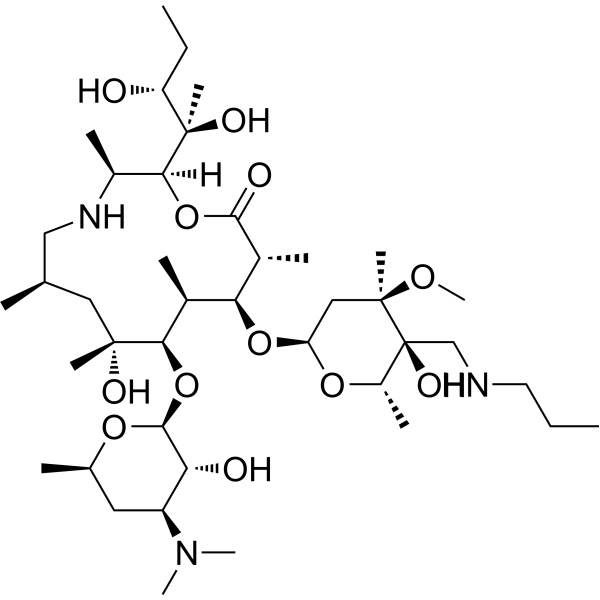
Tulathromycin B (CP 547272) is an isomer of Tulathromycin. Tulathromycin is a semi-synthetic macrolide triamilide that inhibits protein synthesis by binding to the 50S subunit of bacterial ribosomes and exhibits antibacterial activity. Tulathromycin B can be used in studies such as the analysis of Tulathromycin isomers, physicochemical properties, and veterinary drug residues .
loading...
    loading...
Cat. No.: HY-111333
CAS No.: 105888-54-8
Synonyms: Dioxapyrrolomycin; LL-F42248α; AL-R2081
Category:  

Microorganisms Antibiotics

Target:  

Bacterial

Pyrroxamycin is a novel antibiotic produced by Streptomyces, whose chemical structure was determined by chemical properties and X-ray crystallography and 13C NMR spectroscopy analysis. It is active against Gram-positive bacteria and dermatophytes. In this paper, the authors discuss the taxonomy, fermentation, isolation, physicochemical properties, chemical structure, and biological activity of the strain producing Pyrroxamycin.
loading...
    loading...
Cat. No.: HY-W250179
CAS No.: 5168-91-2
Synonyms: Polyoxyethylene (6) cetyl ether
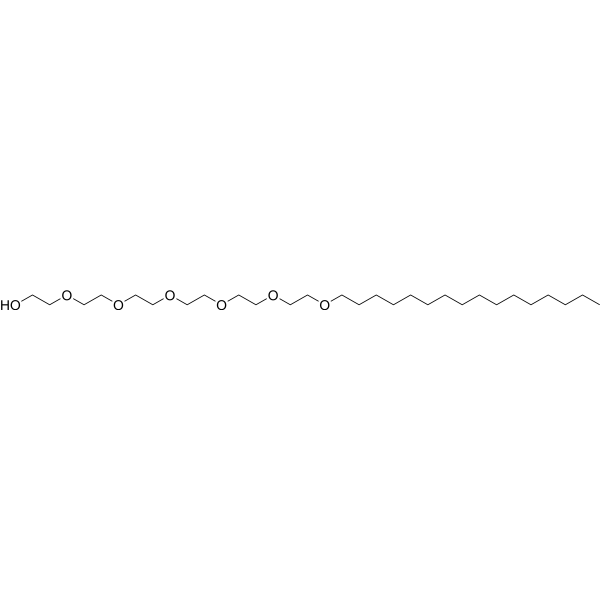
Hexaethylene glycol monohexadecyl ether, is a nonionic surfactant belonging to the polyethylene glycol (PEG) ether family. It has a hydrophilic head and a lipophilic tail, which makes it suitable for a wide range of applications. Specifically, Hexaethylene glycol monohexadecyl ether is commonly used in membrane protein research, for solubilization and stabilization of proteins, and for structural analysis techniques such as X-ray crystallography and electron microscopy. Additionally, Hexaethylene glycol monohexadecyl ether is used in a variety of other industrial and research applications, including drug delivery systems, nanotechnology, and diagnostic analysis. Its unique properties make it ideal for facilitating interactions between molecules with different physicochemical properties.
loading...
    loading...
Cat. No.: HY-121120
CAS No.: 77900-75-5
Isosulfazecin (iSZ) is a novel β-lactam antibiotic produced by Pseudomonas acidophilus sp., synthesized in a nutrient solution supplemented with glycerol and sodium thiosulfate under aerobic conditions in parallel with bacterial growth. It is purified by chromatography and crystallization from aqueous methanol. Physicochemical analysis determined its molecular formula to be C12H20N4O9S, showing a structure with a β-lactam ring, methoxyl and sulfonate groups. Acid hydrolysis yields L-alanine and D-glutamic acid. iSZ is a diastereomer of sulfadiazine and exhibits moderate activity against both gram-positive and gram-negative bacteria, but potent activity against bacteria resistant to β-lactam antibiotics .
loading...
    loading...
Cat. No.: HY-118243
CAS No.: 1089681-42-4
Target:  

Amyloid-β

Research Areas:  

Others

KMS88009 is a potent small molecule that directly interferes with the formation of amyloid-β oligomers, thereby preserving cognitive behavior when used preventively and reversing cognitive behavior decline when used therapeutically. Oral administration of KMS88009 around the onset of Alzheimer's disease symptoms significantly reduced the assembly of amyloid-β oligomers and improved cognitive behavior in the APP/PS1 double transgenic mouse model. This unique dual mode of action suggests that KMS88009 may be a powerful therapeutic candidate for the treatment of Alzheimer's disease. In an evaluation, the physicochemical properties, pharmacokinetics and toxicity of this anti-amyloidogenic small molecule KMS88009 were studied, as well as post-mortem analysis of APP/PS1 TG mice after behavioral testing.
loading...
    loading...
Cat. No.: HY-184604
Silver nanoclusters (AgNCs) are ultrasmall nanoparticles composed of several to tens of silver atoms. Their size is close to the Fermi wavelength of electrons, thus exhibiting unique molecular-like properties, such as strong fluorescence. Silver nanoclusters possess small size, low toxicity, excellent photostability, large Stokes shift, and good biocompatibility. Lipoic acid (also known as octylsulfonic acid) acts as a ligand in the synthesis of silver nanoclusters, primarily playing a role in stabilizing and protecting the silver nanoclusters. The ligand binds to silver atoms through its specific chemical structure, forming a stable nanocluster structure and influencing the physicochemical properties of the clusters, such as fluorescence performance, catalytic activity, and biocompatibility. This demonstrates potential application value in various fields such as chemical analysis, biosensing, catalysis, medicine, and bioimaging.
loading...
    loading...
Cat. No.: HY-L920
24,816 compounds
With the aging population and increasing competitive pressures, neurodegenerative diseases of the central nervous system (CNS) have become a serious medical challenge in modern society, including Parkinson's disease, Alzheimer's disease, brain tumors, and multiple sclerosis. The CNS MPO (Multi-Parameter Optimization) score is a widely recognized algorithm in medicinal chemistry. Developed by Pfizer, this method is based on an analysis of approved CNS drugs and their interior CNS drug candidates, establishing the CNS MPO rules. It incorporates six key physicochemical properties (ClogP, ClogD, MW, TPSA, HBD, and pKa) to prospectively optimize CNS drug attributes—such as high blood-brain barrier (BBB) permeability, low P-gp efflux liability, low metabolic clearance, and high safety—thereby improving the clinical success rate of CNS drug candidates. The CNS MPO compound library is a collection of compounds with CNS MPO scores greater than 5, specifically designed for CNS drug discovery.
Cat. No.: HY-L942
1,632 compounds

Unlike highly conserved orthosteric sites, allosteric sites exhibit low conservation, high hydrophobicity, weak polarity, confined geometry, and dynamic cryptic properties. Rather than rigid keyhole-like cavities, they typically appear as flexible grooves, subunit interface clefts, or shallow depressions formed by protein conformational changes.

Based on the dynamic, hydrophobic, and elongated nature of allosteric pockets, MCE has carried out targeted fragment modification and screening under strict physicochemical criteria: MW 120–280 Da, HBD ≤ 2, HBA ≤ 3, PSA 30–80 Ų, rotatable bonds ≤ 2, cLogP 1–3.5. High 3D diversity was further ensured by PMI analysis, yielding fragments with excellent shape complementarity to allosteric pockets.

This library contains 1,800 structurally diverse, drug-like fragments, this library supports allosteric drug development and pocket optimization. It significantly improves screening hit rates and enables efficient, precise early-stage R&D of allosteric drugs.

