6 Results for "

root number

" in MedChemExpress (MCE) Product Catalog:
Products (6)

6 Results for "root number" in MCE Product Catalog:

Cat. No.: HY-W051140
CAS No.: 10294-26-5
Synonyms: Disilver sulfate, 99%
Silver sulfate acts as an ethylene inhibitor and a shoot regeneration promoter. Silver sulfate promotes shoot proliferation in explants of the cherry rootstock CAB-6P. Silver sulfate is applicable to studies on the optimization of micropropagation for cherry rootstocks .
loading...
    loading...
Cat. No.: HY-W015810
CAS No.: 617-94-7
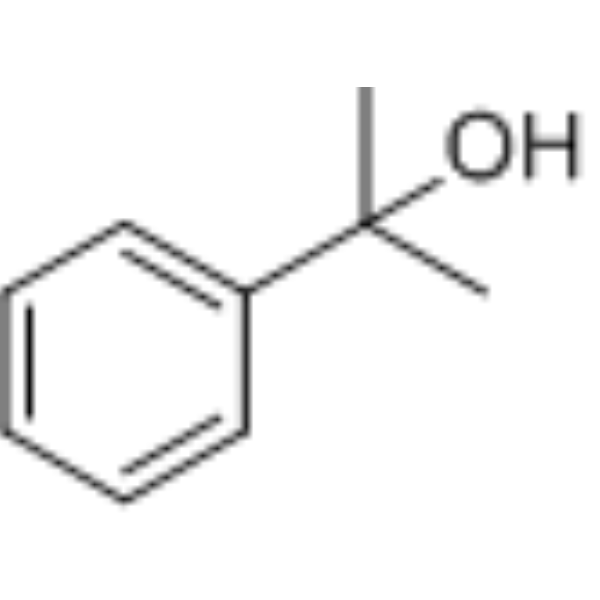
2-Phenyl-2-propanol is a volatile signaling compound released by rhizosphere microorganisms, and also a key product of the selective oxidation of cumene. 2-Phenyl-2-propanol alters primary root structure, regulates the expression of auxin and (±)-Jasmonic acid (HY-122464) responsive genes, and affects cell division. 2-Phenyl-2-propanol reduces the primary root length, lateral root number, lateral root density, and aboveground fresh weight of *Arabidopsis thaliana*. 2-Phenyl-2-propanol is commonly used in research related to cosmetics, pesticides, pharmaceuticals and other fields .
loading...
    loading...
Cat. No.: HY-W720629
CAS No.: 21420-37-1
Cyanamide- 15N2 is the 15N-labeled Cyanamide (HY-Y0070). Cyanamide is a cell division and plant growth inhibitor, as well as an allelochemical derived from Vicia villosa. Cyanamide inhibits root growth and biomass accumulation in a dose-dependent manner by disrupting the formation of mitotic spindles and phragmoplast complexes, reducing the number of mitotic cells and blocking the cell cycle. The effects of Cyanamide are partially reversible after removal from low-concentration environments. Cyanamide is also a specific inhibitor of aldehyde dehydrogenase (ALDH). Although Cyanamide has no direct effect on tumor growth, it can significantly enhance the anti-tumor efficacy of Cyclophosphamide (HY-17420) at non-toxic doses by inhibiting the inactivation of Cyclophosphamide. Cyanamide enables Cyclophosphamide to exert equivalent therapeutic effects at lower doses, effectively inhibiting the growth of primary and metastatic tumors and prolonging the lifespan of tumor-bearing mice. Cyanamide is commonly used in studies related to ha-1 hepatoma and rls lymphosarcoma .
loading...
    loading...
Cat. No.: HY-W015810R
CAS No.: 617-94-7
2-Phenyl-2-propanol (Standard) is the analytical standard of 2-Phenyl-2-propanol (HY-W015810). This product is intended for research and analytical applications. 2-Phenyl-2-propanol is a volatile signaling compound released by rhizosphere microorganisms, and also a key product of the selective oxidation of cumene. 2-Phenyl-2-propanol alters primary root structure, regulates the expression of auxin and (±)-Jasmonic acid (HY-122464) responsive genes, and affects cell division. 2-Phenyl-2-propanol reduces the primary root length, lateral root number, lateral root density, and aboveground fresh weight of *Arabidopsis thaliana*. 2-Phenyl-2-propanol is commonly used in research related to cosmetics, pesticides, pharmaceuticals and other fields .
loading...
    loading...
Cat. No.: HY-18778C
CAS No.: 866399-89-5
Synonyms: TA-8995 hemicalcium; DEZ-001 hemicalcium; AMG-899 hemicalcium
Target:  

CETP PCSK9 LDLR

Research Areas:  

Inflammation/Immunology

Obicetrapib hemicalcium (TA-8995 hemicalcium) is an orally active cholesteryl ester transfer protein (CETP) inhibitor. Obicetrapib hemicalcium shifts the plasma lipoprotein profile toward more HDL-C particles, reduces circulating PCSK9 levels, increases hepatic LDLR expression and LDLR mRNA levels, and promotes hepatic clearance of VLDL remnants. Obicetrapib hemicalcium increases the number of large HDL particles, reduces the number and area of atherosclerotic lesions and alleviates lesion severity, increases the proportion of unaffected arterial segments, improves lesion stability, and promotes regression of aortic root lesions. Obicetrapib hemicalcium also exerts a synergistic effect with Ezetimibe (HY-17376) to reduce non-HDL-C levels and improve atherosclerosis. Obicetrapib hemicalcium can be used in studies related to atherosclerosis and dyslipidemia .
loading...
    loading...
Cat. No.: HY-Y0070
CAS No.: 420-04-2
Cyanamide is a cell division and plant growth inhibitor, as well as an allelochemical derived from Vicia villosa. Cyanamide inhibits root growth and biomass accumulation in a dose-dependent manner by disrupting the formation of mitotic spindles and phragmoplast complexes, reducing the number of mitotic cells and blocking the cell cycle. The effects of Cyanamide are partially reversible after removal from low-concentration environments. Cyanamide is also a specific inhibitor of aldehyde dehydrogenase (ALDH). Although Cyanamide has no direct effect on tumor growth, it can significantly enhance the anti-tumor efficacy of Cyclophosphamide (HY-17420) at non-toxic doses by inhibiting the inactivation of Cyclophosphamide. Cyanamide enables Cyclophosphamide to exert equivalent therapeutic effects at lower doses, effectively inhibiting the growth of primary and metastatic tumors and prolonging the lifespan of tumor-bearing mice. Cyanamide is commonly used in studies related to ha-1 hepatoma and rls lymphosarcoma .
loading...
    loading...

