



1. Search Result
Search Result
Results for "

scan

" in MedChemExpress (MCE) Product Catalog:

30

Inhibitors & Agonists

1

Screening Libraries

1

Fluorescent Dye

4

Peptides

2

Recombinant Proteins

3

Antibodies

10

Oligonucleotides

Cat. No. Product Name Target Research Areas Chemical Structure
  • HY-B1410

    MP-328

    Biochemical Assay Reagents Others Cancer
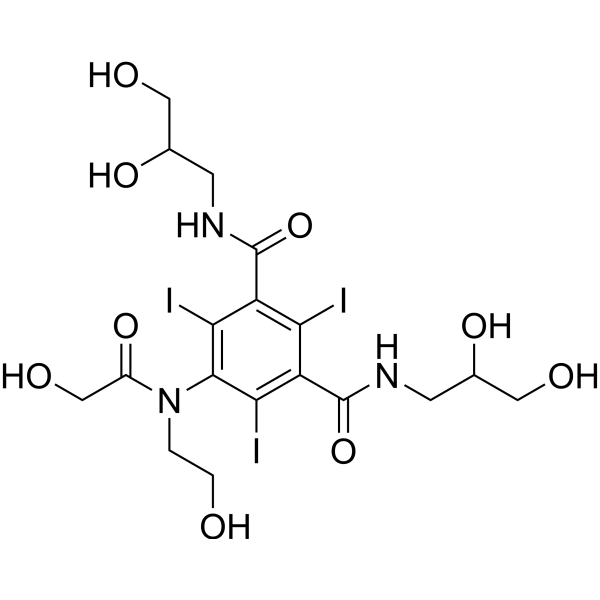
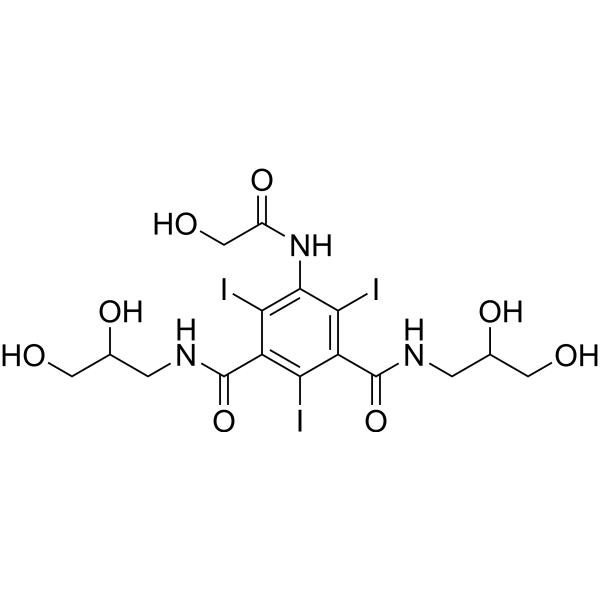
    Ioversol (MP-328) is a nonionic iodinated contrast medium (CM) that is used during a CT scan or x-ray in animal experiment. Ioversol does not damage the blood-brain barrier (BBB) in animal .
    Ioversol
  • HY-D1459

    Fluorescent Dye Metabolic Disease
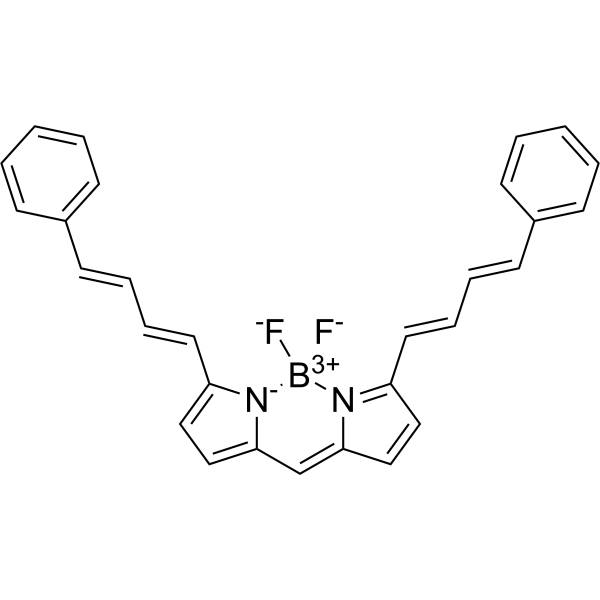
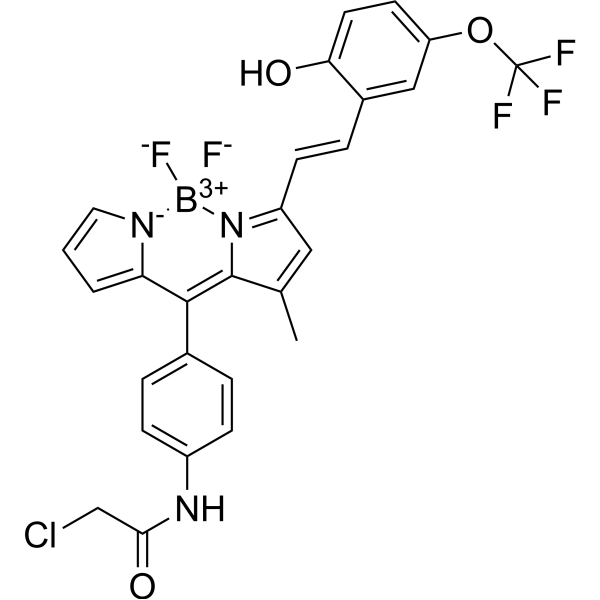
    BODIPY 665/676 is a lipophilic radical-sensitive fluorescent probe that can be used to study radical-driven lipid autoxidation (Ex/Em=665/676 nm) .
    BODIPY 665/676
  • HY-129650
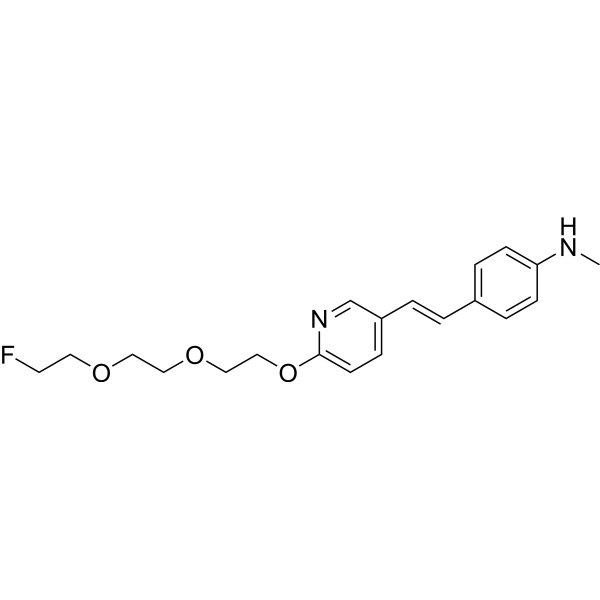
    Florbetapir
    1 Publications Verification

    AV-45; Flobetapir

    Biochemical Assay Reagents Others
    Flobetapir (AV-45) may be a well-tolerated imaging agent. Flobetapir synthesizes Florbetapir (18F) that is a PET scanning radiopharmaceutical compound containing the radionuclide fluorine-18 .
    Florbetapir
  • HY-146245F
    FAM-labeled ODN 1826 sodium
    1 Publications Verification

    Toll-like Receptor (TLR) Inflammation/Immunology Cancer
    FAM-labeled ODN 1826 sodium, a class B CpG ODN (oligodeoxynucleotide), is a TLR9 agonist. FAM-labeled ODN 1826 sodium can be used to evaluate CpG ODN cellular uptake and localization by confocal laser-scanning microscopy or flow cytometry.
    FAM-labeled ODN 1826 sodium
  • HY-150743B

    Toll-like Receptor (TLR) Inflammation/Immunology
    FITC-labeled ODN 2395 (sodium), a C class oligodeoxynucleotide, is a TLR9 agonist. FITC-labeled ODN 2395 (sodium) can be used to evaluate CpG ODN cellular uptake and localization by confocal laser-scanning microscopy (excitation 495 nm, emission 520 nm) or flow cytometry.
    FITC-labeled ODN 2395 sodium
  • HY-150724B

    Toll-like Receptor (TLR) Inflammation/Immunology
    FITC-labeled ODN 1018 (sodium),an oligodeoxynucleotide, is a TLR-9 agonist. FITC-labeled ODN 1018 (sodium) can be used to evaluate CpG ODN cellular uptake and localization by confocal laser-scanning microscopy (excitation 495 nm, emission 520 nm) or flow cytometry.
    FITC-labeled ODN 1018 sodium
  • HY-128890B
    DOTA-​NHS-ester TFA
    1 Publications Verification

    ADC Linker Biochemical Assay Reagents Cancer
    DOTA-​NHS-ester (TFA) is used as a linker for affibody molecules, and it can be employed in small animal positron emission tomography (PET), single photon emission computed tomography (SPECT), and CT scanning. DOTA-​NHS-ester can be used to label radiotracers or imaging probes for tumor detection .
    DOTA-​NHS-ester TFA
  • HY-177291

    Microsomal Triglyceride Transfer Protein (MTP) Smo Hedgehog LDLR Cardiovascular Disease Cancer
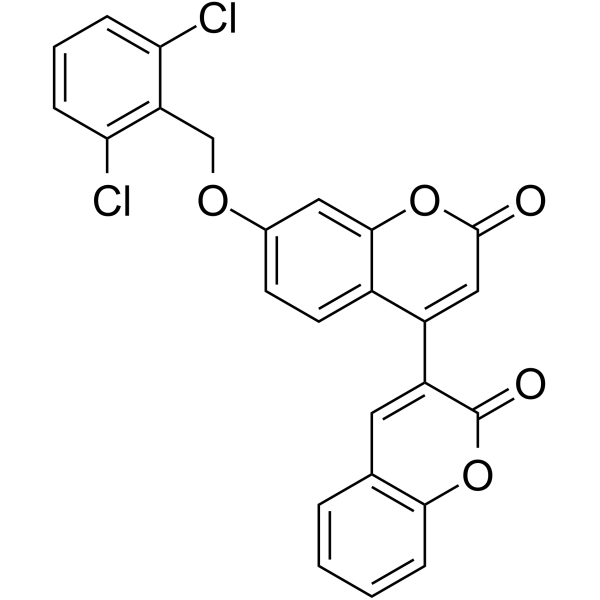
    LAB687 is a microsomal triglyceride transfer protein (MTP) inhibitor with an IC50 of 0.9 nM for apolipoprotein B (apoB) secretion in HepG2 cells. LAB687 also acts as a Smoothened (Smo) antagonist, with IC50 values of 2.48 μM and 3.42 μM against mouse and human Smo receptors, respectively. LAB687 reduces triglyceride and low-density lipoprotein cholesterol (LDL-C) levels, and inhibits the Hedgehog signaling pathway. LAB687 can be used in studies related to Hedgehog-dependent cancers .
    LAB687
  • HY-150741B

    Toll-like Receptor (TLR) Interleukin Related Inflammation/Immunology
    FITC-labeled ODN 2216 (sodium) is a human-specific TLR9 (toll-like receptor 9) ligand or agonist. FITC-labeled ODN 2216 (sodium) can be used to evaluate CpG ODN cellular uptake and localization by confocal laser-scanning microscopy (excitation 495 nm, emission 520 nm) or flow cytometry.
    FITC-labeled ODN 2216 sodium
  • HY-147750

    Phosphodiesterase (PDE) Neurological Disease Cancer
    TDP1 Inhibitor-2 (compound 5) is a potent inhibitor for TDP1 (tyrosyl-DNA phosphodiesterase 1), with an IC50 of 99 nM. TDP1 Inhibitor-2 also can inhibit SCAN1 (spinocerebellar ataxia syndrome with axonal neuropathy), with an IC50 of 3.5 μM .
    TDP1 Inhibitor-2
  • HY-P3911

    Bacterial Infection
    CAP 37 (20-44) is a peptide based on amino acid residues 20 through 44 of CAP37. CAP37, a Cationic antimicrobial protein of 37 kDa, is a multifunctional protein .
    CAP 37 (20-44)
  • HY-P11102

    Bacterial Fungal HIV Parasite Infection Cancer
    Temporin-Sha is an antibacterial peptide with extensive biological activity. Temporin-Sha exhibits broad-spectrum antibacterial activity (e.g., against L. ivanovii, MIC = 6.25 μM), and is effective against Gram-negative bacteria (such as Escherichia coli, MIC = 10 μM), including drug-resistant strains (such as Methicillin (HY-121544)-resistant Staphylococcus aureus). Temporin-Sha also has inhibitory effects on Candida albicans (MIC = 25 μM), Saccharomyces cerevisiae (MIC = 12 μM), the pre-flagellated and non-flagellated forms of Leishmania infantum (IC50 = 5-20 μM), and Trypanosoma cruzi (IC50 = 17 μM). Temporin-Sha exhibits antiviral activity against HSV-1 and has anti-cancer effects (cytotoxicity against breast cancer cells MCF-7 and lung cancer cells H460, etc.) .
    Temporin-SHa
  • HY-118431

    Biochemical Assay Reagents Others
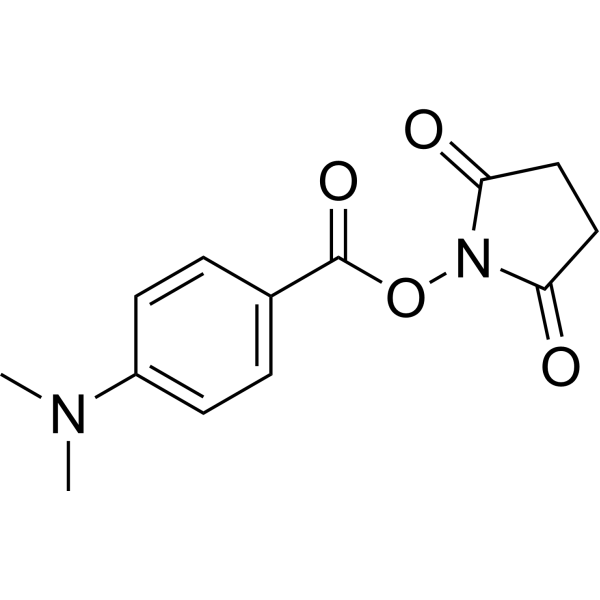
    DMABA NHS ester can chemically react with the primary amine groups of the major phospholipid component of the cell membrane, Phosphatidylethanolamine (PE). Through precursor ion scanning, all PE subclasses labeled with DMABA can be detected. DMABA NHS ester can be used in combination with isotope-labeled compounds such as DMABA-d6 NHS ester, DMABA-d10 NHS ester, and DMABA-d4 NHS ester to observe changes in the distribution of PE lipids and the formation of novel PE lipid products .
    DMABA NHS ester
  • HY-B1410R

    MP-328 (Standard)

    Biochemical Assay Reagents Reference Standards Others Cancer
    Ioversol (Standard) is the analytical standard of Ioversol. This product is intended for research and analytical applications. Ioversol (MP-328) is a nonionic iodinated contrast medium (CM) that is used during a CT scan or x-ray in animal experiment. Ioversol does not damage the blood-brain barrier (BBB) in animal [4].
    Ioversol (Standard)
  • HY-121364

    Histamine Receptor Fluorescent Dye Others
    Bodilisant is a histamine H3 receptor (hH3R) ligand and imaging/labeling agent, with a Ki value of 6.51 nM for hH3R. Bodilisant binds to hH3R to produce strong green fluorescence, localizes to the extracellular membrane without internalization, and generates clear, displaceable fluorescent labeling of hH3R in native human brain tissues. Bodilisant serves as a pharmacological tool to visualize the distribution of hH3R via fluorescence confocal laser scanning microscopy .
    Bodilisant
  • HY-W799437

    Biochemical Assay Reagents Others
    Ioversol hydrolysate-1 is a hydrolyzate of Ioversol (HY-B1410), a non-ionic iodinated contrast agent (CM) used in CT scans or X-rays in animal experiments .
    Ioversol hydrolysate-1
  • HY-129650R

    AV-45 (Standard); Flobetapir (Standard)

    Biochemical Assay Reagents Reference Standards Others
    Flobetapir (Standard) (AV-45 (Standard)) is the analytical standard of Flobetapir (HY-129650). This product is intended for research and analytical applications. Flobetapirmay is a well-tolerated imaging agent. Flobetapir synthesizes Florbetapir (18F) that is a PET scanning radiopharmaceutical compound.
    Florbetapir (Standard)
  • HY-150725B

    Toll-like Receptor (TLR) IFNAR Inflammation/Immunology
    FITC-labeled ODN 1585 (sodium) is a potent inducer of IFN and TNFα production. FITC-labeled ODN 1585 (sodium) can be used to evaluate CpG ODN cellular uptake and localization by confocal laser-scanning microscopy (excitation 495 nm, emission 520 nm) or flow cytometry.
    FITC-labeled ODN 1585 sodium
  • HY-146244B

    Toll-like Receptor (TLR) Inflammation/Immunology
    FITC-labeled agatolimod (sodium), a class B CpG ODN (oligodeoxynucleotide), is a TLR9 agonist. FITC-labeled agatolimod (sodium) can be used to evaluate CpG ODN cellular uptake and localization by confocal laser-scanning microscopy (excitation 495 nm, emission 520 nm) or flow cytometry.
    FITC-labeled agatolimod sodium
  • HY-146245B

    Toll-like Receptor (TLR) Inflammation/Immunology
    FITC-labeled ODN 1826 (sodium), a class B CpG ODN (oligodeoxynucleotide), is a TLR9 agonist. FITC-labeled ODN 1826 (sodium) can be used to evaluate CpG ODN cellular uptake and localization by confocal laser-scanning microscopy (excitation 495 nm, emission 520 nm) or flow cytometry.
    FITC-labeled ODN 1826 sodium
  • HY-150726B

    Toll-like Receptor (TLR) Inflammation/Immunology
    FITC-labeled ODN 1668 (sodium), a class B CpG ODN (oligodeoxynucleotide), is a TLR9 agonist. FITC-labeled ODN 1668 (sodium) can be used to evaluate CpG ODN cellular uptake and localization by confocal laser-scanning microscopy (excitation 495 nm, emission 520 nm) or flow cytometry.
    FITC-labeled ODN 1668 sodium
  • HY-150738B

    Toll-like Receptor (TLR) Inflammation/Immunology
    FITC-labeled ODN 2088 (sodium) is a potent TLR3, TLR7 and TLR9 inhibitor. FITC-labeled ODN 2088 (sodium) can be used to evaluate CpG ODN cellular uptake and localization by confocal laser-scanning microscopy (excitation 495 nm, emission 520 nm) or flow cytometry.
    FITC-labeled ODN 2088 sodium
  • HY-150751B

    Toll-like Receptor (TLR) Inflammation/Immunology
    FITC-labeled ODN TTAGGG (sodium), a inhibitory oligonucleotide (ODN), is a TLR9, AIM2 and cGAS antagonist. FITC-labeled ODN TTAGGG (sodium) can be used to evaluate CpG ODN cellular uptake and localization by confocal laser-scanning microscopy (excitation 495 nm, emission 520 nm) or flow cytometry.
    FITC-labeled ODN TTAGGG sodium
  • HY-W153917

    Biochemical Assay Reagents
    Diatrizoic acid EP impurity A is an organic compound with potential effects on biological systems and specific pharmacological activities. Diatrizoic acid EP impurity A can be used as a contrast agent in imaging examinations to enhance the clarity of images such as X-rays and CT scans. Diatrizoic acid EP impurity A has also been studied for the separation and analysis of compounds.
    Diatrizoic acid EP impurity A
  • HY-153127

    AV-133

    Biochemical Assay Reagents Neurological Disease
    Florbenazine (AV-133) is a diagnostic imaging agent targeting the central nervous system monoamine transporter VMAT2, and its F-18 labeled form can be used for PET scanning. The biodistribution of [18F]Florbenazine in mice shows a high striatum/cerebellum ratio (0.48), which can be used for the diagnostic research of neurodegenerative diseases (including dementia with Lewy bodies and Parkinson's disease) .
    Florbenazine
  • HY-173283

    Fungal Infection
    Antifungal agent 129 (Compound 4g) is an inhibitor targeting Rhizoctonia solani, with an EC50 value of 4.27 mg/L. It has a good control effect against rice sheath blight in in vitro and in vivo experiments. Preliminary exploration through scanning electron microscopy, molecular docking, enzyme activity determination, and cytotoxicity experiments has revealed that Antifungal agent 129 may exert its inhibitory activity by affecting the cell structure or physiological processes of Rhizoctonia solani. Antifungal agent 129 can be used in the research of plant diseases in the agricultural field, such as rice sheath blight, which are caused by Rhizoctonia solani .
    Antifungal agent 129
  • HY-167904

    Biochemical Assay Reagents Others
    Iosefamate meglumine is a contrast agent for hepatic CT scanning .
    Iosefamate meglumine
  • HY-181696

    PSMA Cancer
    EC0652 is a PSMA imaging agent with SPECT imaging capability. EC0652 can be used for the research of metastatic castration-resistant prostate cancer .
    EC0652
  • HY-123446

    Phosphodiesterase (PDE) Neurological Disease
    JNJ-42259152 is a phosphodiesterase 10A (PDE10A) positron emission tomography (PET) tracer that is specific for PDE10A activity. JNJ-42259152 can be dynamically scanned in healthy volunteers to assess its kinetic properties in the brain. The half-life of JNJ-42259152 in the blood is an average of 90 minutes. JNJ-42259152 has demonstrated reliable binding potential (BPND) in different target areas (such as the lentiform nucleus, caudate nucleus, ventral striatum, etc.), providing an important tool for studying neuropsychiatric diseases .
    JNJ-42259152
  • HY-173172

    Eukaryotic Initiation Factor (eIF) Apoptosis c-Myc CDK Cancer
    MG-002 is an orally active eIF4A inhibitor. MG-002 non-productively traps the eukaryotic translation initiation factor 4A (eIF4A) onto RNA, hindering the recruitment and scanning of ribosomes, thereby inhibiting mRNA translation. MG-002 selectively inhibits the growth and metastasis formation of triple-negative breast cancer (TNBC) tumors and induces cell apoptosis. MG-002 significantly inhibits the protein expression of c-MYC and cyclin D1. MG-002 can be used for research on TNBC .
    MG-002

Inquiry Online

Your information is safe with us. * Required Fields.

Salutation


Country or Region *

Applicant Name *


Organization Name *

Department *


Email Address *


Product Name *

Cat. No.


Requested quantity *

Phone Number *


Remarks

Inquiry Online

Inquiry Information

Product Name:
Cat. No.:
Quantity:
MCE Japan Authorized Agent:

