8 Results for "

social interaction model

" in MedChemExpress (MCE) Product Catalog:
Products (8)

8 Results for "social interaction model" in MCE Product Catalog:

2
2 Cited Publications
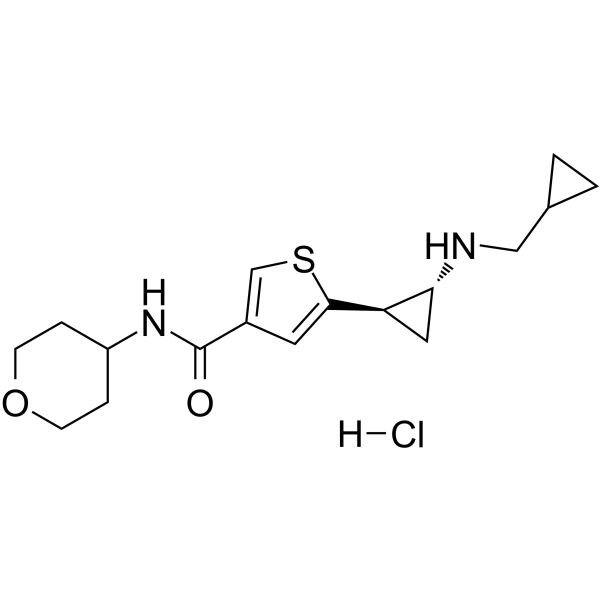
Cat. No.: HY-138830
CAS No.: 1818252-53-7
Purity:  99.81%
Target:  

Histone Demethylase

Research Areas:  

Neurological Disease

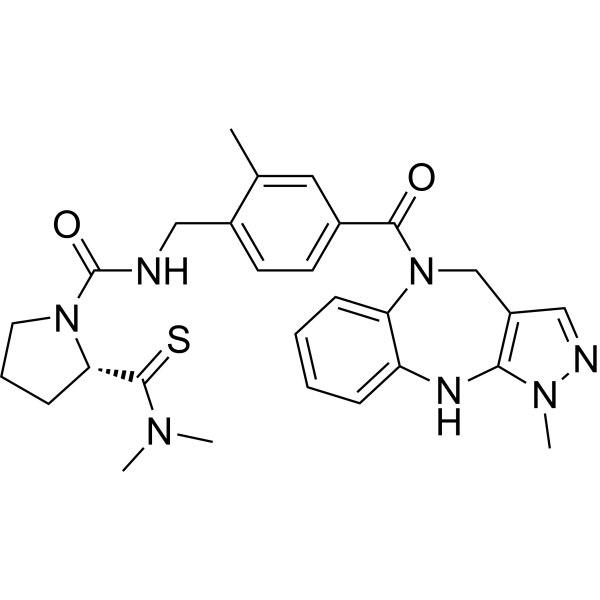
TAK-418 is an orally active, blood-brain barrier-penetrant LSD1 inhibitor with a human IC50 of 2.9 nM. TAK-418 irreversibly inhibits LSD1 by forming a compact flavin-FAD adduct with the catalytic domain FAD, blocking the demethylation of H3K4me1/2 and H3K9me1/2 without disrupting the LSD1-GFI1B interaction. TAK-418 restores normally dysregulated brain gene expression and DNA methylation, increases H3K4me1/2/3 and H3K9me2 at the Ucp2 locus, and induces Ucp2 mRNA expression. TAK-418 rescues defective H3K4 histone modifications, normalizes adult neurogenesis, and improves recognition memory, social behavior, and cognition in rodent models. TAK-418 can be used in research related to neurodevelopmental disorders, Alzheimer's disease, and autism spectrum disorders .
loading...
    loading...
1
1 Cited Publications
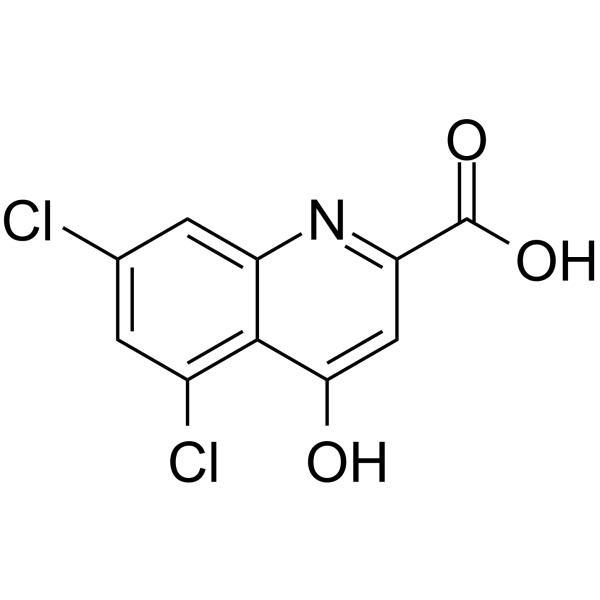
Cat. No.: HY-100834
CAS No.: 131123-76-7
Purity:  99.98%
Synonyms: 5,7-DCKA
Target:  

iGluR

Research Areas:  

Neurological Disease

5,7-Dichlorokynurenic acid (5,7-DCKA) is a selective and competitive antagonist of the glycine site on NMDA receptor with a KB of 65 nM. 5,7-Dichlorokynurenic acid reduces NMDA-induced neuron injury. 5,7-Dichlorokynurenic acid increases social interaction time, increases open arm exploration time, disinhibits suppressed conflict responding in rodent models. 5,7-Dichlorokynurenic acid exhibits anxiolytic-like activity in rodent models and supports exploration of glycine’s role in NMDA receptor-mediated synaptic transmission .
loading...
    loading...
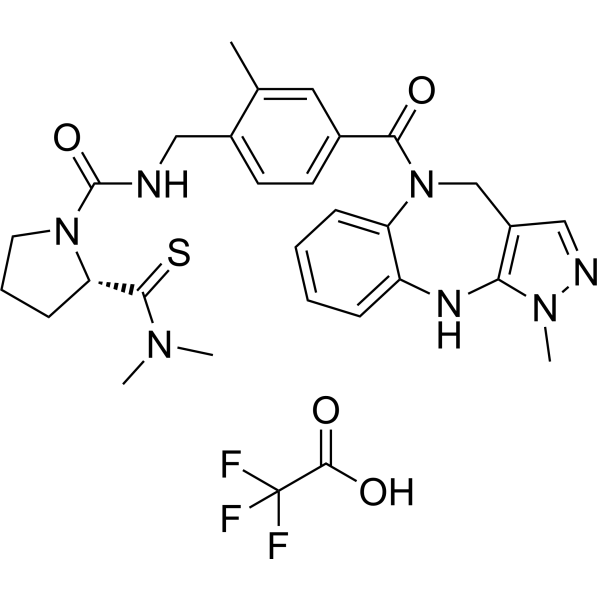
Cat. No.: HY-124733A
CAS No.: 2245072-21-1
Purity:  98.63%
Target:  

Oxytocin Receptor

Research Areas:  

Neurological Disease

LIT-001 is the first nonpeptide oxytocin receptor (OT-R) agonist (EC50=55 nM; Ki=226 nM). LIT-001 improves social interaction in a mouse model of autism .
loading...
    loading...
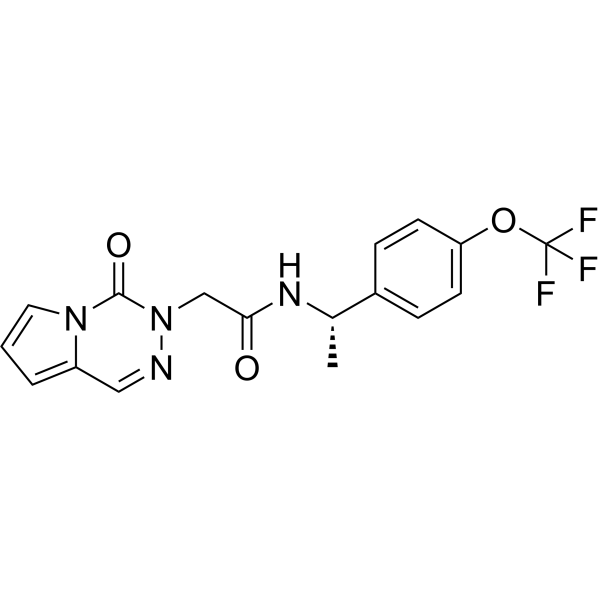
Cat. No.: HY-149651
CAS No.: 2983118-29-0
Purity:  99.80%
Target:  

GPR139

Research Areas:  

Neurological Disease

GPR139 agonist-2 (compound 20a) is a potent GPR139 agonist with an EC50 of 24.7 nM. GPR139 agonist-2 rescues the social interaction deficits and alleviates cognitive deficits in murine schizophrenia models. GPR139 agonist-2 has the potential for antischizophrenia drug research .
loading...
    loading...
Cat. No.: HY-124733
CAS No.: 2245072-20-0
Target:  

Oxytocin Receptor

Research Areas:  

Neurological Disease

LIT-001 free base is the first nonpeptide oxytocin receptor (OT-R) agonist (EC50=55 nM; Ki=226 nM). LIT-001 free base improves social interaction in a mouse model of autism .
loading...
    loading...
Cat. No.: HY-100834A
CAS No.: 1184986-70-6
Synonyms: 5,7-DCKA sodium
Target:  

iGluR

Research Areas:  

Neurological Disease

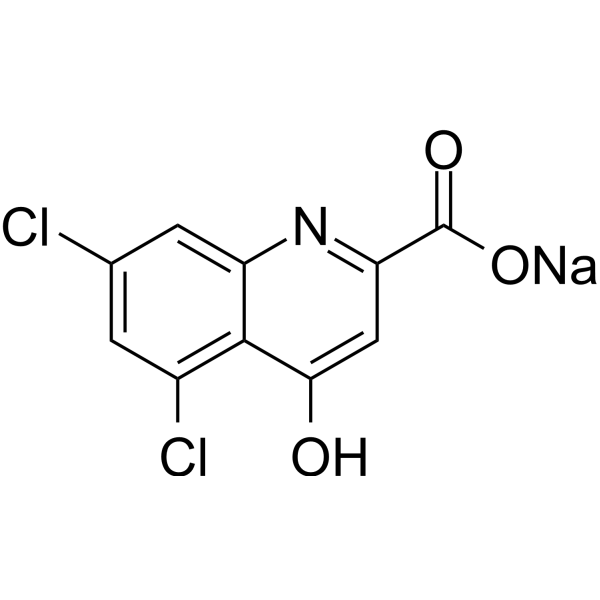
5,7-Dichlorokynurenic acid (5,7-DCKA) sodium is a selective and competitive antagonist of the glycine site on NMDA receptor with a KB of 65 nM. 5,7-Dichlorokynurenic acid sodium reduces NMDA-induced neuron injury. 5,7-Dichlorokynurenic acid sodium increases social interaction time, increases open arm exploration time, disinhibits suppressed conflict responding in rodent models. 5,7-Dichlorokynurenic acid sodium exhibits anxiolytic-like activity in rodent models and supports exploration of glycine’s role in NMDA receptor-mediated synaptic transmission .
loading...
    loading...
Cat. No.: HY-100834R
CAS No.: 131123-76-7
Synonyms: 5,7-DCKA (Standard)
Research Areas:  

Neurological Disease

5,7-Dichlorokynurenic acid (Standard) is the analytical standard of 5,7-Dichlorokynurenic acid (HY-100834). This product is intended for research and analytical applications. 5,7-Dichlorokynurenic acid (5,7-DCKA) is a selective and competitive antagonist of the glycine site on NMDA receptor with a KB of 65 nM. 5,7-Dichlorokynurenic acid reduces NMDA-induced neuron injury. 5,7-Dichlorokynurenic acid increases social interaction time, increases open arm exploration time, disinhibits suppressed conflict responding in rodent models. 5,7-Dichlorokynurenic acid exhibits anxiolytic-like activity in rodent models and supports exploration of glycine’s role in NMDA receptor-mediated synaptic transmission .
loading...
    loading...
Cat. No.: HY-138830B
CAS No.: 1818252-52-6
Target:  

Histone Demethylase

Research Areas:  

Neurological Disease

TAK-418 free base is an orally active, blood-brain barrier-penetrant LSD1 inhibitor with a human IC50 of 2.9 nM. TAK-418 free base irreversibly inhibits LSD1 by forming a compact flavin-FAD adduct with the catalytic domain FAD, blocking the demethylation of H3K4me1/2 and H3K9me1/2 without disrupting the LSD1-GFI1B interaction. TAK-418 free base restores normally dysregulated brain gene expression and DNA methylation, increases H3K4me1/2/3 and H3K9me2 at the Ucp2 locus, and induces Ucp2 mRNA expression. TAK-418 free base rescues defective H3K4 histone modifications, normalizes adult neurogenesis, and improves recognition memory, social behavior, and cognition in rodent models. TAK-418 free base can be used in research related to neurodevelopmental disorders, Alzheimer's disease, and autism spectrum disorders .
loading...
    loading...

