
12 Results for "

splenic T cells

" in MedChemExpress (MCE) Product Catalog:
Products (12)

12 Results for "splenic T cells" in MCE Product Catalog:

1
1 Cited Publications
Cat. No.: HY-P99124

Target:  

CD3

Research Areas:  

Inflammation/Immunology

Anti-Mouse CD3 Antibody (17A2) is an anti-mouse CD3 IgG2b antibody inhibitor derived from the host Rat. Anti-Mouse CD3 Antibody (17A2) enhances T-cell proliferation and activation and stimulate IFN-γ or IL-17 production in splenic T cells. Anti-Mouse CD3 Antibody (17A2) significantly suppresses mortality in Graft-versus-host disease (GVHD) mice models .
loading...
    loading...
Cat. No.: HY-P99976

Target:  

CD19

Research Areas:  

Inflammation/Immunology

Anti-Mouse CD19 Antibody (1D3) is an IgG2a antibody inhibitor targeting mouse CD19. Anti-Mouse CD19 Antibody (1D3) reduces CD19 expression levels on the surface of B cells. Anti-Mouse CD19 Antibody (1D3) inhibits the replication of peritoneal B-1a cells .
loading...
    loading...
Cat. No.: HY-P0085
CAS No.: 105184-37-0
Target:  

Inhibitory Antibodies

Research Areas:  

Inflammation/Immunology

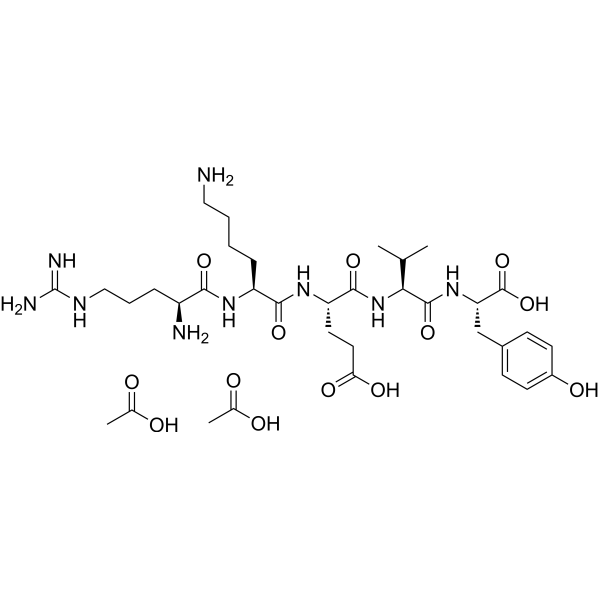
Splenopentin diacetate is a synthetic immunomodulating pentapeptide corresponding to the residues 32-36 of the splenic hormone splenin. Splenopentin diacetate influences both early T and B cell differentiation, to increase the number of antibody-forming cells in mice after gamma irradiation .
loading...
    loading...
Cat. No.: HY-130757
CAS No.: 571194-06-4
Remisporine B is a polyketide, that can be isolated from Penicillium sp. ZJ-SY2. Remisporine B exhibits immunosuppressive efficacy, that inhibits concanavalin A (HY-P2149)-induced T-cell proliferation and LPS (HY-D1056)- induced B-cell proliferations of mouse splenic lymphocytes with IC50 of 30.1 µg/mL and 32.4 µg/mL .
loading...
    loading...
Cat. No.: HY-P991801

Target:  

IFNAR PD-1/PD-L1

Research Areas:  

Cancer

Anti-Mouse IFN Beta Antibody (MIB-5E9.1) is an antibody targeting mouse IFN-β. Anti-Mouse IFN Beta Antibody (MIB-5E9.1) blocks the IFN-β signaling pathway, abolishes LPS-induced upregulation of B7H1 and GITRL in dendritic cells, restores dendritic cell-dependent T cell proliferation impaired by LPS exposure, and reverses LPS-induced upregulation of PD-1 on splenic T cells. Anti-Mouse IFN Beta Antibody (MIB-5E9.1) reduces LPS-induced upregulation of GITR on splenic T cells and inhibits LPS-mediated Treg priming .
loading...
    loading...
Cat. No.: HY-187690
CAS No.: 2170918-46-2
HGR4113 is an orally active anti-inflammatory/antioxidant agent with improved glucose metabolism. HGR4113 inhibits STAT3 phosphorylation, suppresses Th17 differentiation and IL-17 production, reduces oxidative phosphorylation activity, and promotes the differentiation of regulatory T cells among splenic CD4 + T cells. HGR4113 inhibits LPS (HY-D1056)-induced JNK phosphorylation, production of NO, PGE2 and pro-inflammatory cytokines, expression of iNOS and COX-2, as well as nuclear translocation of NF-κB in macrophages, while induces HO-1 expression by activating nuclear translocation of Nrf2. HGR4113 can be used in the research of inflammatory diseases such as type 2 diabetes and Sjögren's syndrome .
loading...
    loading...
Cat. No.: HY-K0360

MCE Mouse CD4+ CD25+ Regulatory T Cell Positive Selection Kit is designed for the isolation of CD4+ CD25+ regulatory T cells (Tregs) from mouse splenic single-cell suspensions. The kit utilizes a two-step isolation strategy. First, CD4 Enrichment Beads are used to deplete non-target cells and enrich CD4+ T cells. Subsequently, CD25 Capture Antibody specifically binds to CD25+ cells, which are then captured by Releasable Magnetic Beads. Following isolation, the magnetic beads are gently detached from the cell surface using Magnetic Beads Release Buffer, yielding label-free CD4+ CD25+ regulatory T cells with no residual magnetic beads.

loading...
    loading...
Cat. No.: HY-186205
CAS No.: 1299471-83-2
Target:  

Drug Metabolite

Research Areas:  

Cancer

(Rac)-EGC-M5 is an orally active metabolite of green tea Catechin (EGC) (HY-N0898). (Rac)-EGC-M5 enhances the activity of CD4 + T cells. (Rac)-EGC-M5 boosts the cytotoxic activity of NK cells in vivo. (Rac)-EGC-M5 can be used in cancer-related research .
loading...
    loading...
Cat. No.: HY-182802
CAS No.: 3097756-33-4
Ferroptosis inducer-15 is a ferroptosis inducer. Ferroptosis inducer-15 downregulates GPX4 expression, triggers lipid peroxidation via ROS accumulation, and disrupts mitochondrial membrane potential to drive ferroptosis. Ferroptosis inducer-15 increases splenic CD4 + T cell proportion, promotes CD8 + cytotoxic T cell tumor infiltration, and activates antitumor immune responses. Ferroptosis inducer-15 exerts antiproliferative activity against colorectal cancer cells and inhibits tumor growth in xenograft mice models without significant body weight loss. Ferroptosis inducer-15 can be used for the research of cancer, such as colorectal cancer .
loading...
    loading...
Cat. No.: HY-119514
CAS No.: 423744-89-2
BC12 is a barbituric acid derivative and a phosphodiesterase 7 (PDE7) inhibitor, with an IC50 of 0.77 μM against human targets. BC12 inhibits the enzymatic activity of PDE7, but this activity is not the driver of its immunomodulatory effects on T lymphocytes. BC12 blocks the upregulation of IL-2 transcription in activated T cells. BC12 modulates the transcriptional response of T cells upon stimulation, exerting anti-inflammatory and pro-stress effects. BC12 inhibits the proliferation of primary mouse T cells and the IL-2 secretion of human peripheral blood T lymphocytes. BC12 exerts immunosuppressive and immunomodulatory effects on T lymphocyte function. BC12 can be used in research related to T lymphocyte-mediated diseases .
loading...
    loading...
Cat. No.: HY-P991753

Target:  

CXCR

Research Areas:  

Infection

Anti-Mouse CCL5 Antibody (R6G9) is a neutralizing agent that binds to CCL5 to inhibit its chemotactic activity towards CD4 + T cells .Anti-Mouse CCL5 Antibody (R6G9) does not suppress CD4 + T cell migration towards infection-derived liver cells, reduce CD4 + T cell hepatic accumulation, or impair CD4 + T cell migratory capacity .Anti-Mouse CCL5 Antibody (R6G9) serves as a tool to assess CCL5’s role in in vivo target cell killing by LCMV-specific CD8 + effector T cells .Anti-Mouse CCL5 Antibody (R6G9) can be used for the research of malaria infection and lymphocytic choriomeningitis virus infection .
loading...
    loading...
Cat. No.: HY-184931
Research Areas:  

Cancer

PTPN22-IN-3 is a potent, selective, and orally active inhibitor of PTPN22 with an IC50 of 0.49 μM and a Ki of 0.28 μM. PTPN22-IN-3 exhibits over 14-fold selectivity against a broad panel of PTPs and shows no significant inhibition against SRC/CSK kinases or IDO1/Arginase metalloenzymes. PTPN22-IN-3 enhances TCR signaling, increases IL-2 expression and secretion, and promotes mouse splenic T cell proliferation. In immune-competent C57BL/6J mice, PTPN22-IN-3 suppresses MC38 syngeneic tumor growth and synergizes with Pembrolizumab (anti-PD-1) (HY-P9902A) therapy. PTPN22-IN-3 can be used for the study of colorectal cancer and other solid tumors responsive to T cell-mediated anti-tumor immunity .
loading...
    loading...
  • 1

