



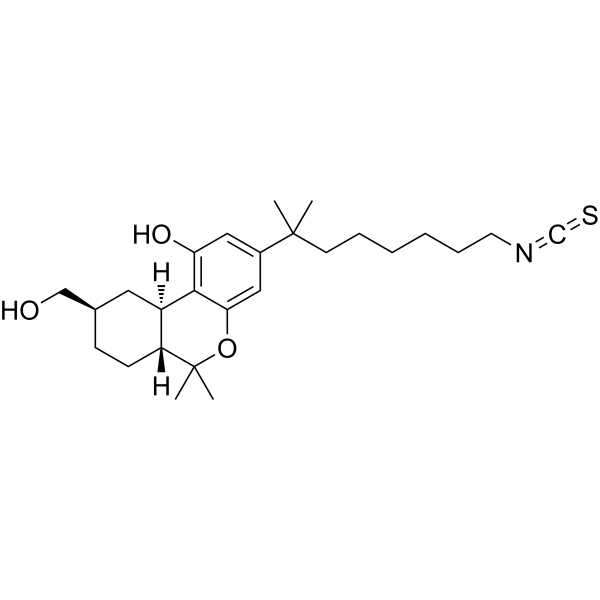
AM841
AM841 is a cannabinoid superagonist and a covalent, irreversible full agonist of CB1. AM841 can activate peripheral CB1 receptors to reduce excitatory neurotransmission and GI smooth muscle contractility, and inhibit synaptic transmission. AM841 is peripherally restricted at low doses in mice, with extremely low brain penetration, potently inhibits gastrointestinal motility, and can reverse acute stress-induced hyperaccelerated gastrointestinal transit; at high doses, it can produce the classic tetrad of central cannabinoid phenotypes (analgesia, catalepsy, hypothermia, decreased spontaneous activity). AM841 can improve intestinal inflammation in mouse colitis models. AM841 induces transient stress-induced hyperthermia. AM841 can be used for research on gastrointestinal motility disorders and colitis.
For research use only. We do not sell to patients.
- CAS No.: 871978-21-1
- Formula: C26H39NO3S
- Molecular Weight:445.66
-
Storage:
Please store the product under the recommended conditions in the Certificate of Analysis.

To place orders, for customer services and technical support, please contact: MedChemExpress USA
Tel: 609-228-6898 E-mail: [email protected] [email protected]


-
 Biological Activity
-
Chemical Information
- Protocols
- Purity & Documentation
- References
-
 Help & FAQs




Biological Activity
Description
IC50 & Target
[1]|
CB1 |
CB2 |
Cellular Effect
|
Cell Line

|
Type | Value | Description | References |
|---|---|---|---|---|
| Hippocampal neurone | EC50 |
6.8 nM
|
Inhibition of excitatory postsynaptic currents in isolated autaptic mouse hippocampal neurons by whole-cell voltage-clamp electrophysiology.
Inhibition of excitatory postsynaptic currents in isolated autaptic mouse hippocampal neurons by whole-cell voltage-clamp electrophysiology.
|
25572435 |
In Vitro
AM841 concentration-dependently inhibits EFS-induced contractions in isolated rat gastric fundus, gastric antrum, ileum, and distal colon via the CB1 receptor, with maximal inhibition rates of approximately 50%, 50%, 40%, and 30%, respectively[2].
AM841 is a potent inhibitor of EPSCs (EC50 6.8 nM) and blocks DSE in isolated autaptic mouse hippocampal neurons[3].
AM841 (100 nM; 30 min initial internalization; up to 120 min recycling) induced rapid CB1 receptor internalization in HEK cells expressing rCB1 and prevented receptor recycling at 120 min[3].
MedChemExpress (MCE) has not independently confirmed the accuracy of these methods. They are for reference only.
In Vivo
AM841 (0.1-0.5 mg/kg; i.p.; single injection) reduces GI motility without producing the central cannabinoid tetrad at 0.1 mg/kg, whereas at 0.5 mg/kg it produces central cannabinoid-like effects and mechanical antinociception in healthy Wistar rats[2].
AM841 (0.1-1 mg/kg; i.p.; single injection) does not reduce spontaneous locomotor activity in mice; it does not produce persistent hypothermia in mice[3].
AM841 (0.1-1 mg/kg; i.p.; single injection) potently inhibits upper gastrointestinal transit and slows colonic propulsion in mice via the CB1 receptor, an effect abolished by AM251 (HY-15443) but not by AM630[3].
AM841 (0.01 mg/kg) normalized stress-enhanced colonic fecal pellet expulsion in mice[3].
MedChemExpress (MCE) has not independently confirmed the accuracy of these methods. They are for reference only.
-
Animal Model:Wistar (male, 240-300 g)[2]
-
Dosage:0.1 mg/kg; 1 mg/kg; 0.1 mg/kg (radiographic analysis 14 h later)
0.1 mg/kg (30 min after AM251 or AM630) -
Administration:i.p.; single injection
-
Result:At 0.1 mg/kg, reduced gastric emptying and intestinal transit.
At 1 mg/kg, enhanced the effect, particularly in intestinal regions; stomach area measurements differed between the two doses.
At 0.1 mg/kg with contrast 14 h later, no effect on GI motility was detected.
AM251 blocked the effect in the stomach and partially blocked it in the small and large intestine.
AM630 did not block the effect in any GI region.
-
Animal Model:Wistar (male, 240-300 g)[2]
-
Dosage:0.1 mg/kg; 0.5 mg/kg
-
Administration:i.p.; single injection
-
Result:At 0.5 mg/kg, induced antinociception in the plantar test, catalepsy in the ring test, and hypothermia in rectal temperature recording; increased the withdrawal threshold to non-noxious stimuli in the Von Frey test.
At 0.1 mg/kg, did not exert effects in the cannabinoid tetrad and did not modify the Von Frey threshold.
Spontaneous locomotor activity was not modified.
-
Animal Model:C57BL/6 wild-type (CB1+/+) and CB1−/− (male, 6-24 weeks old; 18-46 g)[3]
-
Dosage:0.1 mg/kg
-
Administration:i.p.; single injection
-
Result:Caused transient stress-induced hyperthermia but had no lasting effect on core body temperature in either CB1+/+ or CB1−/−.
-
Animal Model:CD1 (male, 5-7 weeks old, 26-40 g); separate experiments in CB1−/−, CB2−/−, and wild-type littermates[3]
-
Dosage:0.1, 1 mg/kg
-
Administration:i.p.; single injection
-
Result:Inhibited upper GI transit to a maximum of about 70% of the vehicle level, with an EC50 of 0.004 mg/kg.
Effects at 1 mg/kg were abolished in CB1−/− and virtually identical in CB2−/− and wild-type.
Effects at 0.1 mg/kg were abolished by prior administration of AM251 (5 mg/kg) and unaffected by AM630 (5 mg/kg).
-
Animal Model:CD1 (male, 5-7 weeks old, 26-40 g); separate experiments in CB1−/−, CB2−/−, and wild-type littermates[3]
-
Dosage:0.1, 1 mg/kg
-
Administration:i.p. or p.o.; single administration
-
Result:Inhibited colonic bead expulsion with an EC50 of 0.03 mg/kg.
Maximum magnitude was a five- to six-fold slowing of colonic transit at 0.1 mg/kg.
At 1 mg/kg, effects were completely abolished in CB1−/− and virtually identical in CB2−/− compared with wild-type.
Effects at 0.1 mg/kg were abolished by AM251 (2 mg/kg) and unaffected by AM630 (1 mg/kg).


Chemical Information
-
CAS No. 871978-21-1
-
Molecular Weight 445.66
-
Formula C26H39NO3S
-
SMILES
OC1=C2[C@@]3([H])[C@](CC[C@H](C3)CO)([H])C(C)(OC2=CC(C(C)(C)CCCCCCN=C=S)=C1)C
-
Shipping
Room temperature in continental US; may vary elsewhere.
-
Storage
Please store the product under the recommended conditions in the Certificate of Analysis.


Purity & Documentation
References

Calculators
Concentration (start) × Volume (start) = Concentration (final) × Volume (final)


AM841 Related Classifications
HY-149933 Related Classifications
 Powered by Bioz