



Sitafloxacin hydrochloride
Based on 7 publication(s) in Google Scholar
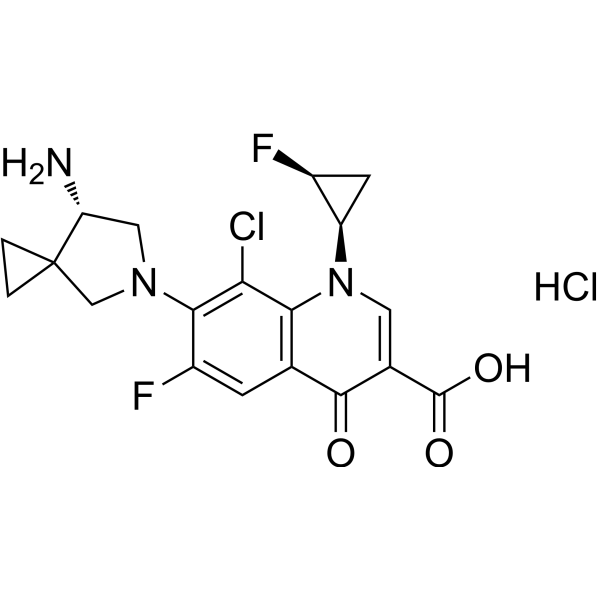
Sitafloxacin (DU6859a) hydrochloride is a potent, orally active fluoroquinolone antibiotic. Sitafloxacin hydrochloride shows antichlamydial activity and antibacterial activities against a broad range of gram-positive and gram-negative bacteria, including anaerobic bacteria, as well as against atypical pathogens. Sitafloxacin hydrochloride can be used for the research of respiratory tract infection and urinary tract infection.
For research use only. We do not sell to patients.
- CAS No.: 346607-37-2
- Formula: C19H19Cl2F2N3O3
- Molecular Weight:446.28
-
Storage:
Please store the product under the recommended conditions in the Certificate of Analysis.

To place orders, for customer services and technical support, please contact: MedChemExpress USA
Tel: 609-228-6898 E-mail: [email protected] [email protected]


-
 Biological Activity
-
Chemical Information
- Purity & Documentation
- References
-
 Help & FAQs


Publications Citing Use of MedChemExpress (MCE) Sitafloxacin hydrochloride
More- Toxicol Sci. 2026 Mar 25:kfag039. [Abstract]
- Antimicrob Resist Infect Control. 2019 Feb 15:8:40. [Abstract]
- Antimicrob Agents Chemother. 2026 Jul 2.
- Infect Drug Resist. 2019 Jan 31:12:345-358. [Abstract]
- Curr Microbiol. 2021 Dec 14;79(1):12. [Abstract]
- PLoS One. 2019 Mar 27;14(3):e0213868. [Abstract]
- bioRxiv. 2024 Nov 06.
All Antibiotic Isoforms
More

Biological Activity
Description
IC50 & Target
|
Quinolone |
In Vitro
Sitafloxacin (DU6859a) hydrochloride shows antibacterial activities with MIC of 0.03, 0.12, 0.06 mg/L for wild-type ATCC 49619, gyrA mutant SP39, parC mutant 1026523 streptococcus pneumoniae stran, respectively[1].
Sitafloxacin (DU6859a) hydrochloride shows antibacterial activities for quinolone-susceptible strains of streptococcus pneumoniae with MIC of 0.03, 0.03 mg/L for EG 00093 and EG 00218 strain, respectively[1].
Sitafloxacin (DU6859a) hydrochloride shows inhibition for DNA gyrase and topoisomerase IV (TopoIV) with >IC50s of 4.38, 3.12 mg/L, respectively[1].
MedChemExpress (MCE) has not independently confirmed the accuracy of these methods. They are for reference only.
In Vivo
MedChemExpress (MCE) has not independently confirmed the accuracy of these methods. They are for reference only.
-
Animal Model:BALB/c female mice[2]
-
Dosage:12.5, 25, 50 and 100 mg/kg
-
Administration:Oral gavage; daily, for 4 weeks
-
Result:Inhibits the growth of Mycobacterium ulcerans and the M. ulcerans cells


Chemical Information
-
CAS No. 346607-37-2
-
Molecular Weight 446.28
-
Formula C19H19Cl2F2N3O3
-
SMILES
O=C(C1=CN([C@H]2[C@@H](F)C2)C3=C(C=C(F)C(N(C[C@H]4N)CC54CC5)=C3Cl)C1=O)O.Cl
-
Synonyms
DU6859a hydrochloride
-
Shipping
Room temperature in continental US; may vary elsewhere.
-
Storage
Please store the product under the recommended conditions in the Certificate of Analysis.


Publications (7)
-
Journal Impact Factor
-
Most Recent
-
Toxicol Sci
In vitro and preclinical assessment of drug interactions between fluoroquinolones and a nonsteroidal antiinflammatory drug predicting risk of seizure. [Abstract]2026 Mar 25:kfag039. PMID: 41883118 -
Antimicrob Resist Infect Control
Effective therapeutic regimens in two South Asian countries with high resistance to major Helicobacter pylori antibiotics. [Abstract]2019 Feb 15:8:40. PMID: 30815255 -
-
Infect Drug Resist
Alternative eradication regimens for Helicobacter pylori infection in Indonesian regions with high metronidazole and levofloxacin resistance. [Abstract]2019 Jan 31:12:345-358. PMID: 30774400 -
Curr Microbiol
Repurposing Sitafloxacin, Prulifloxacin, Tosufloxacin, and Sisomicin as Antimicrobials Against Biofilm and Persister Cells of Pseudomonas aeruginosa. [Abstract]2021 Dec 14;79(1):12. PMID: 34905092 -
PLoS One
Five alternative Helicobacter pylori antibiotics to counter high levofloxacin and metronidazole resistance in the Dominican Republic. [Abstract]2019 Mar 27;14(3):e0213868. PMID: 30917150 -


Purity & Documentation
References
[1]. Okumura R, et al. Dual-targeting properties of the 3-aminopyrrolidyl quinolones, DC-159a and sitafloxacin, against DNA gyrase and topoisomerase IV: contribution to reducing in vitro emergence of quinolone-resistant Streptococcus pneumoniae. J Antimicrob Chemother. 2008 Jul;62(1):98-104. [Content Brief]
[2]. Dhople AM, et al. Activities of sitafloxacin (DU-6859a), either singly or in combination with rifampin, against Mycobacterium ulcerans infection in mice. J Chemother. 2003 Feb;15(1):47-52. [Content Brief]

Calculators
Concentration (start) × Volume (start) = Concentration (final) × Volume (final)


Sitafloxacin hydrochloride Related Classifications
HY-B0395A Related Classifications
 Powered by Bioz