



TAMRA-PEG4-Alkyne

Based on 1 Customer Validation
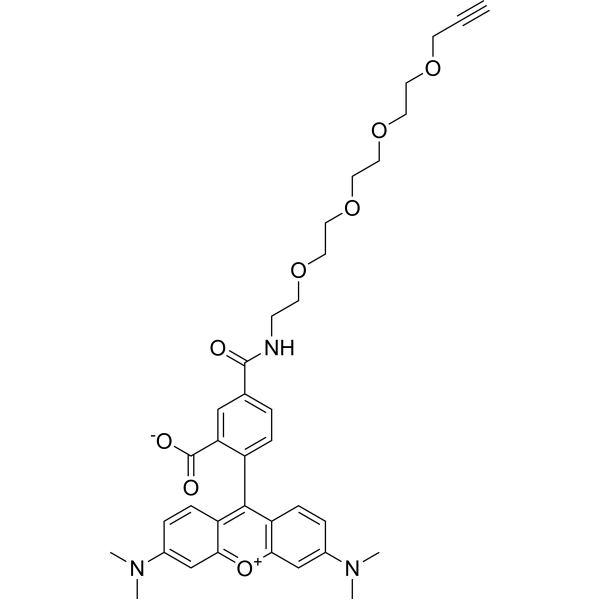
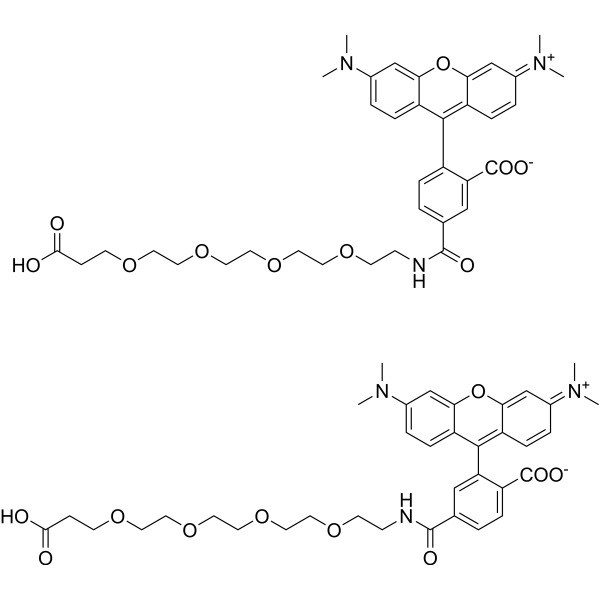
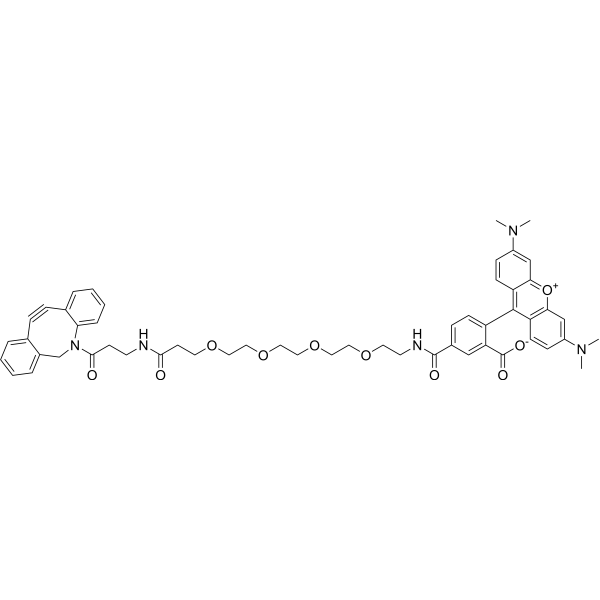
TAMRA-PEG4-Alkyne is a dye derivative of TAMRA (HY-135640) containing 4 PEG units. TAMRA-PEG4-Alkyne contains Alkyne groups and can undergo copper-catalyzed azide-alkyne cycloaddition (CuAAc) with molecules containing Azide groups (Ex/Em = 553/575 nm).
For research use only. We do not sell to patients.
- Purity : 98.67%
- CAS No.: 1225057-68-0
- Formula: C36H41N3O8
- Molecular Weight:643.73
-
Storage:Powder -20°C, 3 years ; In solvent -80°C, 6 months , -20°C, 1 month

To place orders, for customer services and technical support, please contact: MedChemExpress USA
Tel: 609-228-6898 E-mail: [email protected] [email protected]


-
 Biological Activity
-
Chemical Information
-
Solvent & Solubility
- Purity & Documentation
- References
-
 Help & FAQs





Biological Activity
Description
IC50 & Target
|
PEGs |
In Vitro
Guidelines (Following is our recommended protocol. This protocol only provides a guideline, and should be modified according to your specific needs).
1. Gel Fluorescence Analysis of Probe-Modified Proteins.
1.1 Incubate BSA or proteins extracted from MCF7 cells with sulfonated probe at 25 °C for 3 hours.
1.2 Add freshly premixed click chemistry reaction mixture (50 μM TAMRA-PEG4-Alkyne, 100 μM TBTA, 1 mM TCEP, and 1 mM CuSO4) to the above mixture.
1.3 Incubate at room temperature for 1 hour.
1.4 Then add 4× SDS-PAGE loading buffer and boil at 95°C for 10 minutes.
1.5 Analyze the samples using a 12% SDS-PAGE gel (polyacrylamide gel electrophoresis).
2. Cellular Imaging.
2.1 MCF7 cells were washed with PBS and pretreated with a sulfonium-based probe for 1 hour.
2.2 They were washed three times with PBS.
2.3 Then, they were fixed with 300 μL of 4% formaldehyde PBS solution for 15 minutes, followed by permeabilization with 300 μL of 0.1% Triton X-100 PBS solution for 15 minutes.
2.4 Freshly premixed click chemistry reaction mixture (10 μM TAMRA-PEG4-Alkyne (DMSO stock solution), 10 μM TBTA, 0.1 mM TCEP, and 0.1 mM CuSO4) was added to the mixture.
2.5 Incubation continued at room temperature for 1 hour.
2.6 The cells were washed three times with PBS, followed by one wash with 0.1% Tween PBS solution.
2.7 Finally, the cells were stained with 4′,6-diamidinyl-2-phenylindole (DAPI) for imaging.
2.8 The cells were observed using a confocal microscope or a fluorescence microscope.
MedChemExpress (MCE) has not independently confirmed the accuracy of these methods. They are for reference only.


Chemical Information
-
CAS No. 1225057-68-0
-
Appearance Solid
-
Molecular Weight 643.73
-
Formula C36H41N3O8
-
Color Brown to reddish brown
-
SMILES
CN(C1=CC2=[O+]C3=C(C=CC(N(C)C)=C3)C(C4=CC=C(C(NCCOCCOCCOCCOCC#C)=O)C=C4C([O-])=O)=C2C=C1)C
-
Shipping
Room temperature in continental US; may vary elsewhere.
-
Storage
Powder -20°C 3 years In solvent -80°C 6 months -20°C 1 month


Solvent & Solubility
In Vitro:
DMSO : 100 mg/mL (155.34 mM; Need ultrasonic; Hygroscopic DMSO has a significant impact on the solubility of product, please use newly opened DMSO)
Please refer to the solubility information to select the appropriate solvent. Once prepared, please aliquot and store the solution to prevent product inactivation from repeated freeze-thaw cycles.
Storage method and period of stock solution: -80°C, 6 months; -20°C, 1 month. When stored at -80°C, please use it within 6 months. When stored at -20°C, please use it within 1 month.
Please refer to the solubility information to select the appropriate solvent. Once prepared, please aliquot and store the solution to prevent product inactivation from repeated freeze-thaw cycles.
Storage method and period of stock solution: -80°C, 6 months; -20°C, 1 month. When stored at -80°C, please use it within 6 months. When stored at -20°C, please use it within 1 month.
Concentration (start) × Volume (start) = Concentration (final) × Volume (final)


Purity & Documentation
-
Data Sheet (271 KB)
-
SDS (252 KB)
- English - EN (252 KB)
- Français - FR (252 KB)
- Deutsch - DE (252 KB)
- Norwegian - NO (252 KB)
- Español - ES (252 KB)
- Swedish - SV (252 KB)
- Italian - IT (252 KB)
- Korean - KR (252 KB)
- Portuguese - PT (252 KB)
-
Handling Instructions (2659 KB)
References


Complete Stock Solution Preparation Table
Please refer to the solubility information to select the appropriate solvent. Once prepared, please aliquot and store the solution to prevent product inactivation from repeated freeze-thaw cycles.
Storage method and period of stock solution: -80°C, 6 months; -20°C, 1 month. When stored at -80°C, please use it within 6 months. When stored at -20°C, please use it within 1 month.
| Optional Solvent | Concentration Solvent Mass | 1 mg | 5 mg | 10 mg | 25 mg |
|---|---|---|---|---|---|
| DMSO | 1 mM | 1.5534 mL | 7.7672 mL | 15.5345 mL | 38.8362 mL |
| 5 mM | 0.3107 mL | 1.5534 mL | 3.1069 mL | 7.7672 mL | |
| 10 mM | 0.1553 mL | 0.7767 mL | 1.5534 mL | 3.8836 mL | |
| 15 mM | 0.1036 mL | 0.5178 mL | 1.0356 mL | 2.5891 mL | |
| 20 mM | 0.0777 mL | 0.3884 mL | 0.7767 mL | 1.9418 mL | |
| 25 mM | 0.0621 mL | 0.3107 mL | 0.6214 mL | 1.5534 mL | |
| 30 mM | 0.0518 mL | 0.2589 mL | 0.5178 mL | 1.2945 mL | |
| 40 mM | 0.0388 mL | 0.1942 mL | 0.3884 mL | 0.9709 mL | |
| 50 mM | 0.0311 mL | 0.1553 mL | 0.3107 mL | 0.7767 mL | |
| 60 mM | 0.0259 mL | 0.1295 mL | 0.2589 mL | 0.6473 mL | |
| 80 mM | 0.0194 mL | 0.0971 mL | 0.1942 mL | 0.4855 mL | |
| 100 mM | 0.0155 mL | 0.0777 mL | 0.1553 mL | 0.3884 mL |


TAMRA-PEG4-Alkyne Related Classifications
HY-120666 Related Classifications
 Powered by Bioz