



TAT-GluN2BCTM
TAT-GluN2BCTM is a membrane-permeable DAPK1-targeting peptide. TAT-GluN2BCTM targets active DAPK1 to lysosomes for degradation. TAT-GluN2BCTM protects neurons from oxidative stress and NMDAR-mediated excitotoxicity by knocking down DAPK1. TAT-GluN2BCTM can be used in the study of neuroprotection.
For research use only. We do not sell to patients.
- CAS No.: 1587742-50-4
- Formula: C224H374N86O54
- Molecular Weight:5135.91
-
Storage:
Please store the product under the recommended conditions in the Certificate of Analysis.

To place orders, for customer services and technical support, please contact: MedChemExpress USA
Tel: 609-228-6898 E-mail: [email protected] [email protected]


-
 Biological Activity
-
Chemical Information
- Protocols
- Purity & Documentation
- References
-
 Help & FAQs




Biological Activity
Description
IC50 & Target
DAPK1[1].
In Vitro
TAT-GluN2BCTM (200 µM; 0.5, 2, 4 h) results in a time-dependent reduction in DAPK1 levels in NMDA-treated primary neuronal cultures [1].
MedChemExpress (MCE) has not independently confirmed the accuracy of these methods. They are for reference only.
-
Cell Line:primary neuronal cultures (NMDA-treated)
-
Concentration:200 µM
-
Incubation Time:0.5, 2, 4 h
-
Result:Reduced DAPK1 levels in a time-dependent manner.
In Vivo
TAT-GluN2BCTM (10 mg/kg; i.v.; single) shows prominent neuroprotection in the cortex and striatum of rats[1].
TAT-GluN2BCTM is capable of specific knockdown of the active (but not inactive) form of DAPK1[1].
MedChemExpress (MCE) has not independently confirmed the accuracy of these methods. They are for reference only.
-
Animal Model:Focal ischemia rat model[1].
-
Dosage:10 mg/kg
-
Administration:Intravenous injection; single.
-
Result:Reduced the levels of DAPK1 only in the ischemic side of the brain.
Significantly reduced the numbers of degenerating neurons in both striatum and cortical areas.


Chemical Information
-
CAS No. 1587742-50-4
-
Molecular Weight 5135.91
-
Formula C224H374N86O54
-
Sequence
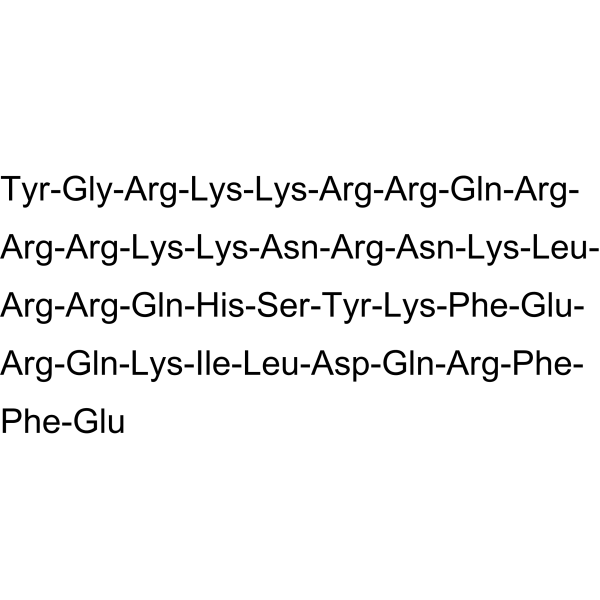
Tyr-Gly-Arg-Lys-Lys-Arg-Arg-Gln-Arg-Arg-Arg-Lys-Lys-Asn-Arg-Asn-Lys-Leu-Arg-Arg-Gln-His-Ser-Tyr-Lys-Phe-Glu-Arg-Gln-Lys-Ile-Leu-Asp-Gln-Arg-Phe-Phe-Glu
-
Sequence Shortening
YGRKKRRQRRRKKNRNKLRRQHSYKFERQKILDQRFFE
-
Shipping
Room temperature in continental US; may vary elsewhere.
-
Storage
Please store the product under the recommended conditions in the Certificate of Analysis.


Purity & Documentation
References

Calculators
Concentration (start) × Volume (start) = Concentration (final) × Volume (final)


TAT-GluN2BCTM Related Classifications
HY-P5277 Related Classifications
 Powered by Bioz