



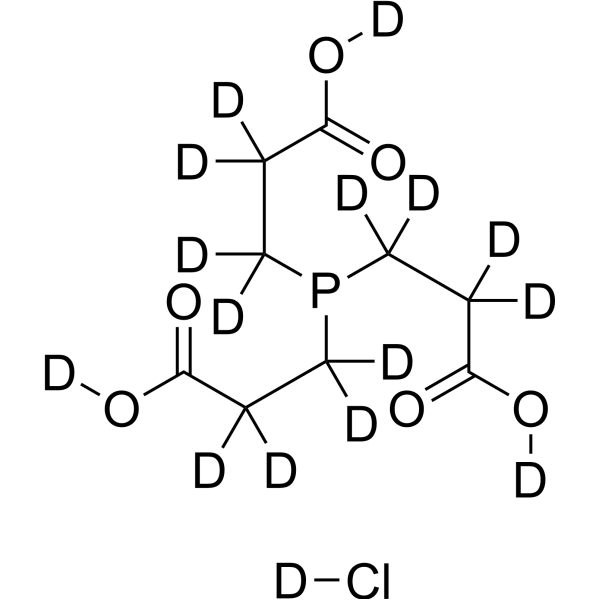
TCEP-d16 hydrochloride
Based on 1 publication(s) in Google Scholar
TCEP-d16 (hydrochloride) is the deuterium labeled TCEP hydrochloride. TCEP hydrochloride (Tris(2-carboxyethyl)phosphine hydrochloride) is a non-thiol reducing agent that is more stable and produces a faster S-S reductive reaction than other chemical reductants. TCEP hydrochloride is a trialkylphosphine, selectively reduces protein disuldes without altering the properties or interacting with thiol-directed agents in the reaction mixture. TCEP hydrochloride is also a commonly used reducing agent in the DNA/AuNP chemistry.
For research use only. We do not sell to patients.
- Purity : 97.0%
- CAS No.: 1174025-33-2
- Formula: C9D16ClO6P
- Molecular Weight:302.75
-
Storage:
4°C, protect from light
* In solvent : -80°C, 6 months; -20°C, 1 month (protect from light)

To place orders, for customer services and technical support, please contact: MedChemExpress USA
Tel: 609-228-6898 E-mail: [email protected] [email protected]


-
 Biological Activity
-
Chemical Information
-
Solvent & Solubility
- Purity & Documentation
- References
-
 Help & FAQs


Publications Citing Use of MedChemExpress (MCE) TCEP-d16 hydrochloride
More

Biological Activity
Description
In Vitro
Stable heavy isotopes of hydrogen, carbon, and other elements have been incorporated into drug molecules, largely as tracers for quantitation during the drug development process. Deuteration has gained attention because of its potential to affect the pharmacokinetic and metabolic profiles of drugs[1].
MedChemExpress (MCE) has not independently confirmed the accuracy of these methods. They are for reference only. .
Application
1. This compound can be used as a tracer
2. This compound can be used as an internal standard for quantitative analysis by NMR, GC-MS, or LC-MS.


Chemical Information
-
CAS No. 1174025-33-2
-
Unlabeled CAS 51805-45-9
-
Appearance Solid
-
Molecular Weight 302.75
-
Formula C9D16ClO6P
-
Color White to off-white
-
SMILES
[2H]OC(C([2H])([2H])C([2H])([2H])P(C([2H])([2H])C([2H])([2H])C(O[2H])=O)C([2H])([2H])C([2H])([2H])C(O[2H])=O)=O.Cl[2H]
-
Shipping
Room temperature in continental US; may vary elsewhere.
-
Storage
4°C, protect from light
* In solvent : -80°C, 6 months; -20°C, 1 month (protect from light)


Publications (1)
-
Journal Impact Factor
-
Most Recent
-
J Hazard Mater
Prenatal amoxicillin exposure induces depressive-like behavior in offspring via gut microbiota and myristic acid-mediated modulation of the STING pathway. [Abstract]2025 Mar 5:485:136750. PMID: 39672059


Solvent & Solubility
In Vitro:
DMSO : 100 mg/mL (330.31 mM; Need ultrasonic and warming; Hygroscopic DMSO has a significant impact on the solubility of product, please use newly opened DMSO)
Please refer to the solubility information to select the appropriate solvent. Once prepared, please aliquot and store the solution to prevent product inactivation from repeated freeze-thaw cycles.
Storage method and period of stock solution: -80°C, 6 months; -20°C, 1 month (protect from light). When stored at -80°C, please use it within 6 months. When stored at -20°C, please use it within 1 month.
Please refer to the solubility information to select the appropriate solvent. Once prepared, please aliquot and store the solution to prevent product inactivation from repeated freeze-thaw cycles.
Storage method and period of stock solution: -80°C, 6 months; -20°C, 1 month (protect from light). When stored at -80°C, please use it within 6 months. When stored at -20°C, please use it within 1 month.
Concentration (start) × Volume (start) = Concentration (final) × Volume (final)


Purity & Documentation
-
Data Sheet (282 KB)
-
SDS (554 KB)
- English - EN (554 KB)
- Français - FR (554 KB)
- Deutsch - DE (554 KB)
- Norwegian - NO (554 KB)
- Español - ES (554 KB)
- Swedish - SV (554 KB)
- Italian - IT (554 KB)
- Korean - KR (554 KB)
- Portuguese - PT (554 KB)
-
Handling Instructions (2659 KB)
References
[1]. Russak EM, et al. Impact of Deuterium Substitution on the Pharmacokinetics of Pharmaceuticals. Ann Pharmacother. 2019 Feb;53(2):211-216. [Content Brief]
[2]. Dieguez-Acuña FJ, et al. Inhibition of NF-kappaB-DNA binding by mercuric ion: utility of the non-thiol reductant, tris(2-carboxyethyl)phosphine hydrochloride (TCEP), on detection of impaired NF-kappaB-DNA binding by thiol-directed agents. Toxicol In Vitro. 2000 Feb;14(1):7-16. [Content Brief]
[3]. Duchardt F, et al. A cell-penetrating peptide derived from human lactoferrin with conformation-dependent uptake efficiency. J Biol Chem. 2009 Dec 25284(52):36099-108. [Content Brief]
[4]. Sequeira MA, et al. Modulating amyloid fibrillation in a minimalist model peptide by intermolecular disulfide chemical reduction. Phys Chem Chem Phys. 2019 Jun 521(22):11916-11923. [Content Brief]
[5]. Wu R, et al. Effects of Small Molecules on DNA Adsorption by Gold Nanoparticles and a Case Study of Tris(2-carboxyethyl)phosphine (TCEP). Langmuir. 2019 Oct 1535(41):13461-13468. [Content Brief]
[6]. Han JC, Han GY. A procedure for quantitative determination of tris(2-carboxyethyl)phosphine, an odorless reducing agent more stable and effective than dithiothreitol. Anal Biochem. 1994220(1):5-10. [Content Brief]


Complete Stock Solution Preparation Table
Please refer to the solubility information to select the appropriate solvent. Once prepared, please aliquot and store the solution to prevent product inactivation from repeated freeze-thaw cycles.
Storage method and period of stock solution: -80°C, 6 months; -20°C, 1 month (protect from light). When stored at -80°C, please use it within 6 months. When stored at -20°C, please use it within 1 month.
| Optional Solvent | Concentration Solvent Mass | 1 mg | 5 mg | 10 mg | 25 mg |
|---|---|---|---|---|---|
| DMSO | 1 mM | 3.3031 mL | 16.5153 mL | 33.0306 mL | 82.5764 mL |
| 5 mM | 0.6606 mL | 3.3031 mL | 6.6061 mL | 16.5153 mL | |
| 10 mM | 0.3303 mL | 1.6515 mL | 3.3031 mL | 8.2576 mL | |
| 15 mM | 0.2202 mL | 1.1010 mL | 2.2020 mL | 5.5051 mL | |
| 20 mM | 0.1652 mL | 0.8258 mL | 1.6515 mL | 4.1288 mL | |
| 25 mM | 0.1321 mL | 0.6606 mL | 1.3212 mL | 3.3031 mL | |
| 30 mM | 0.1101 mL | 0.5505 mL | 1.1010 mL | 2.7525 mL | |
| 40 mM | 0.0826 mL | 0.4129 mL | 0.8258 mL | 2.0644 mL | |
| 50 mM | 0.0661 mL | 0.3303 mL | 0.6606 mL | 1.6515 mL | |
| 60 mM | 0.0551 mL | 0.2753 mL | 0.5505 mL | 1.3763 mL | |
| 80 mM | 0.0413 mL | 0.2064 mL | 0.4129 mL | 1.0322 mL | |
| 100 mM | 0.0330 mL | 0.1652 mL | 0.3303 mL | 0.8258 mL |


TCEP-d16 hydrochloride Related Classifications
HY-W011500S Related Classifications
 Powered by Bioz