



Tetrapeptide-21

Based on 1 Customer Validation
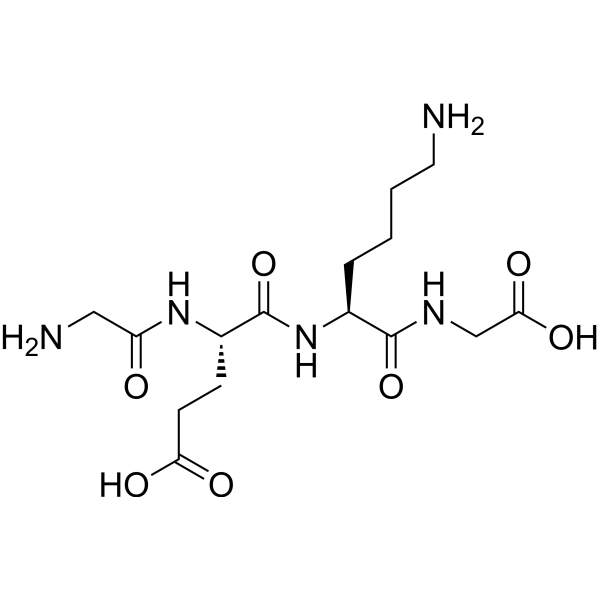
Tetrapeptide-21 is a bioactive peptide composed of four amino acids. Tetrapeptide-21 effectively enhances the vitality of human dermal fibroblasts. Tetrapeptide-21 upregulates the expression of key extracellular matrix (ECM) genes and promotes the synthesis of ECM proteins (such as type I collagen, hyaluronic acid synthase 1, and fibronectin). Tetrapeptide-21 has the efficacy of anti-wrinkle and improving skin elasticity, and has been reported to be used as a cosmetic ingredient.
For research use only. We do not sell to patients.
- Purity : 99.48%
- CAS No.: 960608-17-7
- Formula: C15H27N5O7
- Molecular Weight:389.40
-
Storage:
Sealed storage, away from moisture.
Powder -80°C, 2 years , -20°C, 1 year* In solvent : -80°C, 6 months; -20°C, 1 month (sealed storage, away from moisture)

To place orders, for customer services and technical support, please contact: MedChemExpress USA
Tel: 609-228-6898 E-mail: [email protected] [email protected]


-
 Biological Activity
-
Chemical Information
-
Solvent & Solubility
- Protocols
- Purity & Documentation
- References
-
 Help & FAQs




Biological Activity
Description
In Vitro
Tetrapeptide-21 (0-72 h) reduces cell viability in the later stage (48-72 h), showing potential cytotoxicity, however, the synergistic injectable platelet-rich fibrin (i-PRF) can reverse the toxic effect of the peptide and significantly enhance cell viability and proliferation ability in FBH cells[1].
Tetrapeptide-21 (6-72 h) increases the gene expression of COL1A1, and when used in combination with i-RPF, it also upregulated the expressions of FN1 and HAS1 in FBH cells[1].
MedChemExpress (MCE) has not independently confirmed the accuracy of these methods. They are for reference only.


Chemical Information
-
CAS No. 960608-17-7
-
Appearance Solid
-
Molecular Weight 389.40
-
Formula C15H27N5O7
-
Color White to off-white
-
Sequence
Gly-Glu-Lys-Gly
-
Sequence Shortening
GEKG
-
Shipping
Room temperature in continental US; may vary elsewhere.
-
Storage
Sealed storage, away from moisture
Powder -80°C 2 years -20°C 1 year * In solvent : -80°C, 6 months; -20°C, 1 month (sealed storage, away from moisture)


Solvent & Solubility
In Vitro:
H2O : ≥ 200 mg/mL (513.61 mM)
* "≥" means soluble, but saturation unknown.
Please refer to the solubility information to select the appropriate solvent. Once prepared, please aliquot and store the solution to prevent product inactivation from repeated freeze-thaw cycles.
Storage method and period of stock solution: -80°C, 6 months; -20°C, 1 month (sealed storage, away from moisture). When stored at -80°C, please use it within 6 months. When stored at -20°C, please use it within 1 month.
* Note: If you choose water as the stock solution, please dilute it to the working solution, then filter and sterilize it with a 0.22 μm filter before use.
Please refer to the solubility information to select the appropriate solvent. Once prepared, please aliquot and store the solution to prevent product inactivation from repeated freeze-thaw cycles.
Storage method and period of stock solution: -80°C, 6 months; -20°C, 1 month (sealed storage, away from moisture). When stored at -80°C, please use it within 6 months. When stored at -20°C, please use it within 1 month.
* Note: If you choose water as the stock solution, please dilute it to the working solution, then filter and sterilize it with a 0.22 μm filter before use.
Concentration (start) × Volume (start) = Concentration (final) × Volume (final)


Purity & Documentation
-
Data Sheet (272 KB)
-
SDS (252 KB)
- English - EN (252 KB)
- Français - FR (252 KB)
- Deutsch - DE (252 KB)
- Norwegian - NO (252 KB)
- Español - ES (252 KB)
- Swedish - SV (252 KB)
- Italian - IT (252 KB)
- Korean - KR (252 KB)
- Portuguese - PT (252 KB)
-
Handling Instructions (2659 KB)
References


Complete Stock Solution Preparation Table
Please refer to the solubility information to select the appropriate solvent. Once prepared, please aliquot and store the solution to prevent product inactivation from repeated freeze-thaw cycles.
Storage method and period of stock solution: -80°C, 6 months; -20°C, 1 month (sealed storage, away from moisture). When stored at -80°C, please use it within 6 months. When stored at -20°C, please use it within 1 month.
| Optional Solvent | Concentration Solvent Mass | 1 mg | 5 mg | 10 mg | 25 mg |
|---|---|---|---|---|---|
| H2O | 1 mM | 2.5681 mL | 12.8403 mL | 25.6805 mL | 64.2013 mL |
| 5 mM | 0.5136 mL | 2.5681 mL | 5.1361 mL | 12.8403 mL | |
| 10 mM | 0.2568 mL | 1.2840 mL | 2.5681 mL | 6.4201 mL | |
| 15 mM | 0.1712 mL | 0.8560 mL | 1.7120 mL | 4.2801 mL | |
| 20 mM | 0.1284 mL | 0.6420 mL | 1.2840 mL | 3.2101 mL | |
| 25 mM | 0.1027 mL | 0.5136 mL | 1.0272 mL | 2.5681 mL | |
| 30 mM | 0.0856 mL | 0.4280 mL | 0.8560 mL | 2.1400 mL | |
| 40 mM | 0.0642 mL | 0.3210 mL | 0.6420 mL | 1.6050 mL | |
| 50 mM | 0.0514 mL | 0.2568 mL | 0.5136 mL | 1.2840 mL | |
| 60 mM | 0.0428 mL | 0.2140 mL | 0.4280 mL | 1.0700 mL | |
| 80 mM | 0.0321 mL | 0.1605 mL | 0.3210 mL | 0.8025 mL | |
| 100 mM | 0.0257 mL | 0.1284 mL | 0.2568 mL | 0.6420 mL |
* Note: If you choose water as the stock solution, please dilute it to the working solution, then filter and sterilize it with a 0.22 μm filter before use.


Tetrapeptide-21 Related Classifications
HY-P5232 Related Classifications
 Powered by Bioz