



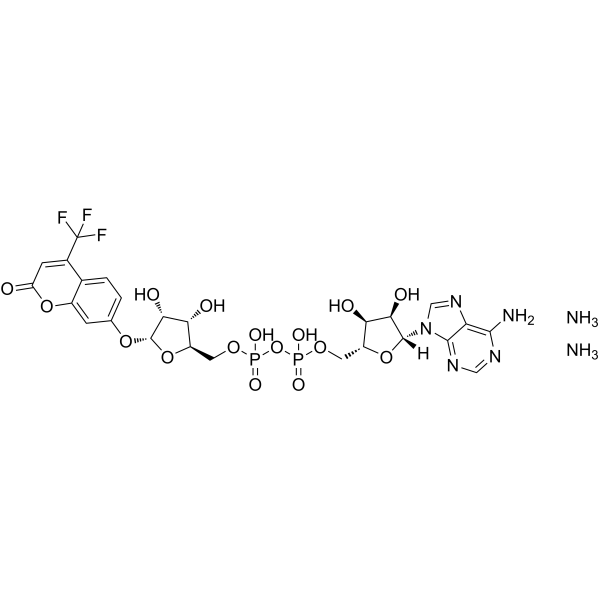
TFMU-ADPr diammonium

Based on 1 Customer Validation
TFMU-ADPr diammonium is a selective reporter substrate of SARS-CoV-2 Macro1 (IC50=0.59 μM), with an excitation wavelength (λEx) of 385 nm, and an emission wavelength (λEm) of 502 nm (or 495 nm). TFMU-ADPr diammonium can also undergo enzymatic hydrolysis with Poly(ADP-ribose) Glycohydrolase (PARG) sourced from human, Tetrahymena thermophila and ADP-ribosylhydrolase 3 from human to release fluorophores, thereby directly reporting total poly (ADP-ribose) hydrolase activity. TFMU-ADPr diammonium binds to the ADPr-binding site of SARS-CoV-2 Macro1, and its TFMU moiety inserts into the narrow hydrophobic groove of this protein. TFMU-ADPr diammonium can thus be used to evaluate small-molecule inhibitors targeting PAR hydrolases under in vitro conditions, to investigate the regulatory mechanisms of ADP-ribosyl catabolic enzymes, or to detect PAR hydrolase activity in whole-cell lysate assays. TFMU-ADPr diammonium is also applicable to COVID-19-related research.
For research use only. We do not sell to patients.
- Purity : 98.78%
- Formula: C25H32F3N7O16P2
- Molecular Weight:805.50
-
Storage:
-20°C, stored under nitrogen, away from moisture
* In solvent : -80°C, 6 months; -20°C, 1 month (stored under nitrogen, away from moisture)

To place orders, for customer services and technical support, please contact: MedChemExpress USA
Tel: 609-228-6898 E-mail: [email protected] [email protected]


-
 Biological Activity
-
Chemical Information
-
Solvent & Solubility
- Protocols
- Purity & Documentation
- References
-
 Help & FAQs




Biological Activity
Description
In Vitro
TFMU-ADPr diammonium (0-500 μM, 0-120 μM; 5 minutes) serves as a continuous fluorescent substrate for hPARG (full-length PARG from Homo sapiens), ttPARG (PARG from Tetrahymena thermophila) and hARH3 (full-length ARH3 from H. sapiens), enabling robust enzyme kinetic assays. The corresponding KM values for the three enzymes are 66.2 μM, 210 μM and 6.3 μM, respectively[1].
TFMU-ADPr diammonium (200 μM) can report the combined hydrolase activity of PARG and ARH3 in U2OS cell lysates, and this activity is detected in both wild-type cells and ARH3 knockout cells (the latter represents PARG-only activity)[1].
TFMU-ADPr diammonium (0-50 μM) serves as an effective reporter substrate for detecting the inhibitory activity of hARH3, which is confirmed by the potent inhibitory effect of the endogenous metabolite ADPr-Arg (Ki=18 nM)[1].
TFMU-ADPr diammonium (in a dose-response manner; incubation duration 30 min) potently binds SARS-CoV-2 Macro1 (IC50=0.59 μM), human MacroD1, human MacroD2, VEEV Macro, and human PARP9 Macro2; compared with ADPr, it shows significantly improved binding potency for all tested macrodomains except CHIKV Macro[2].
TFMU-ADPr diammonium (2 mM; 5 d) binds to the conserved ADPr-binding pocket of SARS-CoV-2 Macro1, and its TFMU group forms favorable interactions with hydrophobic residues in the adjacent hydrophobic groove, thereby contributing to high binding affinity[2].
TFMU-ADPr diammonium acts as an inhibitor of the ADPr hydrolase activity of SARS-CoV-2 Macro1 and human MacroD1 in cell lysates[2].
Experimental procedure for in vitro detection using TFMU-ADPr diammonium mainly focuses on enzyme kinetics and inhibition assays, as specified below[3]:
1. Experimental Preparation:
Establish a reaction system in a 384-well plate. The system contains 50 mM Na2HPO4 (pH 7.4), 10 mM MgCl2, 5 mM DTT, TFMU-ADPr diammonium at a specified concentration as the substrate, and the enzyme to be tested (such as hARH1, hARH3, etc.). For inhibitor studies, pre-incubate the enzyme with the inhibitor at room temperature for 5 minutes first.
2. Reaction Initiation and Signal Detection:
After shaking the reaction system for 5 seconds, record the fluorescence signal using a Molecular Devices SpectraMax M3 microplate reader. Set the excitation wavelength (λEx) to 385 nm and the emission wavelength (λEm) to 502 nm (or 495 nm). Read each well 6 times in low-gain mode, and record the fluorescence value every 5 seconds for a continuous detection duration of 15 min.
3. Data Processing:
Determine the initial reaction rate by fitting the linear segment of the reaction progress curve. Fit the initial rate to the substrate concentration, use the nonlinear curve fitting algorithm in GraphPad Prism 6, and analyze enzyme kinetic parameters based on the Michaelis-Menton equation. For inhibition assays, use enzyme-free reactions and inhibitor-free reactions as positive and negative controls, respectively, calculate the inhibition percentage, and obtain relevant inhibition parameters through dose-response curve fitting.
MedChemExpress (MCE) has not independently confirmed the accuracy of these methods. They are for reference only. Further protocols information, click here.


Chemical Information
-
Appearance Solid
-
Molecular Weight 805.50
-
Formula C25H32F3N7O16P2
-
Color White to off-white
-
SMILES
O[C@H]1[C@](O[C@@H]([C@H]1O)COP(OP(OC[C@H]2O[C@@H]([C@@H]([C@@H]2O)O)OC3=CC=C(C(C(F)(F)F)=CC(O4)=O)C4=C3)(O)=O)(O)=O)([H])N5C6=NC=NC(N)=C6N=C5.N.N
-
Shipping
Room temperature in continental US; may vary elsewhere.
-
Storage
-20°C, stored under nitrogen, away from moisture
* In solvent : -80°C, 6 months; -20°C, 1 month (stored under nitrogen, away from moisture)


Solvent & Solubility
In Vitro:
H2O : 125 mg/mL (155.18 mM; Need ultrasonic)
Please refer to the solubility information to select the appropriate solvent. Once prepared, please aliquot and store the solution to prevent product inactivation from repeated freeze-thaw cycles.
Storage method and period of stock solution: -80°C, 6 months; -20°C, 1 month (stored under nitrogen, away from moisture). When stored at -80°C, please use it within 6 months. When stored at -20°C, please use it within 1 month.
* Note: If you choose water as the stock solution, please dilute it to the working solution, then filter and sterilize it with a 0.22 μm filter before use.
Please refer to the solubility information to select the appropriate solvent. Once prepared, please aliquot and store the solution to prevent product inactivation from repeated freeze-thaw cycles.
Storage method and period of stock solution: -80°C, 6 months; -20°C, 1 month (stored under nitrogen, away from moisture). When stored at -80°C, please use it within 6 months. When stored at -20°C, please use it within 1 month.
* Note: If you choose water as the stock solution, please dilute it to the working solution, then filter and sterilize it with a 0.22 μm filter before use.
Concentration (start) × Volume (start) = Concentration (final) × Volume (final)

Protocols
-
Cell Cytotoxicity Assay
Cytotoxicity assays are usually based on the assessment of cell membrane damage, which can also be indirectly detected by measuring cell viability. Detection methods include MTT assay, CKK-8 assay, LDH assay and ATP assay, etc.
-
Detergent-Based Total Protein Extraction from Cultured Mammalian Cells (RIPA/NP-40/Triton Lysis)
Detergent-based total protein extraction lyses cultured mammalian cells by using amphipathic detergents to disrupt lipid membranes and solubilize proteins into aqueous lysate; RIPA combines non-ionic detergent with ionic detergents, whereas NP-40/Triton buffers are milder non-ionic lysis conditions. The readout is the recovered clarified protein lysate, which is commonly quantified by detergent-compatible protein assays and then used for downstream protein analysis such as SDS-PAGE and Western blotting.


Purity & Documentation
-
Data Sheet (275 KB)
-
SDS (252 KB)
- English - EN (252 KB)
- Français - FR (252 KB)
- Deutsch - DE (252 KB)
- Norwegian - NO (252 KB)
- Español - ES (252 KB)
- Swedish - SV (252 KB)
- Italian - IT (252 KB)
- Korean - KR (252 KB)
- Portuguese - PT (252 KB)
-
Handling Instructions (2659 KB)
References
[1]. Drown BS, et al. Monitoring Poly(ADP-ribosyl)glycohydrolase Activity with a Continuous Fluorescent Substrate. Cell Chem Biol. 2018;25(12):1562-1570.e19. [Content Brief]
[2]. Anmangandla A, et al. A Fluorescence Polarization Assay for Macrodomains Facilitates the Identification of Potent Inhibitors of the SARS-CoV-2 Macrodomain. ACS Chem Biol. 2023;18(5):1200-1207. [Content Brief]
[3]. Rack JGM, et al. (ADP-ribosyl)hydrolases: Structural Basis for Differential Substrate Recognition and Inhibition. Cell Chem Biol. 2018 Dec 20;25(12):1533-1546.e12. [Content Brief]


Complete Stock Solution Preparation Table
Please refer to the solubility information to select the appropriate solvent. Once prepared, please aliquot and store the solution to prevent product inactivation from repeated freeze-thaw cycles.
Storage method and period of stock solution: -80°C, 6 months; -20°C, 1 month (stored under nitrogen, away from moisture). When stored at -80°C, please use it within 6 months. When stored at -20°C, please use it within 1 month.
| Optional Solvent | Concentration Solvent Mass | 1 mg | 5 mg | 10 mg | 25 mg |
|---|---|---|---|---|---|
| H2O | 1 mM | 1.2415 mL | 6.2073 mL | 12.4146 mL | 31.0366 mL |
| 5 mM | 0.2483 mL | 1.2415 mL | 2.4829 mL | 6.2073 mL | |
| 10 mM | 0.1241 mL | 0.6207 mL | 1.2415 mL | 3.1037 mL | |
| 15 mM | 0.0828 mL | 0.4138 mL | 0.8276 mL | 2.0691 mL | |
| 20 mM | 0.0621 mL | 0.3104 mL | 0.6207 mL | 1.5518 mL | |
| 25 mM | 0.0497 mL | 0.2483 mL | 0.4966 mL | 1.2415 mL | |
| 30 mM | 0.0414 mL | 0.2069 mL | 0.4138 mL | 1.0346 mL | |
| 40 mM | 0.0310 mL | 0.1552 mL | 0.3104 mL | 0.7759 mL | |
| 50 mM | 0.0248 mL | 0.1241 mL | 0.2483 mL | 0.6207 mL | |
| 60 mM | 0.0207 mL | 0.1035 mL | 0.2069 mL | 0.5173 mL | |
| 80 mM | 0.0155 mL | 0.0776 mL | 0.1552 mL | 0.3880 mL | |
| 100 mM | 0.0124 mL | 0.0621 mL | 0.1241 mL | 0.3104 mL |
* Note: If you choose water as the stock solution, please dilute it to the working solution, then filter and sterilize it with a 0.22 μm filter before use.


TFMU-ADPr diammonium Related Classifications
HY-146248B Related Classifications
 Powered by Bioz