



TLQP-21
Based on 2 publication(s) in Google Scholar
TLQP-21, a VGF-derived peptide endowed of endocrine and extraendocrine properties, is a potent G-protein-coupled receptor complement-3a receptor 1 (C3aR1) agonist (EC50: mouse TLQP-21=10.3 μM; human TLQP-21=68.8 μM). TLQP-21 activates C3aR1 to induce an increase of intracellular Ca2+. TLQP-21 is used for the research in regulation of nociception and other relevant physiologic functions.
For research use only. We do not sell to patients.
- CAS No.: 869988-94-3
- Formula: C107H170N40O26
- Molecular Weight:2432.75
-
Storage:
Please store the product under the recommended conditions in the Certificate of Analysis.


To place orders, for customer services and technical support, please contact: MedChemExpress USA
Tel: 609-228-6898 E-mail: [email protected] [email protected]


-
 Biological Activity
-
Chemical Information
-
Solvent & Solubility
- Protocols
- Purity & Documentation
- References
-
 Help & FAQs


-
HY-15886
Mdivi-1Drp1 Inhibitor -
HY-100573
NecrosulfonamideMLKL/GSDMD Inhibitor -

HY-107754
Cesium chloridePotassium Channel Blocker -

HY-P1344
DAPK Substrate PeptideDAPK Peptide Substrate -
HY-12497
ANA-12TrkB Antagonist -
HY-12866
LarotrectinibTRK Inhibitor -
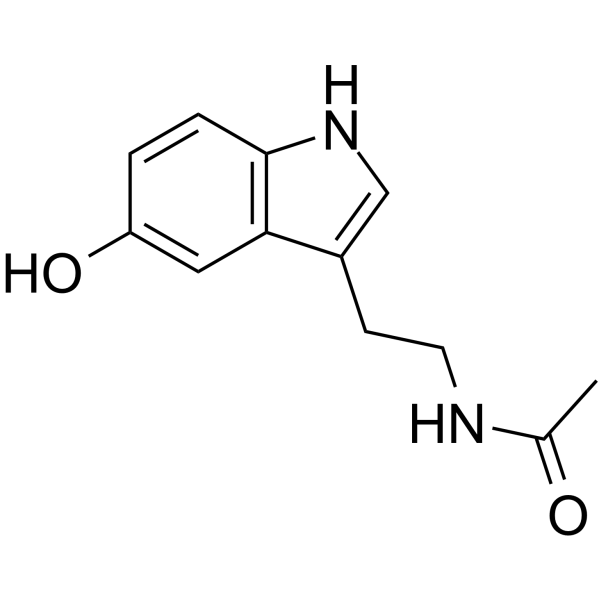
HY-107854
N-Acetyl-5-hydroxytryptamineMelatonin Precursor -
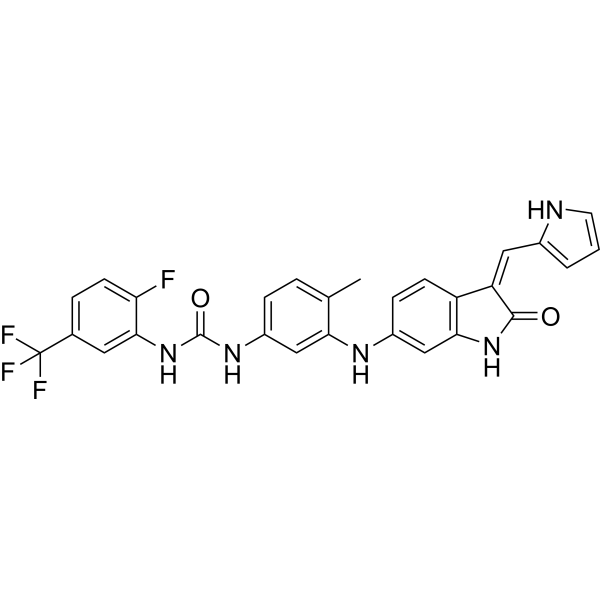
HY-13491
GNF-5837Trk Receptor Inhibitor -
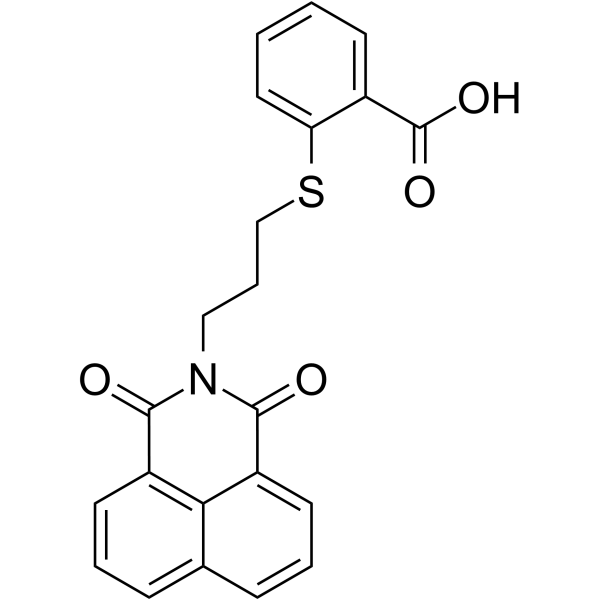
HY-100676
GRI977143LPA2 Agonist -
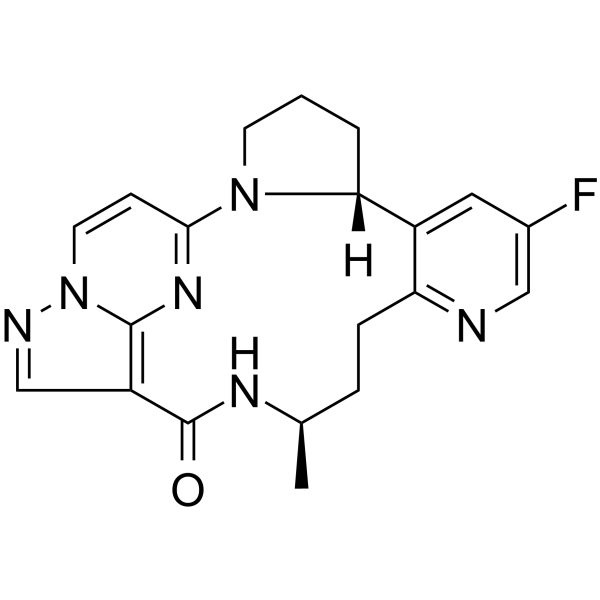
HY-101977
SelitrectinibTRK Kinase Inhibitor -
HY-12842
UC-112XIAP Inhibitor -
HY-16961
SitravatinibRTK Inhibitor
Publications Citing Use of MedChemExpress (MCE) TLQP-21
More

Biological Activity
Description
In Vitro
TLQP-21 is a peptide of 21 amino acids. At a dose of 3 μM TLQP-21 induces up to ~69% of the corresponding contraction promoted by acetylcholine[1][2].
MedChemExpress (MCE) has not independently confirmed the accuracy of these methods. They are for reference only. Further protocols information, click here.


Chemical Information
-
CAS No. 869988-94-3
-
Molecular Weight 2432.75
-
Formula C107H170N40O26
-
Sequence
Thr-Leu-Gln-Pro-Pro-Ala-Ser-Ser-Arg-Arg-Arg-His-Phe-His-His-Ala-Leu-Pro-Pro-Ala-Arg
-
Sequence Shortening
TLQPPASSRRRHFHHALPPAR
-
Shipping
Room temperature in continental US; may vary elsewhere.
-
Storage
Please store the product under the recommended conditions in the Certificate of Analysis.


Publications (2)
-
Journal Impact Factor
-
Most Recent
-
Int Immunopharmacol
Identification and characterization of prognosis-related genes in the tumor microenvironment of esophageal squamous cell carcinoma. [Abstract]2021 Jul:96:107616. PMID: 34162127 -
J Neurochem
Complement C3a and C5a Receptors Are Presented in Mouse Sciatic and Human Sural Nerves and Selectively Modulate the Neuronal Function of Large-Caliber Fibers in Mice. [Abstract]2025 Jun;169(6):e70129. PMID: 40539483


Solvent & Solubility
In Vitro
H2O
Peptide Solubility and Storage Guidelines:
1. Calculate the length of the peptide.
2. Calculate the overall charge of the entire peptide according to the following table:
| Contents | Assign value | |
|---|---|---|
| Acidic amino acid | Asp (D), Glu (E), and the C-terminal -COOH. | -1 |
| Basic amino acid | Arg (R), Lys (K), His (H), and the N-terminal -NH2 | +1 |
| Neutral amino acid | Gly (G), Ala (A), Leu (L), Ile (I), Val (V), Cys (C), Met (M), Thr (T), Ser (S), Phe (F), Tyr (Y), Trp (W), Pro (P), Asn (N), Gln (Q) | 0 |
3. Recommended solution:
| Overall charge of peptide | Details |
|---|---|
| Negative (<0) |
1. Try to dissolve the peptide in water first. 2. If water fails, add NH4OH (<50 μL). 3. If the peptide still does not dissolve, add DMSO (50-100 μL) to solubilize the peptide. |
| Positive (>0) |
1. Try to dissolve the peptide in water first. 2. If water fails, try dissolving the peptide in a 10%-30% acetic acid solution. 3. If the peptide still does not dissolve, try dissolving the peptide in a small amount of DMSO. |
| Zero (=0) |
1. Try to dissolve the peptide in organic solvent (acetonitrile, methanol, etc.) first. 2. For very hydrophobic peptides, try dissolving the peptide in a small amount of DMSO, and then dilute the solution with water to the desired concentration. |

Protocols
-
Ca2+ Staining Technique
Ca2+ staining is an experimental technique that utilizes specific fluorescent probes (such as Fluo-4 AM, Fura-2, etc.) to qualitatively or quantitatively detect dynamic changes in intracellular Ca2+ concentrations; this is achieved by monitoring the changes in fluorescent signals generated when these probes bind to free intracellular calcium ions. The underlying principle relies primarily on the presence of chelating groups within the probe's molecular structure that possess high affinity for calcium ions.


Purity & Documentation
References
[1]. Elena Bresciani , et al. TLQP-21, A VGF-Derived Peptide Endowed of Endocrine and Extraendocrine Properties: Focus on In Vitro Calcium Signaling. Int J Mol Sci. 2019 Dec 24;21(1):130. [Content Brief]
[2]. Cheryl Cero, et al. The TLQP-21 Peptide Activates the G-protein-coupled Receptor C3aR1 via a Folding-Upon-Binding Mechanism. ructure. 2014 Dec 2;22(12):1744-1753. [Content Brief]

Calculators
Concentration (start) × Volume (start) = Concentration (final) × Volume (final)


TLQP-21 Related Classifications
HY-P1345 Related Classifications
 Powered by Bioz