



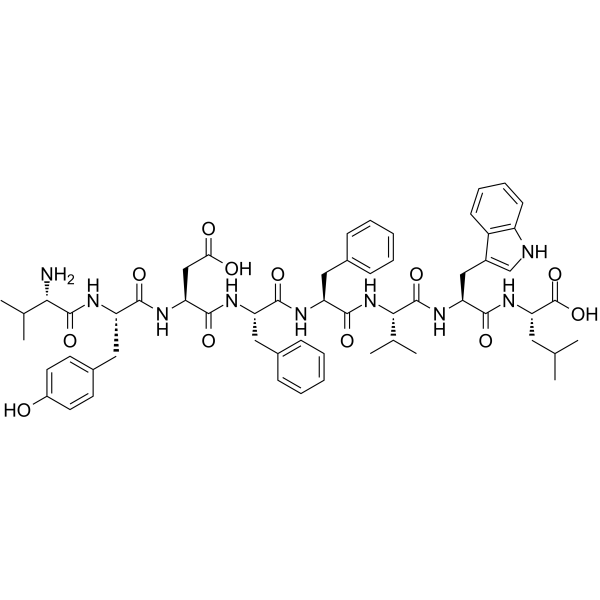
Tyrosinase-related Protein 2 (TRP-2) (181-188)

Based on 1 Customer Validation
Tyrosinase-related Protein 2 (TRP-2) (181-188) is a peptide epitope of the TRP-2 protein that conforms to the MHC class I H2-Kb binding motif. It is the major reactive epitope within TRP-2 recognized by anti-B16 CTLs, induces TRP-2-specific CTL and CD8+ T cell responses, and mediates antibody-dependent antitumor effects against lung metastasis. Tyrosinase-related Protein 2 (TRP-2) (181-188) is used in melanoma research.
For research use only. We do not sell to patients.
- Purity : 98.52%
- CAS No.: 187671-49-4
- Formula: C58H73N9O12
- Molecular Weight:1088.25
-
Storage:
Sealed storage, away from moisture and light, under nitrogen.
Powder -80°C, 2 years , -20°C, 1 year* In solvent : -80°C, 6 months; -20°C, 1 month (sealed storage, away from moisture and light, under nitrogen)

To place orders, for customer services and technical support, please contact: MedChemExpress USA
Tel: 609-228-6898 E-mail: [email protected] [email protected]


-
 Biological Activity
-
Chemical Information
-
Solvent & Solubility
- Protocols
- Purity & Documentation
- References
-
 Help & FAQs




Biological Activity
Description
In Vitro
TRP-2 181-188 (10 μg/mL; 90 min) is the major reactive epitope within TRP-2 recognized by anti-B16 line A CTLs when presented by MC38 cells, stimulating 6.0 U/mL/24 h of IFN-γ release[1].
MedChemExpress (MCE) has not independently confirmed the accuracy of these methods. They are for reference only. Further protocols information, click here.
In Vivo
Tyrosinase‑related Protein 2 (TRP‑2) (181‑188) peptide co‑injected with IC31 (100 µg/mouse TRP‑2181‑188 peptide; 100 nmol/mouse KLKL5KLK; 5 nmol/mouse ODN1a; single intrapad injection) induces robust peptide‑specific type 1 cellular immune response with approximately 155 IFN‑γ‑producing cells per 106 splenocytes[3].
Tyrosinase-related Protein 2 (TRP-2) (181-188) peptide with a single injection of IC31 (100 µg/mouse TRP-2181-188 peptide; 100 nmol/mouse KLKL5KLK; 5 nmol/mouse ODN1a) induces potent TRP-2181-188-specific CTL effector cells, producing 69.2% specific lysis of target cells in vivo[3].
MedChemExpress (MCE) has not independently confirmed the accuracy of these methods. They are for reference only.
-
Animal Model:C57BL/6 (female, 6-12 weeks old)[1]
-
Dosage:1-2 × 10⁶ CTLs; 6 × 10⁴ IU IL-2
-
Administration:i.v. (single dose on day 3); i.p. (three times per day for 3 days)
-
Result:Showed a highly significant effect against 3-day-old B16 lung metastases when administered intravenously in combination with low-dose IL-2.
-
Animal Model:C57BL/6[2]
-
Dosage:50 μl
-
Administration:i.v.; at day 0, 3, and 6
-
Result:Delayed tumor growth when compared with sera from mice immunized with VRP expressing other antigens.
-
Animal Model:C57BL/6 (H-2b; female; 6-10 weeks old)[3]
-
Dosage:100 µg/mouse (TRP-2181-188 peptide); 100 nmol/mouse (KLKL5KLK); 5 nmol/mouse (ODN1a)
-
Administration:Intrafootpad; single injection
-
Result:Induced approximately 155 IFN-γ-producing cells per 106 splenocytes when co-injected with IC31.
Induced no peptide-specific IFN-γ-producing cells when injected alone or with KLKL5KLK or ODN1a alone.
Induced no peptide-specific IL-4 production.
-
Animal Model:C57BL/6 (H-2b; female; 6-10 weeks old)[3]
-
Dosage:100 µg/mouse (TRP-2181-188 peptide); 100 nmol/mouse (KLKL5KLK); 5 nmol/mouse (ODN1a)
-
Administration:Injection; single dose
-
Result:Induced 69.2% antigen-specific lysis of target cells in vivo when co-injected with IC31.
Induced no cytotoxic activity in naïve mice (21.3%).
Induced no cytotoxic activity in mice vaccinated with peptide alone (18.9%).
Unspecific lysis of target cells pulsed with irrelevant antigen was not higher than 15%.


Chemical Information
-
CAS No. 187671-49-4
-
Appearance Solid
-
Molecular Weight 1088.25
-
Formula C58H73N9O12
-
Color White to off-white
-
Sequence
Val-Tyr-Asp-Phe-Phe-Val-Trp-Leu
-
Sequence Shortening
VYDFFVWL
-
Shipping
Room temperature in continental US; may vary elsewhere.
-
Storage
Sealed storage, away from moisture and light, under nitrogen
Powder -80°C 2 years -20°C 1 year * In solvent : -80°C, 6 months; -20°C, 1 month (sealed storage, away from moisture and light, under nitrogen)


Solvent & Solubility
In Vitro:
DMSO : ≥ 12.5 mg/mL (11.49 mM; Hygroscopic DMSO has a significant impact on the solubility of product, please use newly opened DMSO)
* "≥" means soluble, but saturation unknown.
Please refer to the solubility information to select the appropriate solvent. Once prepared, please aliquot and store the solution to prevent product inactivation from repeated freeze-thaw cycles.
Storage method and period of stock solution: -80°C, 6 months; -20°C, 1 month (sealed storage, away from moisture and light, under nitrogen). When stored at -80°C, please use it within 6 months. When stored at -20°C, please use it within 1 month.
Please refer to the solubility information to select the appropriate solvent. Once prepared, please aliquot and store the solution to prevent product inactivation from repeated freeze-thaw cycles.
Storage method and period of stock solution: -80°C, 6 months; -20°C, 1 month (sealed storage, away from moisture and light, under nitrogen). When stored at -80°C, please use it within 6 months. When stored at -20°C, please use it within 1 month.
Concentration (start) × Volume (start) = Concentration (final) × Volume (final)

Protocols
-
Tail-Vein Experimental Metastasis Xenograft
Tail-vein experimental metastasis xenograft models assess the ability of injected tumor cells to survive circulation, arrest in vascular beds, extravasate, and colonize distant organs, most commonly lung after lateral tail-vein injection; this model bypasses primary-tumor formation, local invasion, and intravasation, so the readout reflects late metastatic colonization rather than the full metastatic cascade. The main readouts are metastatic burden measured by bioluminescence imaging, gross metastatic nodules, histology, organ weight, survival, or ex vivo tumor-cell quantification; luciferase-labeled tumor cells permit longitudinal noninvasive monitoring, while histology confirms organ colonization and tissue localization.
-
Research Protocol for Cancer Immunology
Cancer immunology studies how the immune system recognizes, suppresses, edits, or fails to eliminate malignant cells through tumor antigen release, antigen presentation, T-cell priming, immune trafficking, tumor-cell killing, and feedback inhibition in the tumor microenvironment. The cancer-immunity cycle links tumor antigenicity, dendritic-cell priming, CD8+ T-cell infiltration, cytotoxic function, and immune-checkpoint regulation to tumor rejection or immune escape. Immune-checkpoint pathways such as PD-1/PD-L1 and CTLA-4 suppress antitumor T-cell activity and can be therapeutically blocked, but many tumors remain resistant because of poor antigen presentation, weak T-cell infiltration, suppressive myeloid cells, regulatory T cells, and tumor-intrinsic immune-exclusion programs. Unresolved questions include which immune-cell states predict response, how tumor-intrinsic pathways exclude immune cells, how myeloid suppression limits checkpoint blockade, and which combination strategies
-
Orthotopic Cell-Line Xenograft
Orthotopic cell-line xenograft models involve implantation of human cancer cell lines into the anatomically corresponding organ of immunodeficient mice to reproduce tumor growth within a native microenvironment, enabling more clinically relevant tumor behavior compared with subcutaneous models. These models are widely used because orthotopic placement better recapitulates tumor progression, including invasion and metastatic spread, which are often underrepresented in heterotopic implantation systems. Compared with conventional xenografts, orthotopic implantation is described as more technically complex but provides improved simulation of tumor-microenvironment interactions and metastatic behavior, making it particularly valuable for translational oncology research. Surgical orthotopic implantation approaches have been emphasized as enabling faithful reproduction of clinical cancer features, including metastasis and disease progression patterns that align with the tumor’s organ of origi


Purity & Documentation
-
Data Sheet (291 KB)
-
SDS (252 KB)
- English - EN (252 KB)
- Français - FR (252 KB)
- Deutsch - DE (252 KB)
- Norwegian - NO (252 KB)
- Español - ES (252 KB)
- Swedish - SV (252 KB)
- Italian - IT (252 KB)
- Korean - KR (252 KB)
- Portuguese - PT (252 KB)
-
Handling Instructions (2659 KB)
References


Complete Stock Solution Preparation Table
Please refer to the solubility information to select the appropriate solvent. Once prepared, please aliquot and store the solution to prevent product inactivation from repeated freeze-thaw cycles.
Storage method and period of stock solution: -80°C, 6 months; -20°C, 1 month (sealed storage, away from moisture and light, under nitrogen). When stored at -80°C, please use it within 6 months. When stored at -20°C, please use it within 1 month.
| Optional Solvent | Concentration Solvent Mass | 1 mg | 5 mg | 10 mg | 25 mg |
|---|---|---|---|---|---|
| DMSO | 1 mM | 0.9189 mL | 4.5945 mL | 9.1891 mL | 22.9727 mL |
| 5 mM | 0.1838 mL | 0.9189 mL | 1.8378 mL | 4.5945 mL | |
| 10 mM | 0.0919 mL | 0.4595 mL | 0.9189 mL | 2.2973 mL |


Tyrosinase-related Protein 2 (TRP-2) (181-188) Related Classifications
HY-P2527 Related Classifications
 Powered by Bioz