



UM4118

Based on 1 Customer Validation
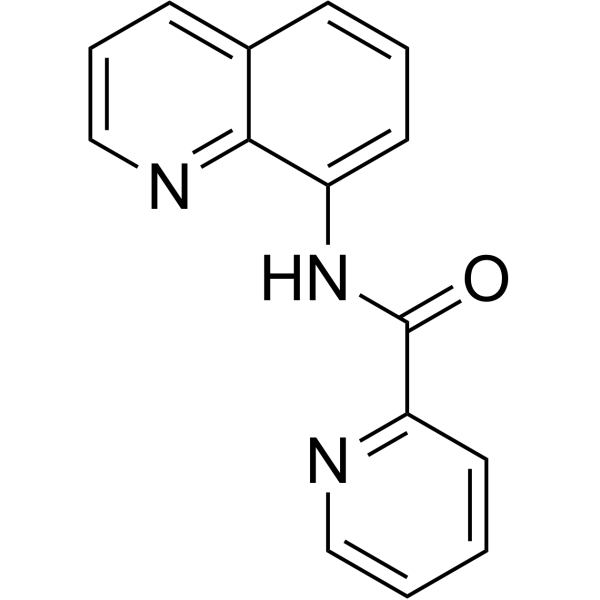
UM4118 is a potent copper-selective non-genotoxic copper ionophore that induces cuproptosis in acute myeloid leukemia cells. UM4118 exhibits stronger activity against SF3B1G12C mutant acute myeloid leukemia cells. UM4118 transports extracellular copper into cells, elevates intracellular and mitochondrial copper levels, and triggers lipoylated DLAT aggregation, proteotoxic stress, iron-sulfur cluster protein depletion, reduced lipoylated protein levels, and maximal mitochondrial respiratory damage. UM4118 cytotoxicity can be enhanced by supplementation with extracellular copper, abolished by copper chelation, and shows synthetic lethal effects in the absence of iron-sulfur cluster biosynthesis/transport genes. UM4118 can be used for the study of acute myeloid leukemia.
For research use only. We do not sell to patients.
- Purity : 99.66%
- CAS No.: 324530-92-9
- Formula: C15H11N3O
- Molecular Weight:249.27
-
Storage:Powder -20°C, 3 years , 4°C, 2 years ; In solvent -80°C, 6 months , -20°C, 1 month

To place orders, for customer services and technical support, please contact: MedChemExpress USA
Tel: 609-228-6898 E-mail: [email protected] [email protected]


-
 Biological Activity
-
Chemical Information
-
Solvent & Solubility
- Protocols
- Purity & Documentation
- References
-
 Help & FAQs




Biological Activity
Description
In Vitro
UM4118 (40 μM) binds copper and zinc in a cell-free system[1].
UM4118 (2 μM; 3 h) specifically increases intracellular copper levels in OCI-AML5 cells by importing copper from the extracellular media[1].
UM4118 (40 nM) shows potent and selective antiproliferative activity against OCI‑AML5 cells (IC50 = 40 nM) and is further potentiated in ABCB7‑downregulated OCI‑AML5 cells[1].
UM4118 (150 nM; 24 h) impairs maximal mitochondrial respiration capacity in OCI-AML5 cells, indicating reliance on mitochondrial respiration for its activity[1].
UM4118 (300 nM; 16 h) induces DLAT aggregation in OCI-AML5 cells, a hallmark of cuproptosis, with enhanced aggregation observed upon copper supplementation[1].
UM4118 (2 μM; 3 h) increases intramitochondrial copper levels in human embryonic kidney 293 cells[1].
UM4118 (110 nM; 14 day) has synthetic lethal interactions with knockdown of glycolysis enzymes, ISC biosynthesis genes, or ABCB7 in EKO OCI-AML5 cells, while knockdown of TCA cycle or lipoylation enzymes rescues cells from UM4118-induced cytotoxicity[1].
UM4118 acts synergistically with Pladienolide B (HY-16399) in OCI-AML5 cells[1].
UM4118 (20 nM; 48 h) reduces clonogenic potential of K562 cells, with a significantly stronger effect in SF3B1K700E mutant cells than in SF3B1 WT cells[1].
MedChemExpress (MCE) has not independently confirmed the accuracy of these methods. They are for reference only.
-
Cell Line:OCI-AML5 acute myeloid leukemia cells
-
Concentration:300 nM; 1 μM (copper supplement)
-
Incubation Time:16 h
-
Result:Induced DLAT aggregation, with total DLAT fluorescence intensity increasing to ~1.2 (normalized to cell number) without copper and ~2.4 with copper, versus ~0.6 and ~0.8 in DMSO controls, respectively.
Had its induced DLAT aggregation further exacerbated by copper supplementation.
-
Cell Line:isogenic K562 acute myeloid leukemia cells (SF3B1 WT vs. SF3B1 K700E mutant)
-
Concentration:20 nM
-
Incubation Time:48 h
-
Result:Reduced colony formation by a fold change of 28.1 in SF3B1 WT K562 cells and 98 in SF3B1 K700E mutant K562 cells.


Chemical Information
-
CAS No. 324530-92-9
-
Appearance Solid
-
Molecular Weight 249.27
-
Formula C15H11N3O
-
Color Off-white to light yellow
-
SMILES
O=C(C1=NC=CC=C1)NC2=CC=CC3=CC=CN=C32
-
Shipping
Room temperature in continental US; may vary elsewhere.
-
Storage
Powder -20°C 3 years 4°C 2 years In solvent -80°C 6 months -20°C 1 month


Solvent & Solubility
In Vitro:
DMSO : 116.67 mg/mL (468.05 mM; ultrasonic and warming and heat to 60°C; Hygroscopic DMSO has a significant impact on the solubility of product, please use newly opened DMSO)
Please refer to the solubility information to select the appropriate solvent. Once prepared, please aliquot and store the solution to prevent product inactivation from repeated freeze-thaw cycles.
Storage method and period of stock solution: -80°C, 6 months; -20°C, 1 month. When stored at -80°C, please use it within 6 months. When stored at -20°C, please use it within 1 month.
Please refer to the solubility information to select the appropriate solvent. Once prepared, please aliquot and store the solution to prevent product inactivation from repeated freeze-thaw cycles.
Storage method and period of stock solution: -80°C, 6 months; -20°C, 1 month. When stored at -80°C, please use it within 6 months. When stored at -20°C, please use it within 1 month.
Concentration (start) × Volume (start) = Concentration (final) × Volume (final)


Purity & Documentation
-
Data Sheet (278 KB)
-
SDS (251 KB)
- English - EN (251 KB)
- Français - FR (251 KB)
- Deutsch - DE (251 KB)
- Norwegian - NO (251 KB)
- Español - ES (251 KB)
- Swedish - SV (251 KB)
- Italian - IT (251 KB)
- Korean - KR (251 KB)
- Portuguese - PT (251 KB)
-
Handling Instructions (2659 KB)
References


Complete Stock Solution Preparation Table
Please refer to the solubility information to select the appropriate solvent. Once prepared, please aliquot and store the solution to prevent product inactivation from repeated freeze-thaw cycles.
Storage method and period of stock solution: -80°C, 6 months; -20°C, 1 month. When stored at -80°C, please use it within 6 months. When stored at -20°C, please use it within 1 month.
| Optional Solvent | Concentration Solvent Mass | 1 mg | 5 mg | 10 mg | 25 mg |
|---|---|---|---|---|---|
| DMSO | 1 mM | 4.0117 mL | 20.0586 mL | 40.1171 mL | 100.2929 mL |
| 5 mM | 0.8023 mL | 4.0117 mL | 8.0234 mL | 20.0586 mL | |
| 10 mM | 0.4012 mL | 2.0059 mL | 4.0117 mL | 10.0293 mL | |
| 15 mM | 0.2674 mL | 1.3372 mL | 2.6745 mL | 6.6862 mL | |
| 20 mM | 0.2006 mL | 1.0029 mL | 2.0059 mL | 5.0146 mL | |
| 25 mM | 0.1605 mL | 0.8023 mL | 1.6047 mL | 4.0117 mL | |
| 30 mM | 0.1337 mL | 0.6686 mL | 1.3372 mL | 3.3431 mL | |
| 40 mM | 0.1003 mL | 0.5015 mL | 1.0029 mL | 2.5073 mL | |
| 50 mM | 0.0802 mL | 0.4012 mL | 0.8023 mL | 2.0059 mL | |
| 60 mM | 0.0669 mL | 0.3343 mL | 0.6686 mL | 1.6715 mL | |
| 80 mM | 0.0501 mL | 0.2507 mL | 0.5015 mL | 1.2537 mL | |
| 100 mM | 0.0401 mL | 0.2006 mL | 0.4012 mL | 1.0029 mL |


UM4118 Related Classifications
HY-162386 Related Classifications
 Powered by Bioz