



Donanemab

Based on 1 Customer Validation
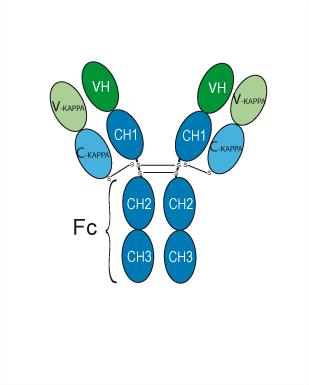
Donanemab (LY3002813) is a humanized IgG1 monoclonal antibody directed at an N-terminal pyroglutamate amyloid beta (Aβ) epitope. Donanemab has the potential for early Alzheimer's disease research.
For research use only. We do not sell to patients.
- Purity : 99.19%
- CAS No.: 1931944-80-7
- Molecular Weight:145.36 kDa
-
Storage:
Please store the product under the recommended conditions in the Certificate of Analysis.


To place orders, for customer services and technical support, please contact: MedChemExpress USA
Tel: 609-228-6898 E-mail: [email protected] [email protected]


-
 Biological Activity
-
Chemical Information
- Protocols
- Purity & Documentation
- References
-
 Help & FAQs


-

HY-P9967
AducanumabAnti-Aβ Monoclonal Antibody -

HY-P99022
GantenerumabAnti-Aβ Monoclonal Antibody -

HY-P99185
BapineuzumabAmyloid Beta Binder -

HY-P99317
SolanezumabAnti-Aβ Antibody -

HY-P990110
Lecanemab (Mouse IgG2a)Monoclonal Antibody -

HY-P99835
CrenezumabAnti-Aβ Antibody -

HY-P9902
PembrolizumabPD-1 Inhibitor -

HY-Y0320
Dimethyl sulfoxide, meets analytical specification of Ch.P.Aprotic Solvent -
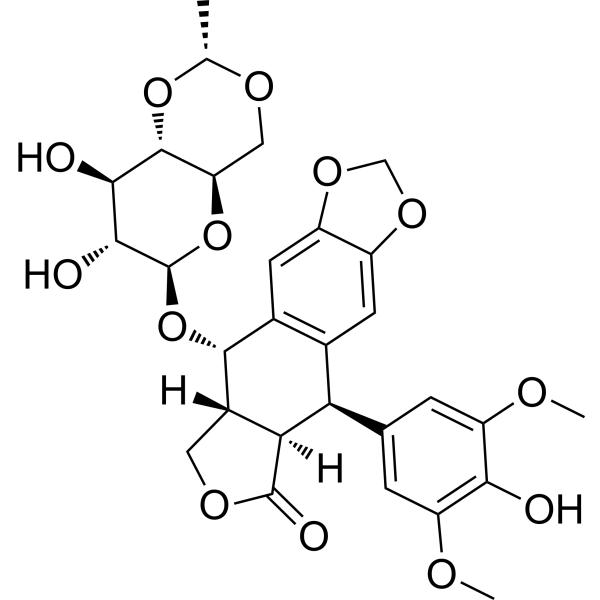
HY-13629
EtoposideTopoisomerase II Inhibitor -

HY-P9999
TrontinemabAβ/TFRC Antibody -
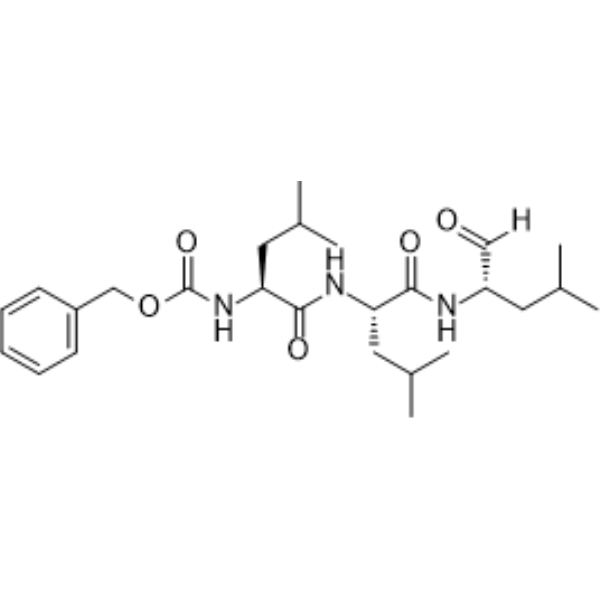
HY-13259
MG-132Proteasome Inhibitor -
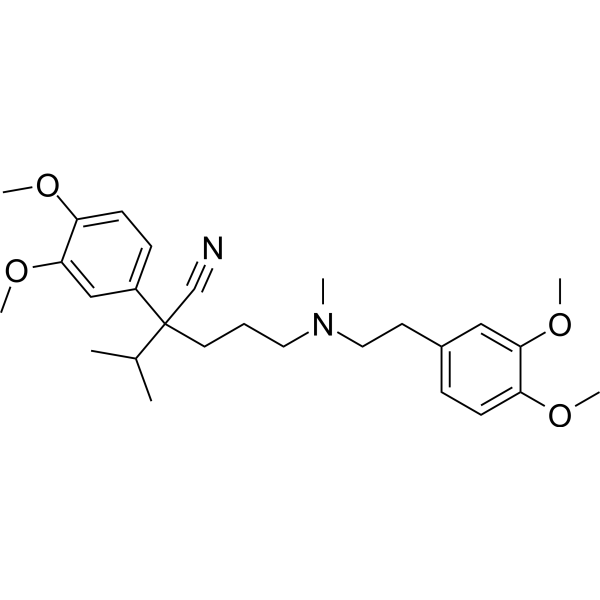
HY-14275
VerapamilCalcium Channel Blocker


Biological Activity
Description
Isotype
Human IgG1 kappa
Recommend Isotype Controls
Species Reactivity
Human
IC50 & Target
Amyloid Beta/Aβ
In Vitro
Donanemab is a humanized IgG1 antibody directed at an N-terminal pyroglutamate Aβ epitope that is present only in established plaques. Donanemab is specific for this epitope and shows no off-target binding to other Aβ species, neurotransmitters, or their receptors[2].
MedChemExpress (MCE) has not independently confirmed the accuracy of these methods. They are for reference only.
Clinical Trial
| NCT Number | Sponsor | Condition | Start Date |
Phase

|
|---|---|---|---|---|
| NCT01329991 | 2011-05 | PHASE1 |
Gene ID
Accession
Conjugated
Unconjugated
Reconsititution
The product can be reconstituted/diluted with sterile PBS or saline.
Format
-
Human IgG1 kappa
Application
ELISA, FACS, Functional assay
Verified Bioactivity
-
 Flow cytometric analysis of 1.5×10⁶ HUVEC cells with Donanemab (HY-P99859, red). Cells were fixed with 4% paraformaldehyde and permeabilised with 90% methanol. Then stained with the primary antibody at 1/200 dilution for an hour at 4℃. Goat Anti-Human IgG H&L (AF488) (HY-P83776) was used as the secondary antibody at 1/1,000 dilution for 30 minutes at 4℃. Human IgG1 kappa, Isotype Control (HY-P99001, blue) was used as the isotype control.


Chemical Information
-
CAS No. 1931944-80-7
-
Appearance Liquid
-
Molecular Weight 145.36 kDa
-
Color Colorless to light yellow
-
SMILES
[Donanemab]
-
Synonyms
LY3002813
-
Shipping
Shipping with dry ice.
-
Formulation
Please refer to the lot-specific COA for specific buffer information.
-
Storage
Please store the product under the recommended conditions in the Certificate of Analysis.


Purity & Documentation
-
Data Sheet (258 KB)
-
SDS (251 KB)
- English - EN (251 KB)
- Français - FR (251 KB)
- Deutsch - DE (251 KB)
- Norwegian - NO (251 KB)
- Español - ES (251 KB)
- Swedish - SV (251 KB)
- Italian - IT (251 KB)
- Korean - KR (251 KB)
- Portuguese - PT (251 KB)
-
Inhibitory Antibodies User Guide (603 KB)
References

Calculators
Concentration (start) × Volume (start) = Concentration (final) × Volume (final)


Donanemab Related Classifications
HY-P99859 Related Classifications
 Powered by Bioz