



WWL123

Based on 1 Customer Validation
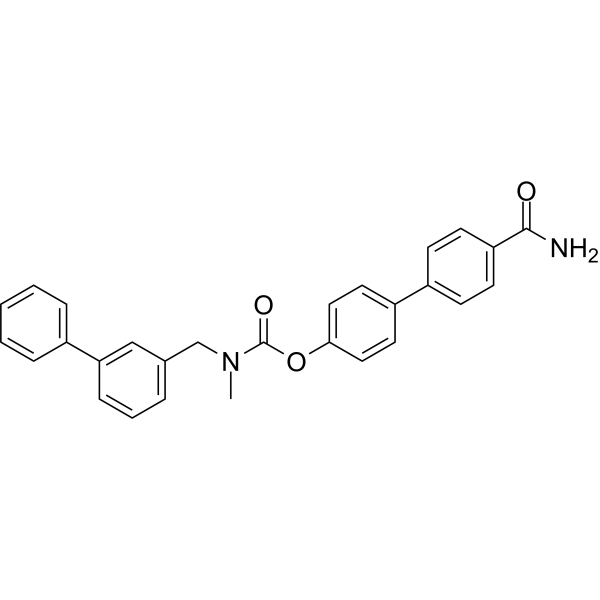
WWL123, a carbamate-based compound, is a potent and selective ABHD6 inhibitor. WWL123 can be used for research of inflammation, metabolic disorders (obesity and type II diabetes mellitus) and epilepsy.
For research use only. We do not sell to patients.
- Purity : 98.0%
- CAS No.: 1338574-83-6
- Formula: C28H24N2O3
- Molecular Weight:436.50
-
Storage:Powder -20°C, 3 years ; In solvent -80°C, 6 months , -20°C, 1 month

To place orders, for customer services and technical support, please contact: MedChemExpress USA
Tel: 609-228-6898 E-mail: [email protected] [email protected]


-
 Biological Activity
-
Chemical Information
-
Solvent & Solubility
- Protocols
- Purity & Documentation
- References
-
 Help & FAQs


-
HY-120177
KT182 -
HY-15249
JZL 184MAGL Inhibitor -
HY-117474
MJN110MAGL Inhibitor -
HY-117632
ElcubragistatMAGL Inhibitor -
HY-18977
KML29MAGL Inhibitor -
HY-12332
JW 642MAGL Inhibitor -
HY-108613
JJKK 048MAGL Inhibitor -

HY-15249R
JZL 184 (Standard)MAGL Inhibitor -
HY-114926
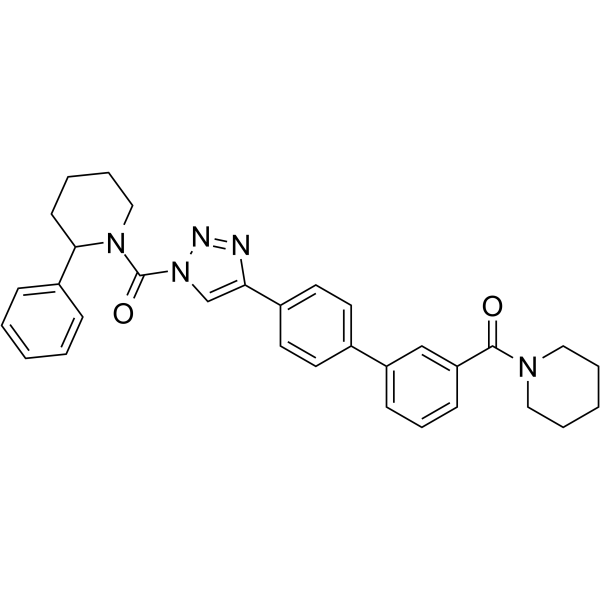
KT185ABHD6 Inhibitor -
HY-132310
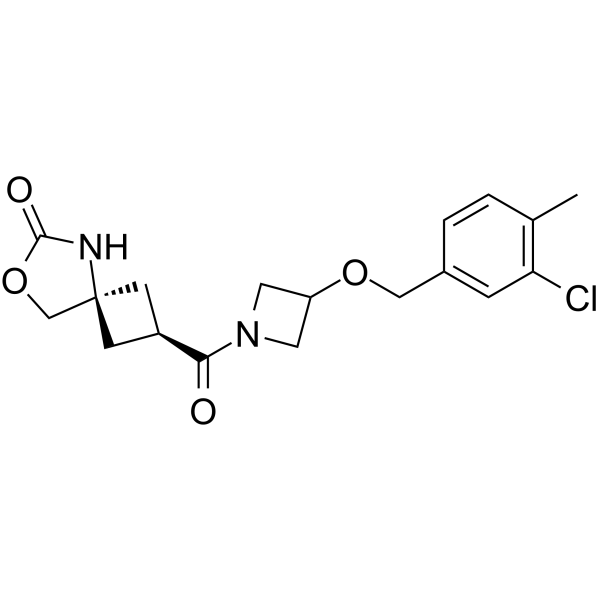
MAGL-IN-4MAGL Inhibitor -

HY-12332R
JW 642 (Standard)MAGL Inhibitor -

HY-108613R
JJKK 048 (Standard)Reference Standard


Biological Activity
Description


Chemical Information
-
CAS No. 1338574-83-6
-
Appearance Solid
-
Molecular Weight 436.50
-
Formula C28H24N2O3
-
Color White to off-white
-
SMILES
O=C(C1=CC=C(C2=CC=C(OC(N(CC3=CC=CC(C4=CC=CC=C4)=C3)C)=O)C=C2)C=C1)N
-
Shipping
Room temperature in continental US; may vary elsewhere.
-
Storage
Powder -20°C 3 years In solvent -80°C 6 months -20°C 1 month


Solvent & Solubility
In Vitro:
DMSO : 1 mg/mL (2.29 mM; Need ultrasonic and warming; Hygroscopic DMSO has a significant impact on the solubility of product, please use newly opened DMSO)
Please refer to the solubility information to select the appropriate solvent. Once prepared, please aliquot and store the solution to prevent product inactivation from repeated freeze-thaw cycles.
Storage method and period of stock solution: -80°C, 6 months; -20°C, 1 month. When stored at -80°C, please use it within 6 months. When stored at -20°C, please use it within 1 month.
Please refer to the solubility information to select the appropriate solvent. Once prepared, please aliquot and store the solution to prevent product inactivation from repeated freeze-thaw cycles.
Storage method and period of stock solution: -80°C, 6 months; -20°C, 1 month. When stored at -80°C, please use it within 6 months. When stored at -20°C, please use it within 1 month.
Concentration (start) × Volume (start) = Concentration (final) × Volume (final)


Purity & Documentation
-
Data Sheet (266 KB)
-
SDS (251 KB)
- English - EN (251 KB)
- Français - FR (251 KB)
- Deutsch - DE (251 KB)
- Norwegian - NO (251 KB)
- Español - ES (251 KB)
- Swedish - SV (251 KB)
- Italian - IT (251 KB)
- Korean - KR (251 KB)
- Portuguese - PT (251 KB)
-
Handling Instructions (2659 KB)
References


Complete Stock Solution Preparation Table
Please refer to the solubility information to select the appropriate solvent. Once prepared, please aliquot and store the solution to prevent product inactivation from repeated freeze-thaw cycles.
Storage method and period of stock solution: -80°C, 6 months; -20°C, 1 month. When stored at -80°C, please use it within 6 months. When stored at -20°C, please use it within 1 month.
| Optional Solvent | Concentration Solvent Mass | 1 mg | 5 mg | 10 mg | 25 mg |
|---|---|---|---|---|---|
| DMSO | 1 mM | 2.2910 mL | 11.4548 mL | 22.9095 mL | 57.2738 mL |


WWL123 Related Classifications
HY-110178 Related Classifications
 Powered by Bioz