



Fudapirine

Based on 1 Customer Validation
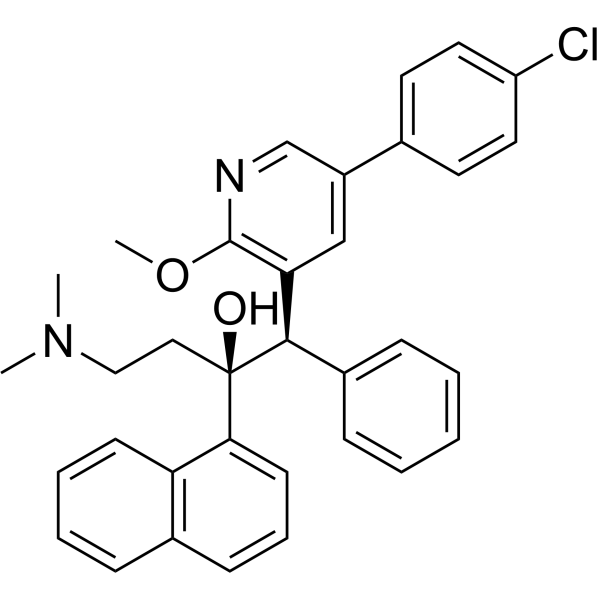
Fudapirine (WX-081; Sudapyridine) is an orally active bactericidal agent that targets mycobacterial ATP synthase. Fudapirine induces mycobacterial death by inhibiting ATP synthesis, disrupting proton motive force and depleting bacterial energy. Fudapirine can be used in the research of tuberculosis and *Mycobacterium tuberculosis* infection.
For research use only. We do not sell to patients.
- Purity : 95.0%
- CAS No.: 1859978-72-5
- Formula: C34H33ClN2O2
- Molecular Weight:537.09
-
Storage:
-20°C, sealed storage, away from moisture and light
* In solvent : -80°C, 6 months; -20°C, 1 month (sealed storage, away from moisture and light)

To place orders, for customer services and technical support, please contact: MedChemExpress USA
Tel: 609-228-6898 E-mail: [email protected] [email protected]


-
 Biological Activity
-
Chemical Information
-
Solvent & Solubility
- Protocols
- Purity & Documentation
- References
-
 Help & FAQs




Biological Activity
Description
Cellular Effect
|
Cell Line

|
Type | Value | Description | References |
|---|---|---|---|---|
| HeLa | CC50 |
> 64 μg/mL
|
Cytotoxicity against human HeLa cells.
Cytotoxicity against human HeLa cells.
|
35636648 |
| Vero | CC50 |
> 50 μg/mL
|
Cytotoxicity against Vero cells.
Cytotoxicity against Vero cells.
|
35636648 |
| CHO | IC50 |
> 30.00 μM
|
Inhibition of hERG ion channel activity in hERG-CHO cells measured by manual patch-clamp electrophysiology.
Inhibition of hERG ion channel activity in hERG-CHO cells measured by manual patch-clamp electrophysiology.
|
35170994 |
In Vitro
Fudapirine (WX-081; Sudapyridine) exhibits potent anti-mycobacterial activity against Mycobacterium smegmatis, drug-susceptible Chinese Mycobacterium tuberculosis strains, and multidrug-resistant Mycobacterium tuberculosis strains; Metabolite M3 shows potent anti-mycobacterial activity against Mycobacterium tuberculosis H37Rv, with a minimum inhibitory concentration ranging from 0.136 to 0.155 μg/mL[1].
Fudapirine potently inhibits the growth of Mycobacterium tuberculosis H37Rv, with an MIC of 0.08 μg/mL under normoxic MABA conditions and an MIC of 0.56 μg/mL under hypoxic LORA conditions[2].
Fudapirine (0.00625-0.4 μg/mL; 7 days) exhibits potent in vitro activity against Mycobacterium tuberculosis H37Rv, drug-susceptible clinical isolates and multidrug-resistant clinical isolates, and shows no cross-resistance with other anti-tuberculosis drugs[3].
Fudapirine (0.5-16×MIC; sampled at 0, 3, 7, 10, 14 days) exerts concentration-dependent bactericidal activity against Mycobacterium tuberculosis H37Rv, drug-susceptible clinical isolate 14242, and multidrug-resistant clinical isolate 14619. Significant bactericidal effects are observed at concentrations of 4×MIC and higher over the 14-day treatment period[3].
Fudapirine (0.0039-2.0 μg/mL; 3-10 days) exhibits potent in vitro antibacterial activity against most non-tuberculous mycobacteria (NTM) reference strains[4].
Sudapyridine (0.05-8.67 μg/mL) inhibits the growth of clinical and reference strains of Mycobacterium avium, Mycobacterium abscessus subsp. abscessus and Mycobacterium abscessus subsp. massiliense in vitro, with MIC ranges of 0.05-0.94 μg/mL, 0.88-7.22 μg/mL and 0.22-8.67 μg/mL, respectively[5].
Fudapirine (0.0039-2.0 μg/mL; 7 days) potently inhibits the growth of the reference Mycobacterium tuberculosis strain H37Rv and 114 clinically isolated strains (including drug-susceptible tuberculosis, multidrug-resistant tuberculosis, and pre-extensively drug-resistant tuberculosis strains) in vitro, with an MIC50 of 0.25 μg/mL and an MIC90 of 0.5 μg/mL[6].
Fudapirine (0.0625-32×MIC; 7 days) exhibits bactericidal activity against the Mycobacterium tuberculosis reference strain H37Rv and most tested clinical isolates (S-TB, MDR-TB, Pre-XDR-TB), with an MBC range of 0.5 μg/mL to 8 μg/mL[6].
Fudapirine (1×10-16× MIC; 3-4 weeks per concentration step) induces the generation of drug-resistant Mycobacterium tuberculosis H37Rv strains carrying atpE mutations (Ala63Val, Ala63Thr, Ala63Pro), with an MIC of 2 µg/mL[7].
Fudapirine (4-8× MIC; 4 weeks) induces spontaneous drug resistance in Mycobacterium tuberculosis H37Rv[7].
Fudapirine (serial two-fold dilution; administered for 7 days) induces cross-resistance in BDQ-resistant Mycobacterium tuberculosis strains carrying the atpE mutation, with an MIC of 2 µg/mL[7].
Fudapirine (1/16-8× MIC; 24 h) inhibits ATP synthesis in the susceptible Mycobacterium tuberculosis strain H37Rv in a dose-dependent manner, but exerts no such effect on BDQ-resistant strains carrying the atpE mutation[7].
Fudapirine (1-15 μM; 60 min) does not disrupt the membrane potential component of the proton motive force in Mycobacterium tuberculosis[7].
Fudapirine (0.5-1 µg/mL; administered 4 hours post-infection and treated for 48 hours) reduces the intracellular bacterial load of antimicrobial agent-resistant Mycobacterium tuberculosis in J774A.1 macrophages[7].
Fudapirine is metabolized into four distinct metabolites in human liver microsomes, among which M3 is the most abundant metabolite following the parent drug, accounting for 12.46% of the total peak area[1].
Fudapirine (1-16 μg/mL; 24-48 h) exhibits low cytotoxicity toward differentiated THP-1 macrophages, with cell survival remaining close to 100% at concentrations up to 4 μg/mL after 24 h of incubation[4].
Fudapirine (0.01-1 μM; 10 min) inhibits ATP synthesis in inverted membrane vesicles of Mycobacterium smegmatis mc2155[7].
Fudapirine (15 μM) disrupts the transmembrane pH gradient component of the proton motive force in inverted membrane vesicles of Mycobacterium smegmatis mc2 155[7].
Sudapyridine (1×10⁶-10× MIC; 48 h) reduces the loads of Mycobacterium avium, Mycobacterium abscessus and Mycobacterium chelonae in J774A.1 macrophages in a concentration-dependent manner, with maximum reduction amplitudes of 1.18, 1.50 and 1.03 log10 CFU/mL, respectively[5].
Fudapirine (1.86-14.90 μM; 1-5 days) exhibits time- and concentration-dependent intracellular bactericidal activity against the Mycobacterium tuberculosis reference strain H37Rv in differentiated THP-1 macrophages[6].
Fudapirine activates the NF-κB and MAPK signaling pathways in HEK293T cells[7].
Fudapirine (12 h) upregulates the mRNA expression of proinflammatory cytokines and type I interferons, and downregulates the expression of IL-10, in LPS-stimulated J774A.1 macrophages[7].
Fudapirine (administered 4 hours post-infection and treated for 24 hours) upregulates the mRNA expression levels of TNF-α, IL-2, IL-12 and IFNγ in J774A.1 macrophages infected with Mycobacterium tuberculosis H37Rv[7].
Fudapirine (administered 4 hours post-infection and treated for 24 hours) upregulates the mRNA expression levels of IL-6 and IL-1β in Fudapirine-resistant Mycobacterium tuberculosis-infected J774A.1 macrophages[7].
Fudapirine (treated for 24 h at 0.5-1 µg/mL, 4 h post-infection) upregulates innate immunity-related pathways (including NF-κB and MAPK) and downregulates the mTOR pathway in J774A.1 macrophages infected with Fudapirine-resistant Mycobacterium tuberculosis[7].
MedChemExpress (MCE) has not independently confirmed the accuracy of these methods. They are for reference only.
-
Cell Line:Differentiated THP-1 human macrophages
-
Concentration:1-16 μg/mL
-
Incubation Time:24, 48 h
-
Result:Maintained nearly 100% THP-1 cell viability at 4 μg/mL, over 90% at 8 μg/mL, and over 75% at 16 μg/mL after 24 h incubation.
Maintained 100% THP-1 cell viability at 1 μg/mL, over 75% at 8 μg/mL, and below 75% at 16 μg/mL after 48 h incubation.
Parmacokinetics
| Species | Dose | Route | CL | Vd | T1/2 | AUC0-last | AUC0-inf | Cmax | Bioavailability | Tmax | F | Plasma Concentration |
|---|---|---|---|---|---|---|---|---|---|---|---|---|
| Mice[2] | 1 mg/kg | i.v. | 3.59 mL/min/kg | 10.4 L/kg | 46.3 h | / | / | / | / | / | / | / |
| Mice[2] | 6.25 mg/kg | p.o. | / | / | / | 10155 ng·h/mL | / | 503 ng/mL | / | / | 40.7 % | / |
| Rat[2] | 1 mg/kg | i.v. | 8.25 mL/min/kg | 9.2 L/kg | 25.6 h | / | / | / | / | / | / | / |
| Rat[2] | 5.0 mg/kg | p.o. | / | / | / | 4075 ng·h/mL | / | 328 ng/mL | / | / | 36.7 % | / |
| Dog[2] | 0.5 mg/kg | i.v. | 2.04 mL/min/kg | 6.04 L/kg | 56.2 h | / | / | / | / | / | / | / |
| Dog[2] | 2.0 mg/kg | p.o. | / | / | / | 8500 ng·h/mL | / | 390 ng/mL | 58.9 % | / | / | / |
| Mice[2] | 6.25 mg/kg | p.o. | / | / | / | / | / | / | / | / | / | 25.4 ng/mL |
| Rat[2] | 5.0 mg/kg | p.o. | / | / | / | / | / | / | / | / | / | 4.74 ng/mL |
| Mice[3] | 1.0 mg/kg | i.v. | 3.59 mL/min/kg | 10.4 L/kg | 46.3 h | 3991 ng·h/mL | 4797 ng·h/mL | / | / | / | / | / |
| Mice[3] | 6.25 mg/kg | p.o. | / | / | 43.9 h | 10155 ng·h/mL | 11908 ng·h/mL | 503 ng/mL | 40.7 % | 7.33 h | / | / |
| Rat[3] | 1.0 mg/kg | i.v. | 8.25 mL/min/kg | 9.2 L/kg | 25.6 h | 2224 ng·h/mL | 2351 ng·h/mL | / | / | / | / | / |
| Rat[3] | 5.0 mg/kg | p.o. | / | / | 29.8 h | 4075 ng·h/mL | 4312 ng·h/mL | 328 ng/mL | 36.7 % | 1.00 h | / | / |
| Dog[3] | 0.5 mg/kg | i.v. | 2.04 mL/min/kg | 6.04 L/kg | 56.2 h | 3610 ng·h/mL | 4250 ng·h/mL | / | / | / | / | / |
| Dog[3] | 2.0 mg/kg | p.o. | / | / | 51.1 h | 8500 ng·h/mL | 9490 ng·h/mL | 390 ng/mL | / | 4.67 h | 58.9 % | / |
| Dog[3] | 6.0 mg/kg | p.o. | / | / | 55.6 h | 20200 ng·h/mL | 22800 ng·h/mL | 1080 ng/mL | / | 5.33 h | 46.6 % | / |
| Dog[3] | 20.0 mg/kg | p.o. | / | / | 57.6 h | 50400 ng·h/mL | 58200 ng·h/mL | 1660 ng/mL | / | 7.67 h | 34.9 % | / |
| Mice[6] | 6.25 mg/kg | p.o. | / | / | / | 10155 ng·h/mL | / | 503 ng/mL | / | / | / | / |
In Vivo
Fudapirine (5-20 mg/kg; p.o.; administered consecutively for 5 days per week; total 20 days) exhibits potent, dose-dependent anti-tuberculosis activity in acutely infected BALB/c mice[3].
Fudapirine (5-20 mg/kg; p.o.; administered consecutively for 5 days per week; for a total of 8 weeks) exhibits significant anti-tuberculosis activity in chronically infected BALB/c mice[3].
Fudapirine (25 mg/kg; p.o.; once daily for 28 consecutive days) exhibits bactericidal activity against Mycobacterium avium, Mycobacterium abscessus and Mycobacterium chelonae in mice, reducing the pulmonary bacterial load by up to 4.11 log10 CFU[5].
Fudapirine (15 mg/kg; single administration) exhibited prolonged tissue retention of its major metabolite M3 in Sprague-Dawley rats, with peak tissue concentrations occurring at 6-72 h post-dose and detectable levels persisting for at least 168 h[1].
Fudapirine (30-200 mg/kg; p.o.; once daily for 14 consecutive days) exhibits favorable in vivo tolerance in Sprague-Dawley rats[2].
Fudapirine (200 mg/kg; p.o.; once daily for 14 consecutive days) shows no risk of in vivo QTc interval prolongation in Beagle dogs[2].
Fudapirine (200 mg/kg; p.o.; once daily for 14 consecutive days) exhibits cardiac safety in healthy beagle dogs, with no qualitative electrocardiographic abnormalities or elevation of cardiac troponin I[3].
MedChemExpress (MCE) has not independently confirmed the accuracy of these methods. They are for reference only.
-
Animal Model:Sprague-Dawley rats (male and female)[1]
-
Dosage:15 mg/kg
-
Administration:single dose
-
Result:Ranged peak time of metabolite M3 in various tissues from 6 to 72 h in both female and male rats.
Remained detectable in various tissues of male and female rats (except the brain) 168 h postdosing, with the highest concentration observed in the spleen.
-
Animal Model:CD-1 mice[2]
-
Dosage:5, 10, 20 mg/kg
-
Administration:p.o.; daily 5 days/week; 4 weeks
-
Result:Reduced lung bacterial load in a dose-dependent manner.
Reduced CFU by more than three logs compared to vehicle controls at 5 mg/kg.
Cleared bacteria from mouse lungs at 20 mg/kg.\n
Reduced lung bacterial load in a dose-dependent manner.
Reduced CFU by more than two and a half logs compared to vehicle controls at 20 mg/kg.
-
Animal Model:Sprague-Dawley rats (8 males and 8 females per dose group)[2]
-
Dosage:30, 100, 200 mg/kg
-
Administration:p.o.; once daily for 14 days
-
Result:Caused death in 2 out of 16 animals at 200 mg/kg on day 14, with an AUC exposure of 248 μM⋅h.
Showed improved tolerance relative to the high dose at lower doses.
-
Animal Model:Beagle dogs[2]
-
Dosage:200 mg/kg
-
Administration:p.o.; once daily for 14 days
-
Result:Showed no qualitative ECG changes or QTc interval prolongation.
-
Animal Model:BALB/c (male, 18 to 20 g, specific pathogen-free, high-dose aerosol infection with Mycobacterium tuberculosis H37Rv)[3]
-
Dosage:5, 10, 20 mg/kg
-
Administration:p.o.; 5 consecutive days per week; 20 days
-
Result:Reduced pulmonary bacilli loads 1000-fold compared to the vehicle group at 5 mg/kg.
Lowered lung CFU counts 2.2 to 3.2 log10 units than untreated controls at 10 mg/kg and 20 mg/kg.
Achieved clearance of all culturable organisms in mouse lungs at 20 mg/kg.
Demonstrated activity not different from equivalent dose bedaquiline at 20 mg/kg.
Produced a larger reduction in CFU than equivalent dose bedaquiline at 10 mg/kg.
-
Animal Model:BALB/c (male, 18 to 20 g, specific pathogen-free, low-dose aerosol infection with Mycobacterium tuberculosis H37Rv)[3]
-
Dosage:5, 10, 20 mg/kg
-
Administration:p.o.; 5 consecutive days per week; 8 weeks
-
Result:Reduced lung CFU counts compared to the vehicle group at all tested doses, with efficacy increasing with dose.
Produced a greater reduction in lung CFU than 10 mg/kg rifampin at 5 mg/kg.
Showed efficacy slightly lower than bedaquiline but not significantly different across all tested doses.
-
Animal Model:Beagle (male and female, healthy)[3]
-
Dosage:200 mg/kg
-
Administration:p.o.; once daily for 14 days
-
Result:Caused no mortality or moribundity.
Showed no qualitative ECG changes, only physiologically appropriate lengthening of the QT interval.
Detected no significant changes in cardiac troponin I (cTnI) levels.
Exhibited severity and incidence of treatment-related changes in clinical signs, body weight, food consumption, hematology, coagulation, serum chemistry, and histopathology similar or less than those seen with bedaquiline fumarate.
-
Animal Model:BALB/c mice (male/female not specified; treated with dexamethasone 5 mg/kg by gavage from 7 days before to 6 days after infection, then infected with Mycobacterium avium, Mycobacterium abscessus, or Mycobacterium chelonae via tail vein injection of 1×10⁷ CFU/mL bacterial solution)[5]
-
Dosage:25 mg/kg
-
Administration:p.o.; once daily for 28 days
-
Result:Reduced Mycobacterium avium load in the lungs by 4.11 log10 CFU and in the spleen by 3.37 log10 CFU.
Reduced Mycobacterium abscessus lung bacterial load by about 3.1 log10 CFU and spleen bacterial load by about 2.6 log10 CFU.
Reduced Mycobacterium chelonae lung bacterial load by 3.57 log10 CFU.
Clinical Trial
| NCT Number | Sponsor | Condition | Start Date |
Phase
|
|---|---|---|---|---|
| NCT01329991 | Plexxikon| | 2011-05 | PHASE1 |


Chemical Information
-
CAS No. 1859978-72-5
-
Appearance Solid
-
Molecular Weight 537.09
-
Formula C34H33ClN2O2
-
Color White to off-white
-
SMILES
CN(C)CC[C@@](O)(C1=CC=CC2=C1C=CC=C2)[C@H](C3=CC=CC=C3)C4=C(N=CC(C5=CC=C(C=C5)Cl)=C4)OC
-
Synonyms
WX-081; Sudapyridine
-
Shipping
Room temperature in continental US; may vary elsewhere.
-
Storage
-20°C, sealed storage, away from moisture and light
* In solvent : -80°C, 6 months; -20°C, 1 month (sealed storage, away from moisture and light)


Solvent & Solubility
In Vitro:
DMSO : 25 mg/mL (46.55 mM; Need ultrasonic; Hygroscopic DMSO has a significant impact on the solubility of product, please use newly opened DMSO)
Please refer to the solubility information to select the appropriate solvent. Once prepared, please aliquot and store the solution to prevent product inactivation from repeated freeze-thaw cycles.
Storage method and period of stock solution: -80°C, 6 months; -20°C, 1 month (sealed storage, away from moisture and light). When stored at -80°C, please use it within 6 months. When stored at -20°C, please use it within 1 month.
Please refer to the solubility information to select the appropriate solvent. Once prepared, please aliquot and store the solution to prevent product inactivation from repeated freeze-thaw cycles.
Storage method and period of stock solution: -80°C, 6 months; -20°C, 1 month (sealed storage, away from moisture and light). When stored at -80°C, please use it within 6 months. When stored at -20°C, please use it within 1 month.
Concentration (start) × Volume (start) = Concentration (final) × Volume (final)


Purity & Documentation
-
Data Sheet (313 KB)
-
SDS (252 KB)
- English - EN (252 KB)
- Français - FR (252 KB)
- Deutsch - DE (252 KB)
- Norwegian - NO (252 KB)
- Español - ES (252 KB)
- Swedish - SV (252 KB)
- Italian - IT (252 KB)
- Korean - KR (252 KB)
- Portuguese - PT (252 KB)
-
Handling Instructions (2659 KB)
References
[2]. Huang Z, et al. Discovery and preclinical profile of sudapyridine (WX-081), a novel anti-tuberculosis agent. Bioorganic & medicinal chemistry letters. 2022 Sep 01;71:128824. [Content Brief]
[3]. Yao R, et al. Sudapyridine (WX-081), a Novel Compound against Mycobacterium tuberculosis. Microbiology spectrum. 2022 Feb 23;10(1):e0247721. [Content Brief]
[4]. Zhu R, et al. Activity of the Sudapyridine (WX-081) against Non-Tuberculous Mycobacteria Isolated in Beijing, China. Microbiology spectrum. 2022 Dec 21;10(6):e0137222. [Content Brief]
[8]. van der Meer JW, et al. Abstract!. The Netherlands journal of medicine. 2002 Dec;60(11):418. [Content Brief]


Complete Stock Solution Preparation Table
Please refer to the solubility information to select the appropriate solvent. Once prepared, please aliquot and store the solution to prevent product inactivation from repeated freeze-thaw cycles.
Storage method and period of stock solution: -80°C, 6 months; -20°C, 1 month (sealed storage, away from moisture and light). When stored at -80°C, please use it within 6 months. When stored at -20°C, please use it within 1 month.
| Optional Solvent | Concentration Solvent Mass | 1 mg | 5 mg | 10 mg | 25 mg |
|---|---|---|---|---|---|
| DMSO | 1 mM | 1.8619 mL | 9.3094 mL | 18.6189 mL | 46.5471 mL |
| 5 mM | 0.3724 mL | 1.8619 mL | 3.7238 mL | 9.3094 mL | |
| 10 mM | 0.1862 mL | 0.9309 mL | 1.8619 mL | 4.6547 mL | |
| 15 mM | 0.1241 mL | 0.6206 mL | 1.2413 mL | 3.1031 mL | |
| 20 mM | 0.0931 mL | 0.4655 mL | 0.9309 mL | 2.3274 mL | |
| 25 mM | 0.0745 mL | 0.3724 mL | 0.7448 mL | 1.8619 mL | |
| 30 mM | 0.0621 mL | 0.3103 mL | 0.6206 mL | 1.5516 mL | |
| 40 mM | 0.0465 mL | 0.2327 mL | 0.4655 mL | 1.1637 mL |


Fudapirine Related Classifications
HY-146158 Related Classifications
 Powered by Bioz
Keywords
- Fudapirine
- 1859978-72-5
- WX-081
- Sudapyridine
- WX081
- WX 081
- Bacterial
- ATP Synthase
- atpE subunit
- Mycobacterium tuberculosis
- mycobacterial ATP synthase
- Mycobacterium smegmatis
- MAPK signaling pathways
- HEK293T cells
- non-tuberculous mycobacteria
- J774A.1 macrophages
- NF-κB signaling pathways
- multidrug-resistant Mycobacterium tuberculosis
- Inhibitor
- inhibitor
- inhibit