



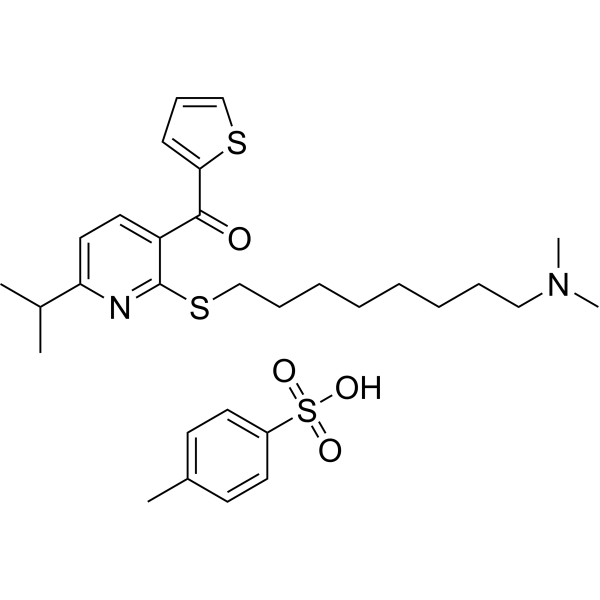
Y-29794 tosylate

Based on 1 Customer Validation
Y-29794 tosylate is a selective, orally active inhibitor for non-peptide prolyl endopeptidase (PREP), with an IC50 of 3 nM and a Ki of 0.95 nM. Y-29794 tosylate enhances the effect of thyrotropin-releasing hormone (TRH) on the release of ACh in the rat hippocampus, exhibits potential neuroprotective efficacy. Y-29794 tosylate exhibits anticancer activity through inhibition of the IRS1-AKT-mTORC1 pathway. Y-29794 tosylate penetrates the brain-blood barrier (BBB).
Nos produits utilisent uniquement pour la recherche. Nous ne vendons pas aux patients.
- Pureté : 99.86%
- CAS No.: 143984-17-2
- Formule: C30H42N2O4S3
- Masse moléculaire:590.86
-
Stockage:Powder -20°C, 3 years , 4°C, 2 years ; In solvent -80°C, 6 months , -20°C, 1 month

To place orders, for customer services and technical support, please contact: MedChemExpress USA
Tel: 609-228-6898 E-mail: [email protected] [email protected]


-
 Activité biologique
-
Chemical Information
- Protocole
- Pureté et documentation
- Références
-
 Help & FAQs




Activité biologique
Description
IC50 & Target
|
PREP 3 nM (IC50) |
In Vitro
Y-29794 tosylate inhibits proliferations of TNBC cancer cells BT20, BT549, MDA453, DU4475, MDA 231, MDA468 and SUM159PT (0-10 μM, 4 days), arrest cell cycle at G1/sub G1 pahse (0-10 μM, 48 h), induces cell death (5-10 mM)[1].
MedChemExpress (MCE) has not independently confirmed the accuracy of these methods. They are for reference only. Further protocols information, click here.
-
Cell Line:TNBC, BT20, BT549, MDA453, DU4475, MDA 231, MDA468, SUM159PT
-
Concentration:0-10 μM
-
Incubation Time:4 days
-
Result:Inhibited cell proliferation, induced cell death.
-
Cell Line:MDA231, MDA468
-
Concentration:0-10 μM
-
Incubation Time:48 h
-
Result:Arrested cell cycle at G1 phase at 0-5 μM, arrested cell cycle at sub G1 phase at 5-10 μM.
In Vivo
MedChemExpress (MCE) has not independently confirmed the accuracy of these methods. They are for reference only.
-
Animal Model:TNBC xenograft NOD-SCID mice model[1]
-
Dosage:12.5-50 mg/kg
-
Administration:i.p., daily, 5 times a week for 5 weeks
-
Result:Inhibited tumor growth, maintained body weight.


Chemical Information
-
CAS No. 143984-17-2
-
Appearance Solid
-
Masse moléculaire 590.86
-
Formule C30H42N2O4S3
-
Color Off-white to light brown
-
SMILES
O=C(C1=CC=C(C(C)C)N=C1SCCCCCCCCN(C)C)C2=CC=CS2.O=S(C3=CC=C(C)C=C3)(O)=O
-
Livraison
Room temperature in continental US; may vary elsewhere.
-
Stockage
Powder -20°C 3 years 4°C 2 years In solvent -80°C 6 months -20°C 1 month

Protocole
-
Cell Cytotoxicity Assay
Cytotoxicity assays are usually based on the assessment of cell membrane damage, which can also be indirectly detected by measuring cell viability. Detection methods include MTT assay, CKK-8 assay, LDH assay and ATP assay, etc.
-
Research Protocol for Endocrine Diseases
Endocrine diseases often arise from disrupted hormone production, hormone signaling, or target-tissue responsiveness; for diabetes-focused endocrine disease models, insulin signaling regulates glucose uptake, hepatic glucose output, lipid metabolism, and β-cell compensation. Type 2 diabetes develops through interacting defects in insulin resistance, β-cell dysfunction, adipose inflammation, hepatic glucose overproduction, altered incretin signaling, and ectopic lipid metabolism. A major unresolved question is whether endocrine dysfunction is driven primarily by target-tissue insulin resistance, intrinsic β-cell failure, immune/inflammatory stress, or combined multi-organ failure that differs by disease stage.


Pureté et documentation
-
Fiche technique (273 KB)
-
SDS (251 KB)
- English - EN (251 KB)
- Français - FR (251 KB)
- Deutsch - DE (251 KB)
- Norwegian - NO (251 KB)
- Español - ES (251 KB)
- Swedish - SV (251 KB)
- Italian - IT (251 KB)
- Korean - KR (251 KB)
- Portuguese - PT (251 KB)
-
Instruction de manipulation (2659 KB)
Références
[1]. Perez RE, et al. Prolyl endopeptidase inhibitor Y-29794 blocks the IRS1-AKT-mTORC1 pathway and inhibits survival and in vivo tumor growth of triple-negative breast cancer. Cancer Biol Ther. 2020 Nov 1;21(11):1033-1040. [Content Brief]
[2]. Nakajima T, et al. Y-29794--a non-peptide prolyl endopeptidase inhibitor that can penetrate into the brain. Neurosci Lett. 1992 Jul 20;141(2):156-60. [Content Brief]

Calculators
Concentration (start) × Volume (start) = Concentration (final) × Volume (final)


Y-29794 tosylate Related Classifications
HY-15113A Related Classifications
 Powered by Bioz