



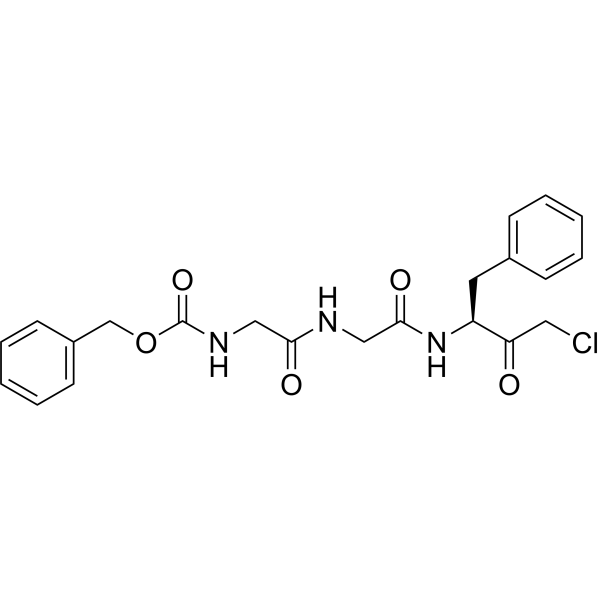
Z-GGF-CMK

Based on 1 Customer Validation
Z-GGF-CMK is an Antibacterial agent, an inhibitor of the ClpP1P2 serine protease complex (with an IC50 of 50 μM against intracellular ClpP1P2 protease activity in Mycobacterium bovis BCG), and a selective inhibitor of the mycobacterial Proteasome (with an IC50 of 50 μM against the proteasome in M. bovis BCG). Z-GGF-CMK inhibits the growth of mycobacteria. Z-GGF-CMK exhibits cytotoxic activity against liver cancer cells. Z-GGF-CMK can be used in the research of tuberculosis.
For research use only. We do not sell to patients.
- Purity : 99.74%
- CAS No.: 35172-59-9
- Formula: C22H24ClN3O5
- Molecular Weight:445.90
-
Storage:
Sealed storage, away from moisture.
Powder -80°C, 2 years , -20°C, 1 year* In solvent : -80°C, 6 months; -20°C, 1 month (sealed storage, away from moisture)

To place orders, for customer services and technical support, please contact: MedChemExpress USA
Tel: 609-228-6898 E-mail: [email protected] [email protected]


-
 Biological Activity
-
Chemical Information
-
Solvent & Solubility
- Protocols
- Purity & Documentation
- References
-
 Help & FAQs




Biological Activity
Description
IC50 & Target
[1]|
ClpP1P2 50 μM (IC50) |
In Vitro
Z-GGF-CMK (24 h) inhibits intracellular ClpP1P2 protease activity in M. bovis BCG with an IC50 of 50 μM[1].
Z-GGF-CMK (2 h) inhibits proteasome activity in M. bovis BCG with an IC50 of 50 μM[1].
Z-GGF-CMK (2 h) is inactive against human proteasome activity in HepG2 cells at concentrations up to 500 μM[1].
Z-GGF-CMK (5 days) inhibits M. bovis BCG growth with an MIC50 of 30 μM[1].
Z-GGF-CMK (5 days) inhibits M. tuberculosis H37Rv growth with an MIC50 of 30 μM[1].
Z-GGF-CMK exhibits cytotoxicity against HepG2 cells with a CC50 of 125 μM[1].
MedChemExpress (MCE) has not independently confirmed the accuracy of these methods. They are for reference only. Further protocols information, click here.


Chemical Information
-
CAS No. 35172-59-9
-
Appearance Solid
-
Molecular Weight 445.90
-
Formula C22H24ClN3O5
-
Color White to off-white
-
Sequence
{Cbz}-Gly-Gly-Phe-{CMK}
-
Sequence Shortening
{Cbz}-GGF-{CMK}
-
Shipping
Room temperature in continental US; may vary elsewhere.
-
Storage
Sealed storage, away from moisture
Powder -80°C 2 years -20°C 1 year * In solvent : -80°C, 6 months; -20°C, 1 month (sealed storage, away from moisture)


Solvent & Solubility
In Vitro:
DMSO : 100 mg/mL (224.27 mM; Need ultrasonic; Hygroscopic DMSO has a significant impact on the solubility of product, please use newly opened DMSO)
Please refer to the solubility information to select the appropriate solvent. Once prepared, please aliquot and store the solution to prevent product inactivation from repeated freeze-thaw cycles.
Storage method and period of stock solution: -80°C, 6 months; -20°C, 1 month (sealed storage, away from moisture). When stored at -80°C, please use it within 6 months. When stored at -20°C, please use it within 1 month.
Please refer to the solubility information to select the appropriate solvent. Once prepared, please aliquot and store the solution to prevent product inactivation from repeated freeze-thaw cycles.
Storage method and period of stock solution: -80°C, 6 months; -20°C, 1 month (sealed storage, away from moisture). When stored at -80°C, please use it within 6 months. When stored at -20°C, please use it within 1 month.
Concentration (start) × Volume (start) = Concentration (final) × Volume (final)

Protocols
-
Research Protocol for Infectious Diseases
Infectious-disease experiments test how pathogens interact with host barriers, innate immune receptors, inflammatory signaling, pathogen replication, and tissue injury; pattern-recognition receptors such as TLRs, RIG-I-like receptors, NOD-like receptors, and inflammasomes detect microbial molecules and activate NF-κB, interferon, and cytokine responses. The central hypothesis is that infection severity reflects the balance between pathogen burden and host response: protective inflammation restricts pathogen growth, whereas excessive or mislocalized inflammation contributes to tissue damage and disease phenotype. Unresolved questions include which host pathways are protective versus pathogenic, why some infection models fail to translate to human disease, and which combined readouts best predict clinically relevant infection outcomes.
-
Cell Cytotoxicity Assay
Cytotoxicity assays are usually based on the assessment of cell membrane damage, which can also be indirectly detected by measuring cell viability. Detection methods include MTT assay, CKK-8 assay, LDH assay and ATP assay, etc.
-
Liver Cancer Modeling
Liver cancer can be classified into primary liver cancer and secondary liver cancer. Secondary liver cancer is the metastatic liver cancer. Primary liver cancer includes hepatocellular carcinoma (HCC), intrahepatic cholangiocarcinoma (ICC) and fibrolamellar HCC, of which HCC is the most common form, accounting for approximately 90% of primary liver cancers[1]. HCC mouse models include chemical agent-induced models, transplanted tumor models, and genetic engineered models.
-
Cell Viability Determination by MTT Colorimetric Assay
The following protocol uses the MTT colorimetric assay as a classic literature-established method for assessing cell viability/metabolic activity in cultured mammalian cells. MTT[3-(4,5-dimethylthiazol-2-yl)-2,5-diphenyltetrazolium bromide] is reduced by metabolically active cells to a colored formazan product; the amount of formazan is quantified spectrophotometrically and provides an indirect measure of metabolically active viable cells. Importantly, MTT reduction reflects cellular oxidoreductase/metabolic activity rather than an absolute direct count of living cells, so changes in cellular metabolism can alter the signal independently of cell number.


Purity & Documentation
-
Data Sheet (271 KB)
-
SDS (252 KB)
- English - EN (252 KB)
- Français - FR (252 KB)
- Deutsch - DE (252 KB)
- Norwegian - NO (252 KB)
- Español - ES (252 KB)
- Swedish - SV (252 KB)
- Italian - IT (252 KB)
- Korean - KR (252 KB)
- Portuguese - PT (252 KB)
-
Handling Instructions (2659 KB)
References


Complete Stock Solution Preparation Table
Please refer to the solubility information to select the appropriate solvent. Once prepared, please aliquot and store the solution to prevent product inactivation from repeated freeze-thaw cycles.
Storage method and period of stock solution: -80°C, 6 months; -20°C, 1 month (sealed storage, away from moisture). When stored at -80°C, please use it within 6 months. When stored at -20°C, please use it within 1 month.
| Optional Solvent | Concentration Solvent Mass | 1 mg | 5 mg | 10 mg | 25 mg |
|---|---|---|---|---|---|
| DMSO | 1 mM | 2.2427 mL | 11.2133 mL | 22.4266 mL | 56.0664 mL |
| 5 mM | 0.4485 mL | 2.2427 mL | 4.4853 mL | 11.2133 mL | |
| 10 mM | 0.2243 mL | 1.1213 mL | 2.2427 mL | 5.6066 mL | |
| 15 mM | 0.1495 mL | 0.7476 mL | 1.4951 mL | 3.7378 mL | |
| 20 mM | 0.1121 mL | 0.5607 mL | 1.1213 mL | 2.8033 mL | |
| 25 mM | 0.0897 mL | 0.4485 mL | 0.8971 mL | 2.2427 mL | |
| 30 mM | 0.0748 mL | 0.3738 mL | 0.7476 mL | 1.8689 mL | |
| 40 mM | 0.0561 mL | 0.2803 mL | 0.5607 mL | 1.4017 mL | |
| 50 mM | 0.0449 mL | 0.2243 mL | 0.4485 mL | 1.1213 mL | |
| 60 mM | 0.0374 mL | 0.1869 mL | 0.3738 mL | 0.9344 mL | |
| 80 mM | 0.0280 mL | 0.1402 mL | 0.2803 mL | 0.7008 mL | |
| 100 mM | 0.0224 mL | 0.1121 mL | 0.2243 mL | 0.5607 mL |


Z-GGF-CMK Related Classifications
HY-P4284 Related Classifications
 Powered by Bioz