



Fosribnicotinamide-d4

Based on 1 Customer Validation
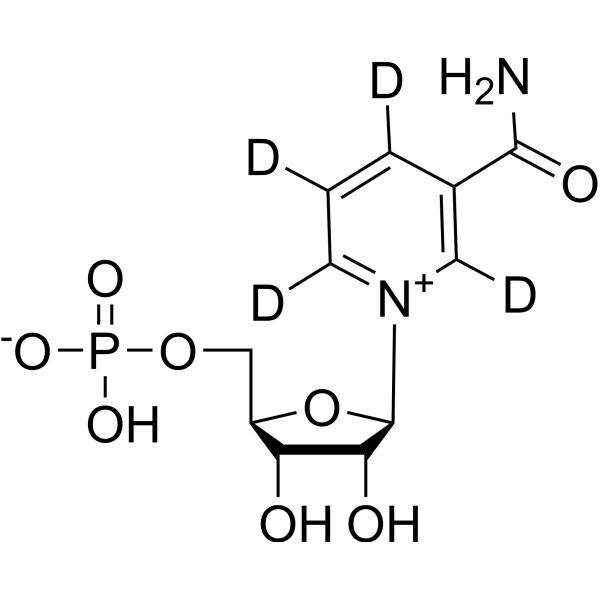
Fosribnicotinamide-d4 (β-Nicotinamide mononucleotide-d4) is the deuterium labeled Fosribnicotinamide. Fosribnicotinamide is a product of the nicotinamide phosphoribosyltransferase (NAMPT) reaction and a key NAD+ intermediate. The pharmacological activities of Fosribnicotinamide include its role in cellular biochemical functions, cardioprotection, diabetes, Alzheimer's disease, and complications associated with obesity.
For research use only. We do not sell to patients.
- Purity : 99.55%
- Formula: C11H11D4N2O8P
- Molecular Weight:338.24
-
Storage:Powder -20°C, 3 years ; In solvent -80°C, 6 months , -20°C, 1 month

To place orders, for customer services and technical support, please contact: MedChemExpress USA
Tel: 609-228-6898 E-mail: [email protected] [email protected]


-
 Biological Activity
-
Chemical Information
-
Solvent & Solubility
- Protocols
- Purity & Documentation
- References
-
 Help & FAQs


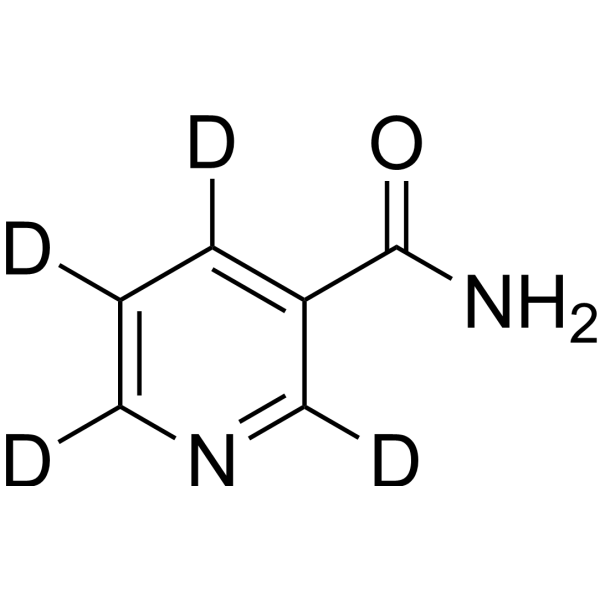
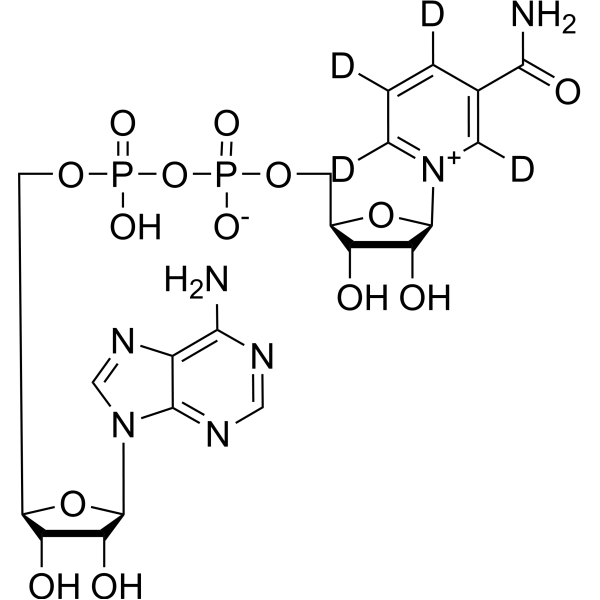
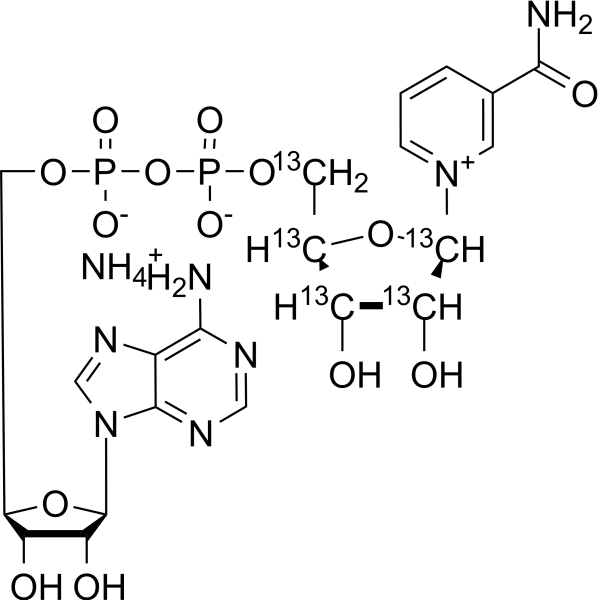
All Endogenous Metabolite Isoforms
More

Biological Activity
Description
In Vitro
Stable heavy isotopes of hydrogen, carbon, and other elements have been incorporated into drug molecules, largely as tracers for quantitation during the drug development process. Deuteration has gained attention because of its potential to affect the pharmacokinetic and metabolic profiles of drugs[1].
MedChemExpress (MCE) has not independently confirmed the accuracy of these methods. They are for reference only. Further protocols information, click here.
Application
1. This compound can be used as a tracer
2. This compound can be used as an internal standard for quantitative analysis by NMR, GC-MS, or LC-MS.


Chemical Information
-
Unlabeled CAS 1094-61-7
-
Appearance Solid
-
Molecular Weight 338.24
-
Formula C11H11D4N2O8P
-
Color White to off-white
-
SMILES
O[C@@H]1[C@H](O)[C@@H](COP(O)([O-])=O)O[C@H]1[N+]2=C([2H])C([2H])=C([2H])C(C(N)=O)=C2[2H]
-
Synonyms
β-Nicotinamide mononucleotide-d4; β-NM-d4; NMN-d4
-
Shipping
Room temperature in continental US; may vary elsewhere.
-
Storage
Powder -20°C 3 years In solvent -80°C 6 months -20°C 1 month


Solvent & Solubility
In Vitro:
H2O : 83.33 mg/mL (246.36 mM; Need ultrasonic and warming)
Please refer to the solubility information to select the appropriate solvent. Once prepared, please aliquot and store the solution to prevent product inactivation from repeated freeze-thaw cycles.
Storage method and period of stock solution: -80°C, 6 months; -20°C, 1 month. When stored at -80°C, please use it within 6 months. When stored at -20°C, please use it within 1 month.
* Note: If you choose water as the stock solution, please dilute it to the working solution, then filter and sterilize it with a 0.22 μm filter before use.
Please refer to the solubility information to select the appropriate solvent. Once prepared, please aliquot and store the solution to prevent product inactivation from repeated freeze-thaw cycles.
Storage method and period of stock solution: -80°C, 6 months; -20°C, 1 month. When stored at -80°C, please use it within 6 months. When stored at -20°C, please use it within 1 month.
* Note: If you choose water as the stock solution, please dilute it to the working solution, then filter and sterilize it with a 0.22 μm filter before use.
Concentration (start) × Volume (start) = Concentration (final) × Volume (final)

Protocols
-
Research Protocol for Metabolic Diseases
AMP-activated protein kinase, AMPK, is a conserved cellular energy sensor that responds to reduced cellular energy status and coordinates metabolism by increasing ATP-generating catabolic pathways while suppressing ATP-consuming anabolic processes. In metabolic disease research, the AMPK pathway is experimentally relevant because it regulates hepatic lipid synthesis, fatty acid oxidation, glucose production, skeletal-muscle glucose disposal, mTORC1-linked biosynthesis, autophagy, mitochondrial homeostasis, and whole-body energy balance. The central pathway logic is that energy stress, metformin, exercise-like stimulation, or direct AMPK activators increase AMPKα Thr172 phosphorylation and downstream substrate phosphorylation, including ACC and RAPTOR. Phosphorylation of ACC suppresses lipogenesis and supports fatty acid oxidation, whereas phosphorylation of RAPTOR suppresses mTORC1 signaling and links cellular energy status to growth and protein synthesis control. The pathway is linked
-
Alzheimer’s Disease Modeling
Alzheimer’s Disease (AD) is a neurodegenerative disorder characterized by a progressive decline in cognitive functions and loss of specific types of neurons and synapses. Alzheimer's symptoms can be simulated in mice by injecting drugs (such as Aβ) or genetically modified.


Purity & Documentation
-
Data Sheet (274 KB)
-
SDS (252 KB)
- English - EN (252 KB)
- Français - FR (252 KB)
- Deutsch - DE (252 KB)
- Norwegian - NO (252 KB)
- Español - ES (252 KB)
- Swedish - SV (252 KB)
- Italian - IT (252 KB)
- Korean - KR (252 KB)
- Portuguese - PT (252 KB)
-
Handling Instructions (2659 KB)
References
[1]. Russak EM, et al. Impact of Deuterium Substitution on the Pharmacokinetics of Pharmaceuticals. Ann Pharmacother. 2019;53(2):211-216. [Content Brief]
[2]. Poddar SK, et al. Nicotinamide Mononucleotide: Exploration of Diverse Therapeutic Applications of a Potential Molecule. Biomolecules. 2019;9(1):34. Published 2019 Jan 21. [Content Brief]
[3]. Lv H, et al. NAD+ Metabolism Maintains Inducible PD-L1 Expression to Drive Tumor Immune Evasion [published online ahead of print, 2020 Nov 3]. Cell Metab. 2020;S1550-4131(20)30554-4. [Content Brief]
[4]. Li J, et al. p53 prevents doxorubicin cardiotoxicity independently of its prototypical tumor suppressor activities. Proc Natl Acad Sci U S A. 2019;116(39):19626-19634. [Content Brief]
[5]. Yoshino J, et al Nicotinamide mononucleotide, a key NAD(+) intermediate, treats the pathophysiology of diet- and age-induced diabetes in mice. Cell Metab. 2011;14(4):528-536. [Content Brief]


Complete Stock Solution Preparation Table
Please refer to the solubility information to select the appropriate solvent. Once prepared, please aliquot and store the solution to prevent product inactivation from repeated freeze-thaw cycles.
Storage method and period of stock solution: -80°C, 6 months; -20°C, 1 month. When stored at -80°C, please use it within 6 months. When stored at -20°C, please use it within 1 month.
| Optional Solvent | Concentration Solvent Mass | 1 mg | 5 mg | 10 mg | 25 mg |
|---|---|---|---|---|---|
| H2O | 1 mM | 2.9565 mL | 14.7824 mL | 29.5648 mL | 73.9120 mL |
| 5 mM | 0.5913 mL | 2.9565 mL | 5.9130 mL | 14.7824 mL | |
| 10 mM | 0.2956 mL | 1.4782 mL | 2.9565 mL | 7.3912 mL | |
| 15 mM | 0.1971 mL | 0.9855 mL | 1.9710 mL | 4.9275 mL | |
| 20 mM | 0.1478 mL | 0.7391 mL | 1.4782 mL | 3.6956 mL | |
| 25 mM | 0.1183 mL | 0.5913 mL | 1.1826 mL | 2.9565 mL | |
| 30 mM | 0.0985 mL | 0.4927 mL | 0.9855 mL | 2.4637 mL | |
| 40 mM | 0.0739 mL | 0.3696 mL | 0.7391 mL | 1.8478 mL | |
| 50 mM | 0.0591 mL | 0.2956 mL | 0.5913 mL | 1.4782 mL | |
| 60 mM | 0.0493 mL | 0.2464 mL | 0.4927 mL | 1.2319 mL | |
| 80 mM | 0.0370 mL | 0.1848 mL | 0.3696 mL | 0.9239 mL | |
| 100 mM | 0.0296 mL | 0.1478 mL | 0.2956 mL | 0.7391 mL |
* Note: If you choose water as the stock solution, please dilute it to the working solution, then filter and sterilize it with a 0.22 μm filter before use.


Fosribnicotinamide-d4 Related Classifications
HY-F0004S Related Classifications
 Powered by Bioz