



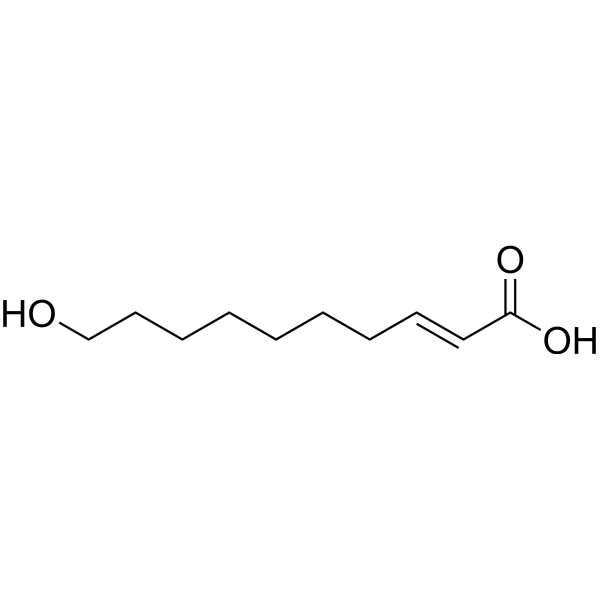
10-Hydroxy-2-decenoic acid (Standard)

Based on 1 Customer Validation
10-Hydroxy-2-decenoic acid (Standard) is an analytical standard for 10-Hydroxy-2-decenoic acid (HY-W592871). This product is intended for research and analytical applications.10-Hydroxy-2-decenoic acid (10-HDA) is an orally active unsaturated medium-chain fatty acid with various physiological activities. 10-Hydroxy-2-decenoic acid induces ROS-mediated apoptosis in A549 cells. 10-Hydroxy-2-decenoic acid inhibits VEGF-induced angiogenesis in human venous endothelial cells. 10-Hydroxy-2-decenoic acid alleviates non-alcoholic fatty liver disease (NAFLD) by activating the AMPK-α signaling pathway. 10-Hydroxy-2-decenoic acid protects against bone loss by inhibiting NF-κB signaling downstream of FFAR4. 10-Hydroxy-2-decenoic acid is an antibiotic against many bacteria and fungi, such as Neurospora sitophila, molds and Staphylococcus aureus. 10-Hydroxy-2-decenoic acid has longevity-promoting effects in C. elegans. 10-Hydroxy-2-decenoic acid prevents osteoarthritis by targeting aspartyl β hydroxylase and inhibiting chondrocyte senescence.
For research use only. We do not sell to patients.
- Purity : 99.93%
- CAS No.: 765-01-5
- Formula: C10H18O3
- Molecular Weight:186.25
-
Storage:
Please store the product under the recommended conditions in the Certificate of Analysis.


To place orders, for customer services and technical support, please contact: MedChemExpress USA
Tel: 609-228-6898 E-mail: [email protected] [email protected]


-
 Product Information
-
Chemical Information
- Purity & Documentation
-
 Help & FAQs





Product Information
Information
Application
The compound is the grade of analytical standard, which is the reference standard supplied assay. It is commonly used in qualitative, quantitative and methodological research experiments in HPLC, GC and MS.


Chemical Information
-
CAS No. 765-01-5
-
Appearance Solid
-
Molecular Weight 186.25
-
Formula C10H18O3
-
Color White to off-white
-
SMILES
O=C(O)/C=C/CCCCCCCO
-
Synonyms
10-HDA (Standard); Queen Bee Acid (Standard)
-
Structure Classification
-
Initial Source
-
Shipping
Room temperature in continental US; may vary elsewhere.
-
Storage
Please store the product under the recommended conditions in the Certificate of Analysis.


Purity & Documentation
-
SDS (252 KB)
- English - EN (252 KB)
- Français - FR (252 KB)
- Deutsch - DE (252 KB)
- Norwegian - NO (252 KB)
- Español - ES (252 KB)
- Swedish - SV (252 KB)
- Italian - IT (252 KB)
- Korean - KR (252 KB)
- Portuguese - PT (252 KB)
-
Handling Instructions (2659 KB)
References
[1]. Geng N, et al.10-hydroxy-2-decenoic acid prevents osteoarthritis by targeting aspartyl β hydroxylase and inhibiting chondrocyte senescence in male mice preclinically. Nat Commun. 2024 Sep 4;15(1):7712. [Content Brief]
[2]. TOWNSEND GF, et al. Studies on the in vitro antitumor activity of fatty acids. I. 10-Hydroxy-2-decenoic acid from royal jelly. Cancer Res. 1960 May;20:503-10. [Content Brief]
[3]. Tang M, et al. 10-Hydroxy-2-decenoic acid attenuates nonalcoholic fatty liver disease by activating AMPK-α signaling pathway. Biochem Pharmacol. 2025 Jan;231:116648. [Content Brief]
[4]. Han L, et al. 10-hydroxy-2-decenoic acid alleviates lipopolysaccharide-induced intestinal mucosal injury through anti-inflammatory, antioxidant, and gut microbiota modulation activities in chickens. Front Microbiol. 2023 Oct 17;14:1285299. [Content Brief]
[5]. Gao K, et al. Anti-Biofilm and Anti-Hemolysis Activities of 10-Hydroxy-2-decenoic Acid against Staphylococcus aureus. Molecules. 2022 Feb 22;27(5):1485. [Content Brief]
[6]. BLUM MS, et al. 10-Hydroxy-delta 2-decenoic acid, an antibiotic found in royal jelly. Science. 1959 Aug 21;130(3373):452-3. [Content Brief]
[7]. Lin XM, et al. 10-HDA Induces ROS-Mediated Apoptosis in A549 Human Lung Cancer Cells by Regulating the MAPK, STAT3, NF-κB, and TGF-β1 Signaling Pathways. Biomed Res Int. 2020 Dec 8;2020:3042636 [Content Brief]
[8]. Honda Y, et al. Lifespan-extending effects of royal jelly and its related substances on the nematode Caenorhabditis elegans. PLoS One. 2011;6(8):e23527. [Content Brief]
[9]. Tsuchiya Y, et al. The key royal jelly component 10-hydroxy-2-decenoic acid protects against bone loss by inhibiting NF-κB signaling downstream of FFAR4. J Biol Chem. 2020 Aug 21;295(34):12224-12232. [Content Brief]

Calculators
Concentration (start) × Volume (start) = Concentration (final) × Volume (final)


10-Hydroxy-2-decenoic acid (Standard) Related Classifications
HY-W592871R Related Classifications
 Powered by Bioz